
































































Brett Mackay, Senior Investment Consultant, 10X Investments
Meet Thandi. At 62, and after decades in banking, she’s a few months away from retirement. She’s currently staring at a quote from her financial adviser that asks her to choose between a living annuity and a guaranteed life annuity.
Her friends haven’t helped much. One told her that “guaranteed is safest”; another said that “living annuities let you keep control”. Both are partly right, but both miss the point.
The real question isn’t which annuity is best, but which one best suits Thandi’s priorities. Three simple questions can help her, and anyone else in a similar position, find that out.
Your retirement income starts with the right questions
Your annuity choice shapes how you receive income, how your savings are managed, your exposure to investment risk, and what you leave your loved ones. It has long-term implications for your lifestyle and financial security. So, what’s the difference?
- Living annuity: Your retirement savings stay invested in a portfolio you choose. Each year you decide how much income to draw, within limits set by law. Your income depends on how much you withdraw and how your investments perform. When you die, whatever is left can go to your beneficiaries.
- Guaranteed life annuity: You use your retirement savings to buy an income from an insurer, which agrees to pay it for the rest of your life, however long you live, and however markets perform. In exchange, the money belongs to the insurer, and the decision usually can’t be reversed.
Question 1: How important is a predictable income throughout retirement?
If you want to know exactly what you’ll receive every month for life, a guaranteed annuity may suit you. The income depends on the options you choose: inflation-linked increases, for example, protect your buying power but mean a lower starting income.
A living annuity offers less certainty but more flexibility over investments and withdrawals. In exchange, you carry the investment and longevity risk: if markets fall, so does your capital, and there’s no guarantee the money will last as long as you do.
For Thandi, a guaranteed annuity might make sense if she has other savings for things like home repairs. A living annuity might appeal if she wants the flexibility to review her income each year, perhaps drawing more in her active early retirement years and less later on.
Question 2: Do you want to leave retirement savings to your loved ones?
With a living annuity, your remaining capital passes to your nominated beneficiaries when you die, subject to the product’s rules. With a guaranteed life annuity, what your family receives depends on the options you select.
A guarantee period keeps payments going to your beneficiaries if you die within a set number of years, while a spouse’s benefit continues an income to your partner after your death. These options come with a cost: they lower the income you’re initially offered. It’s worth weighing how much a financial legacy matters against the income you need.
For Thandi, who has five grandchildren, this question could carry a lot of weight.
Question 3: How comfortable are you with investment risk and managing your income?
A living annuity requires ongoing decisions about how your money is invested and how much you withdraw. Draw too much, or hit a run of poor returns, and you risk outliving your capital.
The Association for Savings and Investment South Africa (ASISA)’s latest guidance, released in September 2026, suggests drawing about 4%–5% a year in the first decade of retirement, and below eight percent later, to be prudent. Income drawn should also not exceed your portfolio’s real (after-inflation) return. These are guidelines, not guarantees, and they work best as part of a broader strategy to make your capital last. That strategy should include a well-diversified portfolio with offshore exposure where appropriate.
With a guaranteed life annuity, the insurer takes on the investment risk in exchange for the agreed income. Either way, inflation, life expectancy and fees, which compound over time, should factor into your overall retirement budget.
What your answers may mean
Your answers are guiding considerations, not a product recommendation. Your circumstances, income needs, health, fees, and product terms all matter. That said, the choice might look something like this:
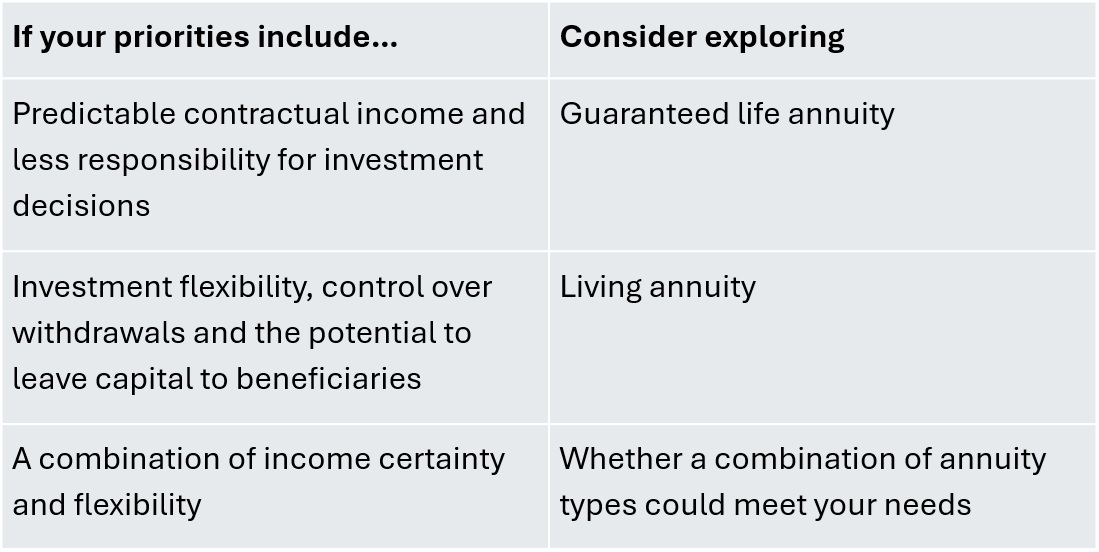
Before you decide
Start with a realistic retirement budget: what you need each month, what other assets and debts you have, and how many years your savings may need to last. Compare products on fees and terms, not only on the income quoted, because small cost differences add up over a long retirement.
And remember that the choice isn’t always either/or. You can split your savings between both annuity types, or move from a living annuity to a guaranteed one later.
For Thandi, these three questions won’t hand her a product. But they will give her better questions to take to her adviser. They can do the same for you: review your retirement needs and speak to a qualified investment consultant before you decide.
ENDS