
































































Romelon Chetty, Portfolio Manager at Prescient Investment Management
Over the past three years, the artificial intelligence (AI) story in equity markets has been told through seven tickers. The Magnificent Seven (Apple, Microsoft, Nvidia, Alphabet, Amazon, Meta and Tesla) accounted for 62% of the S&P 500’s return in 2023 and 53% in 2024, and owning them became shorthand for owning AI itself. When DeepSeek repriced the sector in early 2025, we argued that AI was “no longer the sole domain of a few American tech behemoths”. In 2026, the market has agreed.
As at 30 September 2026, the Magnificent Seven had gained 9% and the S&P 500 12%, whilst semiconductor stocks advanced almost 90% – a rally Nvidia itself did not lead. Figure 1 below shows how market leadership has rotated.
Figure 1: The AI trade has broadened – indexed performance of the Magnificent Seven (MAGS), the S&P 500 (SPY) and semiconductors (SOXX), 2026 year to date
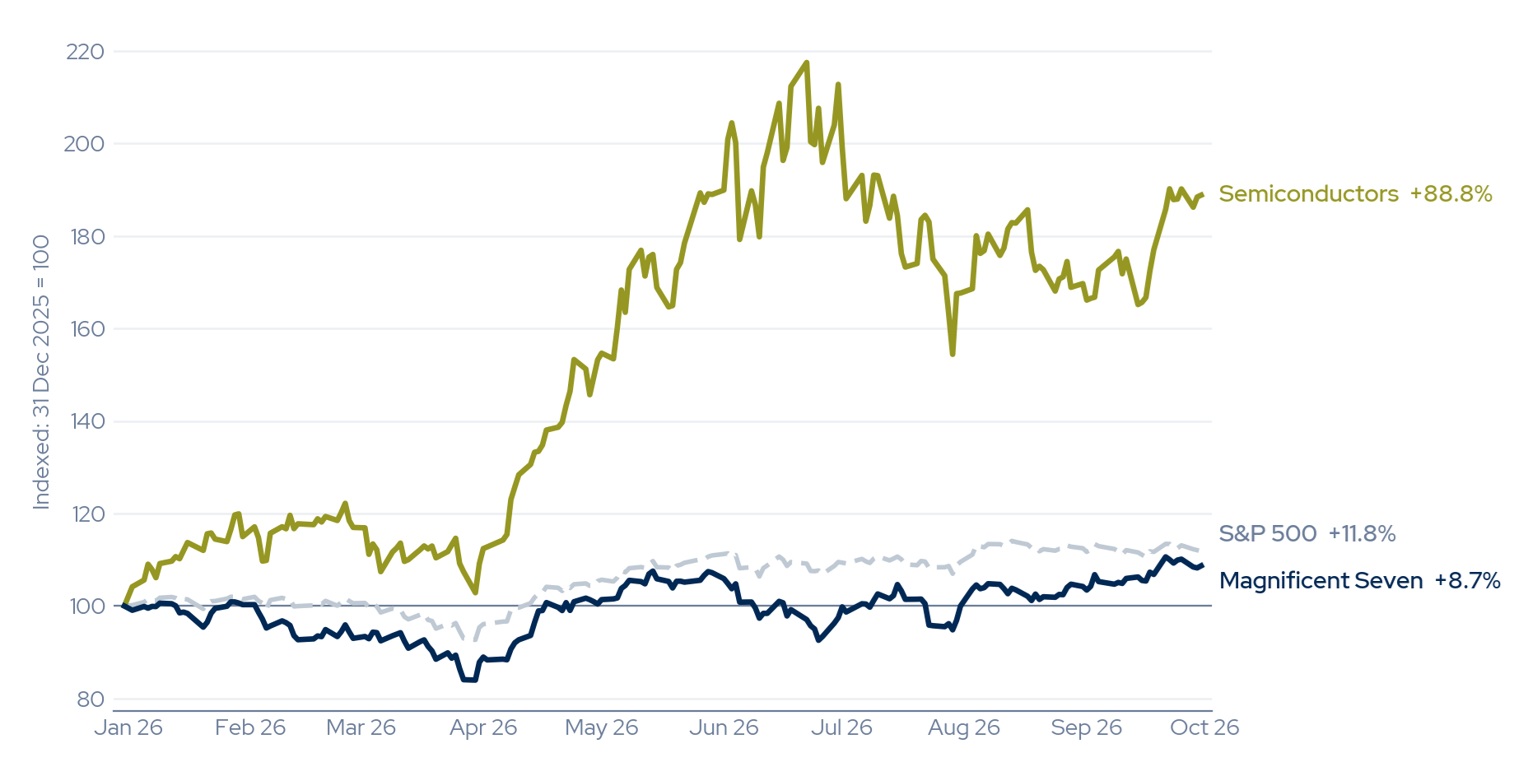
Semiconductor stocks have outpaced both the broader market and the Magnificent Seven by a wide margin in 2026, whilst the former market leaders have done no better than the index.
Sources: Prescient Investment Management, Bloomberg (as at 30 September 2026)
But this raises an important question: if the Magnificent Seven are no longer the AI trade, where has it gone?
The Witwatersrand gold rush of 1886 is a useful lens. The fortunes of individual mining houses were uncertain and uneven – some struck rich reefs, whilst others exhausted their capital in barren ground. Yet the money the diggers spent flowed reliably outward: to the suppliers of timber and dynamite, to the railways that brought in the machinery and the coal, and to the banks, water schemes and power stations. Johannesburg was built less on the gold that came out of the ground than on the spending that went into it.
This same pattern is unfolding in AI. The four largest hyperscalers – Microsoft, Alphabet, Amazon and Meta – are guiding towards roughly $725 billion of combined capital expenditure in 2026, up from approximately $410 billion in 2025 and $226 billion in 2024, as shown in Figure 2 below. Critically, every dollar of that expenditure is a cost to the company spending it and revenue to the company supplying it. The market has started pricing this distinction: when Alphabet raised its 2026 capital expenditure guidance to $195–205 billion in July, its own shares fell whilst suppliers further down the chain rallied.
Figure 2: Combined capital expenditure of Microsoft, Alphabet, Amazon and Meta ($ billion)
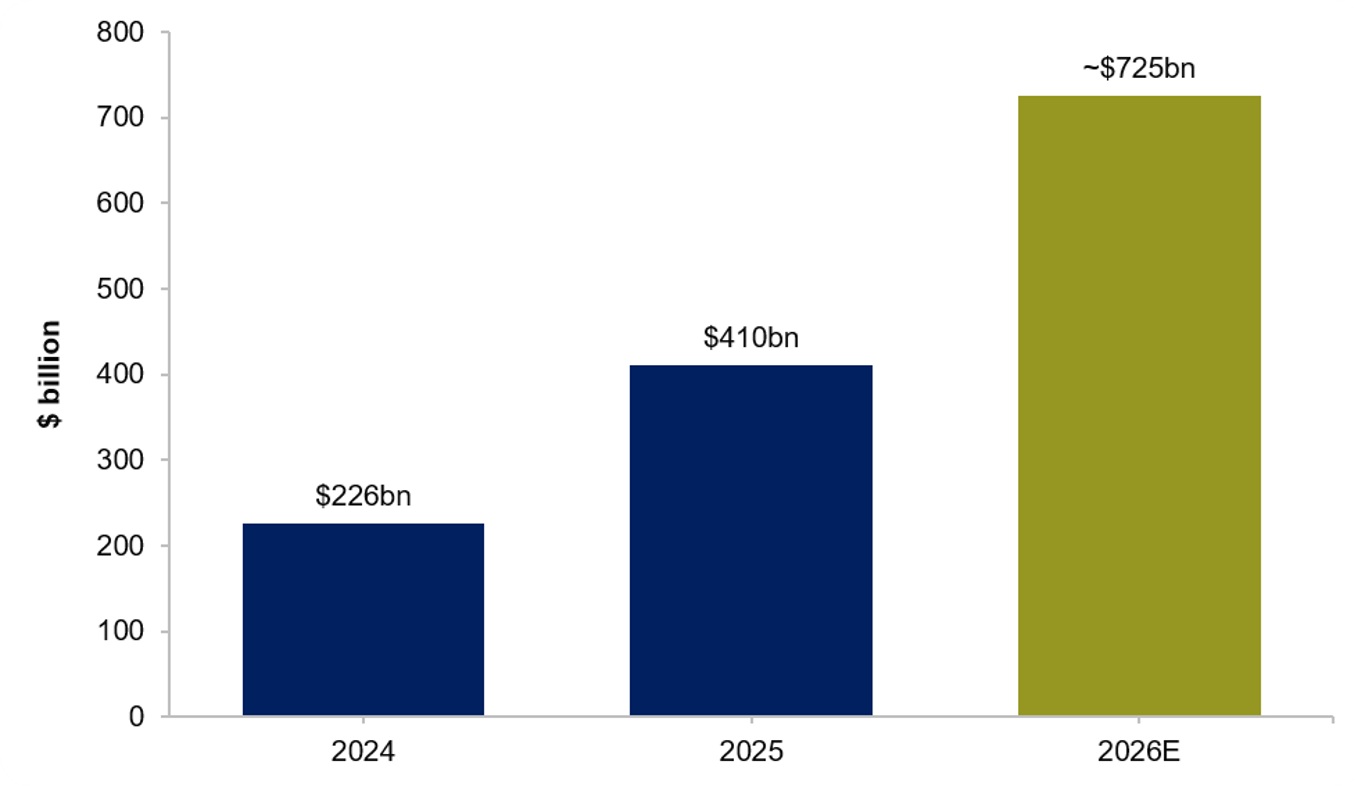
Hyperscaler capital expenditure is guided to roughly triple between 2024 and 2026 – a cost to the spenders, and revenue to the supply chain behind them.
Sources: Prescient Investment Management, company reports and guidance (as at 30 September 2026)
Where did the trade go?
It went down the supply chain. Firstly, to semiconductors beyond Nvidia, whose own shares gained 22% this year against nearly 90% for the sector. TSMC, which manufactures the industry’s leading-edge chips, grew revenue 36% year on year in the second quarter of 2026; memory makers are enjoying a supercycle, with Micron’s quarterly revenue rising from $11.3 billion to $54.2 billion in a single year; and ASML, which supplies the lithography machines, is effectively sold out into 2027. Secondly, and perhaps least appreciated, to the physical layer beneath the digital one. Grid equipment order books have swelled – Siemens Energy’s grid backlog stands at €51 billion and GE Vernova’s at $176 billion – whilst Goldman Sachs Research expects data centres to absorb 5.3% of US peak summer electricity demand this year, up from 4.1%. Even copper, consumed by the tens of thousands of tonnes per data centre, has traded at record levels this year.
Broadening is not the same as de-concentration
However, the broadening should not be misread. The Magnificent Seven still represent roughly 33% of the S&P 500’s market capitalisation, so index investors remain heavily exposed to them. The group no longer trades as a single position, however: the average pairwise correlation, measured on a three-month basis, has fallen from 0.78 in mid-2025 to 0.14, and their 2026 returns now span more than forty percentage points. Furthermore, dispersion within the broadening theme is just as wide – GE Vernova has gained more than 40% this year whilst utility Vistra has fallen 14% – and record memory margins may themselves prove to be a cycle-peak signal. The debate over the return on this spending, now equivalent to roughly 2% of US GDP, remains unresolved. “Buy the infrastructure” is therefore far too coarse an instruction.
At Prescient Investment Management, we view this as precisely the environment a systematic investment process is built for. When a theme fragments from one trade into hundreds of companies across sectors and geographies, conviction-based stock picking becomes harder, not easier – picking the few winners becomes less likely as the set widens. A data-driven process does the opposite: it holds the breadth, measures the dispersion, and allows the weight of evidence rather than the strength of narrative to determine exposure. Additionally, as more investors run similar models on similar data, the discipline to stay different becomes the scarce asset. We are driven by data, not by stories – and the data currently favour breadth.
For South African investors, the implications are far-reaching. Most local portfolios access this theme through capitalisation-weighted global index allocations, which still carry the concentration of the old trade rather than the breadth of the new one. Moreover, South Africa is not a bystander in the build-out: the country hosts more than half of Africa’s data-centre capacity, and Microsoft has committed a further R5.4 billion to local cloud and AI infrastructure. The ripple effects reach our own grid, our own market and our own investment decisions.
Conclusion
The AI trade has not ended; it has matured. What began as a bet on seven companies has become a broad and dispersed opportunity set spanning chipmakers, data centres, power and the industrial economy that connects them. Booms begin with heroes and mature into supply chains – and investors willing to look beyond the behemoths, with discipline rather than conviction, stand to benefit the most.
ENDS