

































































Kyle Hulett, Co-Head: Investments at Sygnia
Escalation between the US/Israel and Iran has driven crude oil to $120 per barrel (/bbl). Equity, currency and bond markets across Europe and emerging economies have sold off sharply as carry trades unwind. The dollar has strengthened and gold has softened, reaffirming the dollar’s safe-haven status in a high-geopolitical-risk environment.
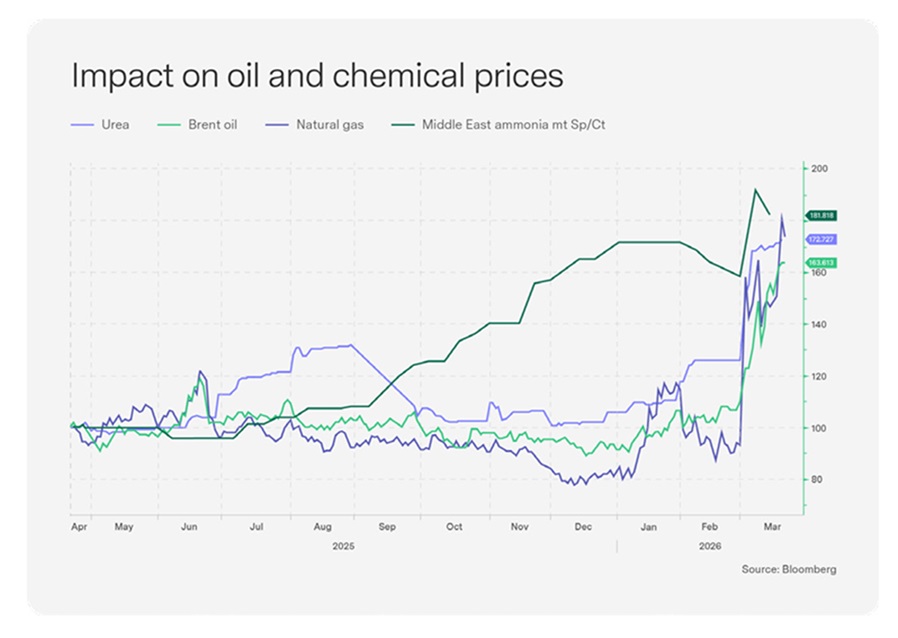
US forces have bombed Iran’s Kharg Island, the country’s principal crude export hub. Iran has struck its Gulf neighbours hard, removing 12 million barrels per day (mb/d) of supply and effectively closing the Strait and impeding the 20 mb/d that ordinarily transits it. In response, the International Energy Agency released 400 million barrels – larger than any prior drawdown. The US has also permit ted purchases of sanctioned Russian oil, estimated at 124 million barrels. However, these measures combined amount to only 26 days of Hormuz-replacement supply. Yemen’s Houthi militia have officially entered the war, which threatens to close the key Bab al-Mandab Strait, the alternative transit route via the Red Sea; this could impact a further 5mb/d of seaborne crude oil. On 18 March, Israel struck the Iranian portion of the South Pars/North Dome gas field, which is the largest gas field in the world and is shared with Qatar. Iran retaliated with widespread attacks on oil and gas infrastructure, impairing 17% of Qatar’s liquid natural gas (LNG) capacity for three to five years. Natural gas prices have almost doubled year-to-date.
Even a unilateral US declaration of “victory” would not produce a clean exit. Several structural obstacles remain:
- Iran has rejected the US’s 15-point proposal, wishing to maintain its nuclear facilities and gain recognition of its “authority” over the Strait of Hormuz.
- Iran “wins” by controlling the Strait. Iran is charging transit fees on some commercial vessels through the strait at $2m per voyage; the US has limited means to prevent Iranian drone attacks on Persian Gulf shipping, and Iranian mines make naval escorts operationally difficult.
- Russia benefits from a prolonged conflict, as higher prices are delivering a financial windfall to Moscow. Russia may also be supplying Iran with weapons.
- Israel has extended evacuation orders in southern Lebanon to cover 14% of the total area, and domestic Israeli polling shows overwhelming support for the operation Prime Minister Netanyahu has advocated for decades. Israeli skirmishes may thus independently continue to keep Iran engaged.
- Ports and infrastructure damaged during the conflict will take time to repair.
- Once drawn down, strategic reserves must be replenished, creating a persistent demand overhang.
JPM research shows energy prices close to $100/bbl through midyear (moderating towards $80/bbl thereafter), which would raise consumer prices by 1.0% and reduce growth by 0.8%.
But the disruption extends well beyond crude oil. The Strait of Hormuz also carries critical flows of chemical and petrochemical products whose supply impairment has global implications for food, agriculture and semiconductor manufacturing. To place this in historical context: the Strait of Hormuz remained open during both the Gulf War (1990) and the Iraq War (2003). The closest historical analogue is Russia’s invasion of Ukraine in 2022, which disrupted the Black Sea, a critical corridor for grain and fertiliser. Around 50% of the world’s seaborne sulphur trade passes through the Strait of Hormuz; sulphuric acid is a key input in wafer cleaning and microchip fabrication. The price of urea – the world’s most widely used nitrogen fertiliser – has risen 70% since the conflict began, and ammonia is up 80%. Furthermore, the Middle East supplies approximately one-third of the world’s commercial helium, which is essential for semiconductor manufacturing equipment.
ENDS