

































































Nic Whittles, Senior Employee Benefits Consultant at BDO Wealth
As South Africa’s two-pot retirement system celebrated its second anniversary on 1 September, much of the public conversation continues to focus on how much money members have withdrawn. While this is understandable, it risks overlooking one of the system’s most important long-term benefits: a significant portion of retirement savings is now being preserved throughout a member’s working life. Under the system, two-thirds of new contributions are allocated to a retirement component that must remain invested until retirement, while one-third is directed to a savings component that can be accessed under certain conditions.
“The previous system placed the responsibility for preservation almost entirely on the individual,” says Nic Whittles, Senior Employee Benefits Consultant at BDO Wealth.
“Every time someone changed jobs, they had to decide whether to preserve their retirement savings or take the money. Many people cashed in and effectively started their retirement savings journey again.”
According to Whittles, this behaviour has been one of the biggest contributors to poor retirement outcomes. The two-pot system seeks to address this by preserving a substantial portion of retirement savings while still providing access to funds when genuine financial needs arise.
The change comes at a time when many South Africans remain under financial pressure. The 2025 Sanlam Benchmark Survey found that 44% of retirement fund members had dipped into emergency savings to make ends meet, while 43% do not have an emergency fund. At the same time, 68% said they would contribute more towards retirement savings if they could afford to do so.
“The savings pot provides an important safety net, but members need to understand the long-term cost of withdrawing whenever they can,” says Whittles.
He believes one of the greatest benefits of the two-pot system is that it encourages members to stay invested and benefit from compound growth over time.
“When money remains invested over 20, 30 or 40 years, compound growth can have a dramatic impact on retirement outcomes. Every withdrawal reduces not only the amount invested, but also the future growth that money could have generated.”
The cost of withdrawing along the way
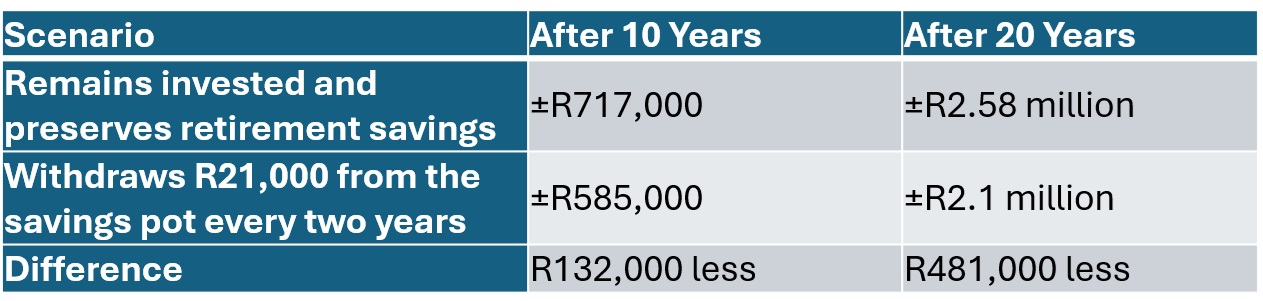
Illustrative example based on a member earning R35,000 per month and contributing 10% of salary to a retirement fund. Actual outcomes will vary depending on investment returns, salary increases, fees, taxes and withdrawal behaviour.
Source: Illustrative calculations based on assumptions discussed by Nic Whittles, Senior Employee Benefits Consultant at BDO Wealth.
The illustration highlights the impact of preservation. A member who regularly accesses their savings pot could accumulate around half a million rand less over a 20-year period than someone who leaves those funds invested. While the savings pot serves an important purpose during times of genuine need, every withdrawal comes with an opportunity cost in the form of lost future growth.
Encouragingly, awareness of the two-pot system has increased from 59% in 2024 to 92% in 2025, according to the Sanlam Benchmark Survey. More than 90% of members also indicated that retirement benefit education and communication are important.
“Members need support when they are making these decisions,” says Whittles. “That conversation should consider their immediate needs, the tax implications and the long-term impact on retirement savings. That’s where employers, benefit consultants, and financial planners can make a meaningful difference.”
As the two-pot system enters its third year, he believes the focus should shift beyond withdrawal statistics.
“Two years in, we shouldn’t look only at what has been withdrawn,” he says. “We should also look at what is now being preserved. That is where the long-term success of the two-pot system will ultimately be measured.”
ENDS