

































































Frank Blackmore, Lead Economist at KPMG South Africa
Yesterday’s numbers for the second quarter GDP were in line with expectations, based on the geopolitical shocks that were provided to the South African economy, but also internationally with the U.S.-Israel war in Iran and its consequent increase in oil prices. What that did to a lot of the economies, was obviously elevate inflation in a lot of markets.
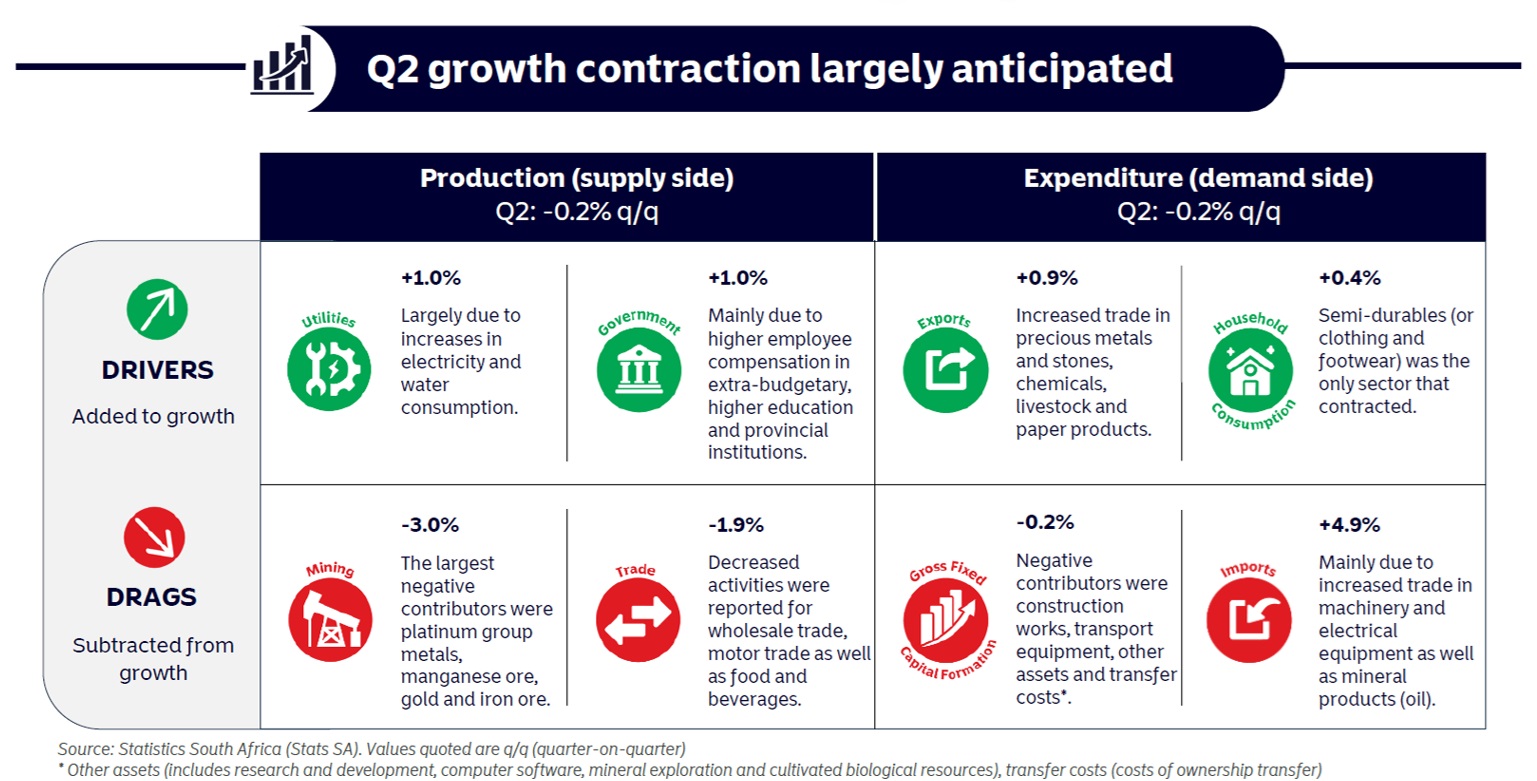
What that means is, on a seasonally adjusted and annual basis, we see a slight contraction on a quarter-to-quarter measure of 0.2%, but if we take a year-on-year view of economic growth, in other words, we look at this quarter compared to last year’s second quarter, we see positive growth just under 1%, coming in at 0.9%.
Sectors that contracted on this basis, since Q1, were mining and quarrying, manufacturing and trade, catering and accommodation.
Mining and quarrying are obviously highly dependent on the prices of resources in order to drive that economic activity, and with the downward expectation of growth caused by the higher prices in the war, the future expectation for those commodities is also going to slow down in terms of pricing.
Manufacturing continues to battle headwinds in terms of infrastructure, consistency of electricity, water, etc. and therefore that is no surprise. Trade catering and accommodation, I think, is indicative of the increased pressure on the consumer coming through in the in these figures.
If we look at the figures on an expenditure basis, so expenditure on GDP, we see that consumption grew slightly slower than the first quarter. Government expenditure also grew slightly slower than the first quarter, and albeit both of those grew positively, and inflation grew better than the first quarter, first quarter realised zero growth in investment, and the second quarter showed a 1.5% year-on-year increase in investment spending.
What is also noticeable is that the value of imports increased a lot quicker than the value of exports, or the amounts of expenditure on imports increased a lot faster than exports. I think that has a lot to do with increase in the prices of oil and refined fuel products, which has also had a negative influence on growth from an expenditure point of view.
Sanisha Packirisamy, Chief Economist, and Tshiamo Masike, Economist, at Momentum Investments
Read Momentum Investments’ full note here.
ENDS