






























































Macro’s & Markets
Sanisha Packirisamy, Senior Economist; and Tshiamo Masike, Economist, at Momentum Group
Read Momentum’s full note here.
Frank Blackmore, Lead Economist at KPMG South Africa
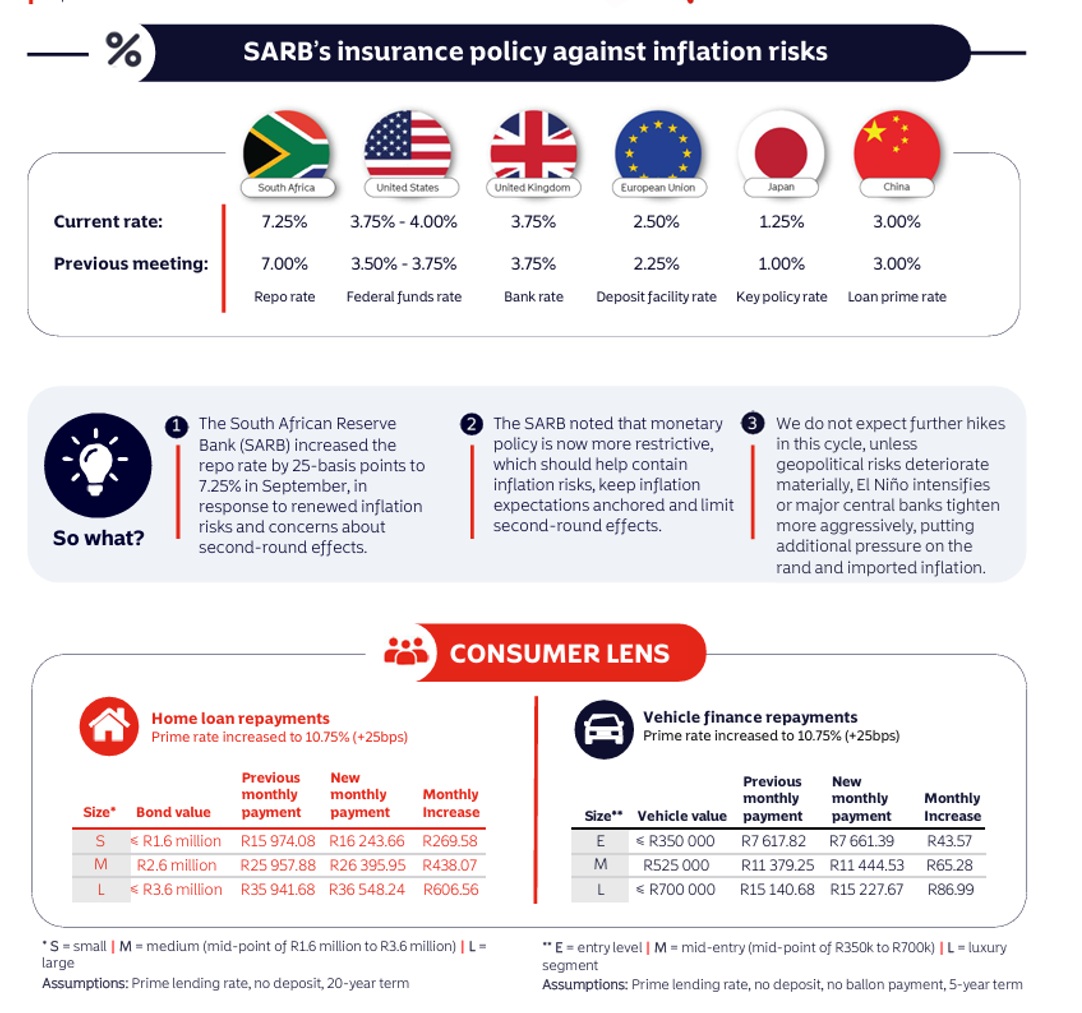
The Monetary Policy Committee of the South African Reserve Bank has decided to increase the policy rate by 25 basis points; the policy rate therefore increases from 7% to 7.25%, meaning prime is now at 10.75%. The reason for the decision was because of the geopolitical environment that has created negative supply shocks in the economy. These negative supply shocks will be largely responsible for triggering second round effects, which basically means that besides the direct effect of an increase in prices, it starts to enter labour markets that are inflationary and becomes more persistent, therefore.
They do foresee a slight increase in downside risks to GDP growth, although growth expectations remain at 1.2%. On inflation, the upside risks are more pronounced, largely driven by fuel price pressures, which have been a key contributor to inflation. Services inflation also remains a concern, particularly in sectors such as transport and other service-related industries.
The best way to beat that inflation is through changing the inflationary expectations which are still noticeably higher than the target rate sitting at 4% currently as opposed to that 3% target rate level therefore the increase in the rates at this point in time will try and prevent those second round effects moving through the economy and the Reserve Bank has emphasise the fact that they will continue to act as appropriate in order to get inflation under control to keep the value of the Rand which is their main target variable.
Johann Els, Chief Economist at PSG Financial Services
The Reserve Bank, at the September MPC meeting this afternoon, decided to raise interest rates by 25 basis points. And that was a unanimous decision.
I expected the decision to be close, with a strong case for a rate hike. However, the fact that it was unanimous was more hawkish than I expected.
It seems the Reserve Bank is concerned about the sustained and large global supply shock, and particularly that this will feed through into inflation expectations going forward, limiting the potential for inflation to ease back towards the 3% target.
Looking through the statement and listening to the discussion at question time, it is clear that there were enough arguments to keep rates unchanged. But it seems the concern that the shock has been sustained for so long, and could therefore push up inflation expectations, was the overriding factor.
Looking through the commentary, it also doesn’t seem that the fact that global central banks have raised interest rates recently played a major role. To me, the bigger issue was the concern that inflation expectations will rise because of the continued shock.
The Governor pointed out, for example, that inflation expectations for the third quarter had come down before it became known that there would be a significant petrol price increase in October.
On growth, the Bank said the global situation is having a much bigger impact on South Africa than previously expected. The risks to growth are to the downside, and the GDP growth forecast for this year was revised slightly lower, also reflecting the new information from the negative GDP growth number in the second quarter.
On inflation, risks were seen to the upside, and the forecast was lifted from 4% to 4.4% for this year and from 3.8% to 4% next year.
But they also pointed out that, because of the resilient rand, food and consumer goods inflation has actually been surprisingly well behaved. They also see no evidence of significant second-round effects, yet, but are clearly concerned.
So again, this brings me back to the concern about an elevated and sustained global price shock leading to further increases in inflation expectations.
They also discussed two alternative scenarios.
The first is a scenario where global interest rates rise by more than the 50 basis points assumed in the base case – effectively double the base case. In the base case, the QPM sees no further rate increases locally. But in this alternative scenario, there is another rate hike, followed by rates staying higher for slightly longer.
The second alternative scenario is where inflation expectations and wages increase. Again, there is another rate hike and rates stay higher for longer.
Just briefly on the QPM, the Quarterly Projection Model: it is a model and shouldn’t be followed too literally. Circumstances can change, and the outcome can obviously be different from what the model currently projects.
For my own outlook, I think the fact that they hiked in May and have now hiked again in September, while acknowledging that monetary policy is already restrictive, means that there should be no further rate increases under current circumstances.
There is also a significant base effect coming through from oil and petrol prices, which should help the inflation numbers over time.
And this is also where I differ slightly from the Bank’s concern about the supply shock. Supply-side price shocks are initially inflationary, but they are ultimately deflationary for demand and growth. We will still see that playing out. If the Middle East situation improves and the war ends, for example, and oil prices come down sharply, the inflation picture could improve much faster than currently expected.
In that scenario, I think rate cuts could also be brought forward more than currently expected.
Inflation expectations might lift a little further, but overall the economy is not strong enough for us to expect demand-driven inflation or a significant second-round price impact.
So my expectation is no further rate increases after this one, under current circumstances.
I would actually have been more concerned about further rate increases if they had not hiked today.
So overall, a slightly more hawkish outcome than I expected, mainly because of the concern that this sustained and large global supply shock will lead to higher inflation expectations.
Tando Ngibe, Senior Manager at Budget Insurance
Consumers, particularly those with a bond, vehicle finance, credit card debt or other interest-linked borrowing, are likely to feel the pinch of today’s interest rate increase on their already stretched budgets.
The 25-basis-point increase announced by the South African Reserve Bank’s Monetary Policy Committee means higher costs at a time when many consumers are already under financial pressure.
For consumers, budgeting remains critical. Consumers should review their monthly expenses, from transport and groceries to insurance, subscriptions and debt repayments, and identify where they can stretch their rand further. The focus should be on protecting essential commitments, cutting unnecessary spending, and building greater financial resilience. Budget, budget, budget is the key message for consumers: understand where your money is going, cut back where you can and, where possible, use any available financial room to reduce debt or build a buffer for future costs.
Hayley Parry, Money Coach & Facilitator at 1Life’s Truth About Money
The South African Reserve Bank has announced it will hike interest rates by 25 basis points, leaving the repo rate at 7.25%. This decision will, without a doubt, put additional financial pressure on South Africans, particularly affecting consumers with home loans, credit cards, and personal loans, resulting in higher monthly repayments. This will leave consumers with less disposable income at the end of the month. The concern is that this hits households already stretched financially. However, if possible, the key to credit repayments is paying extra toward the principal each month, no matter how small the additional payment, as this will reduce your loan payments and shorten the period you need to repay your loan.
As we get closer to the festive season, consumers need to revisit their budgets, look beyond this announcement, and find ways to build financial resilience. When we have announcements like this, it is a reminder for each of us to prioritise financial education that teaches practical money management skills, because financial resilience is becoming increasingly important during these economically uncertain times.
As we have been saying throughout this economically uncertain period, interest rates and petrol prices are continuing to rise and put pressure on consumers. Consumers should focus on what they can control which is your personal budget, look at you cash flow. What can you cut? Subscriptions, spending or lifestyle? Cut down on unnecessary spending and start saving. If possible, with whatever little is left, keep building your emergency fund.
However, saving alone is not enough when the aim is to build generational wealth. The key to building wealth is managing debt wisely and protecting income, and long-term insurance plays a vital role in this process. A properly structured life policy can ensure that if something happens to a breadwinner, the bond can be settled, children’s education protected, and that households continue to thrive. In a slow-growth environment, financial progress will not happen by chance. It will come from steady, disciplined decisions that protect today while building for tomorrow.
ENDS