



























































Rhandzo Mukansi, Yunus January, Sundhiren Govender & Nick Malope, Interest Rate (Fixed Income) and Quantitative Analysis team at Futuregrowth Asset Management
Geopolitics continue to blight the macro narrative
The military conflict between the US/Israel and Iran continued to dominate geopolitical headlines in the third quarter. The reprieve in global energy prices in June, spurred by a 60-day ceasefire and official singing of a memorandum of understanding between the longstanding foes, proved short lived. Consistent with the ebb and flow of the conflict, recent months have been marred by frequent military strikes and ongoing disruptions to maritime trade through the Strait of Hormuz. Elevated uncertainty has restored the geopolitical risk premium in global energy markets, with Brent Crude Oil closing the quarter at $104/barrel – a precipitous climb from $73/barrel at the end of June.
The conflict has spiralled from a “little excursion” at its commencement in February, to a profound military quagmire with few viable offramps. Crucially, it follows the tariff- and trade-related disruption that characterised much of 2025. These sequential price shocks risk structurally buoying inflation expectations, and complicating monetary policy management in a two-paced global economy – one marked by a thriving technological sector and ever-increasing AI-related capital expenditure, alongside a real economy coming under strain from price pressures and elevated real rates.
Against this challenging backdrop, the US Federal Reserve Bank (Fed) shifted from vigilance to policy action during the quarter. While the majority of Federal Open Market Committee (FOMC) members resisted arguments to hike the policy rate at the July meeting, by September, the persistence of the energy price shock skewed the committee to a unanimous, credibility-enhancing 25 basis-point hike in the federal funds rate. In keeping with their price stability mandates, the European Central Bank (ECB) and the Bank of Japan (BoJ) also delivered 25 basis-point policy rate hikes of their own during the quarter.
Hawkish monetary policy measures were accompanied by substantial AI-related corporate debt issuance, alongside growing discomfort from investors over ballooning sovereign debt and mounting debt servicing costs across major developed markets. These realities contributed to an 82 basis-point rise in nominal 10-Year US Treasury yields over the quarter, with the quarter-end yield of 5.22% approaching levels last seen at the turn of the millennium.
A hawkish SARB defends its credibility
The South African Reserve Bank’s (SARB) Monetary Policy Committee (MPC) submitted to the realities that have weighed on all credible, inflation-targeting monetary policy institutions in recent times by unanimously hiking the repo rate by 25 basis points to 7.25% at its September meeting. The SARB continued to frame its decision as a pre-emptive measure to confront potential second-round inflation risk, safeguarding its credibility and inflation-targeting credentials. Notwithstanding the spike in contemporaneous inflation outcomes, an elevated real repo rate continues to afford the SARB reasonable room to assess the pass-through effects of the energy shock. The unfolding El Niño event, and the threat it bears to food production and inflation, will be an additional key consideration for the SARB in the months ahead.
Year-to-date tracking of domestic government finances continually evidences a disciplined fiscal consolidation effort. Corporate income tax receipts have benefited from a favourable commodity cycle, buoying fiscal revenue relative to budgeted expectations for the 2026/27 fiscal year. We expect the Medium-Term Budget Policy Statement to reflect these positive fiscal developments, extending the trend of marginal fiscal outperformance relative to budgeted estimates. If fiscal outperformance continues in line with our expectations, it should sustain positive momentum in South Africa’s sovereign credit ratings over the medium term.
Cash is king in a risk-off environment
The domestic interest-bearing market struggled under the weight of the challenging geopolitical backdrop, unmoored global energy prices and sovereign bond yields, and hawkish monetary policy expectations during the quarter. Against this backdrop, the nominal yield curve shifted upwards in parallel, with the FTSE JSE All Bond Index (ALBI) returning -0.68% for the quarter. The FTSE Inflation-Linked Index (IGOV) returned 1.44%, as inflation-linked bonds (ILBs) benefitted from the excess inflation carry associated with the rise in domestic consumer prices. Cash, proxied by the STeFI Composite Index, was the best-performing interest-bearing asset class, returning 1.72% for the quarter.
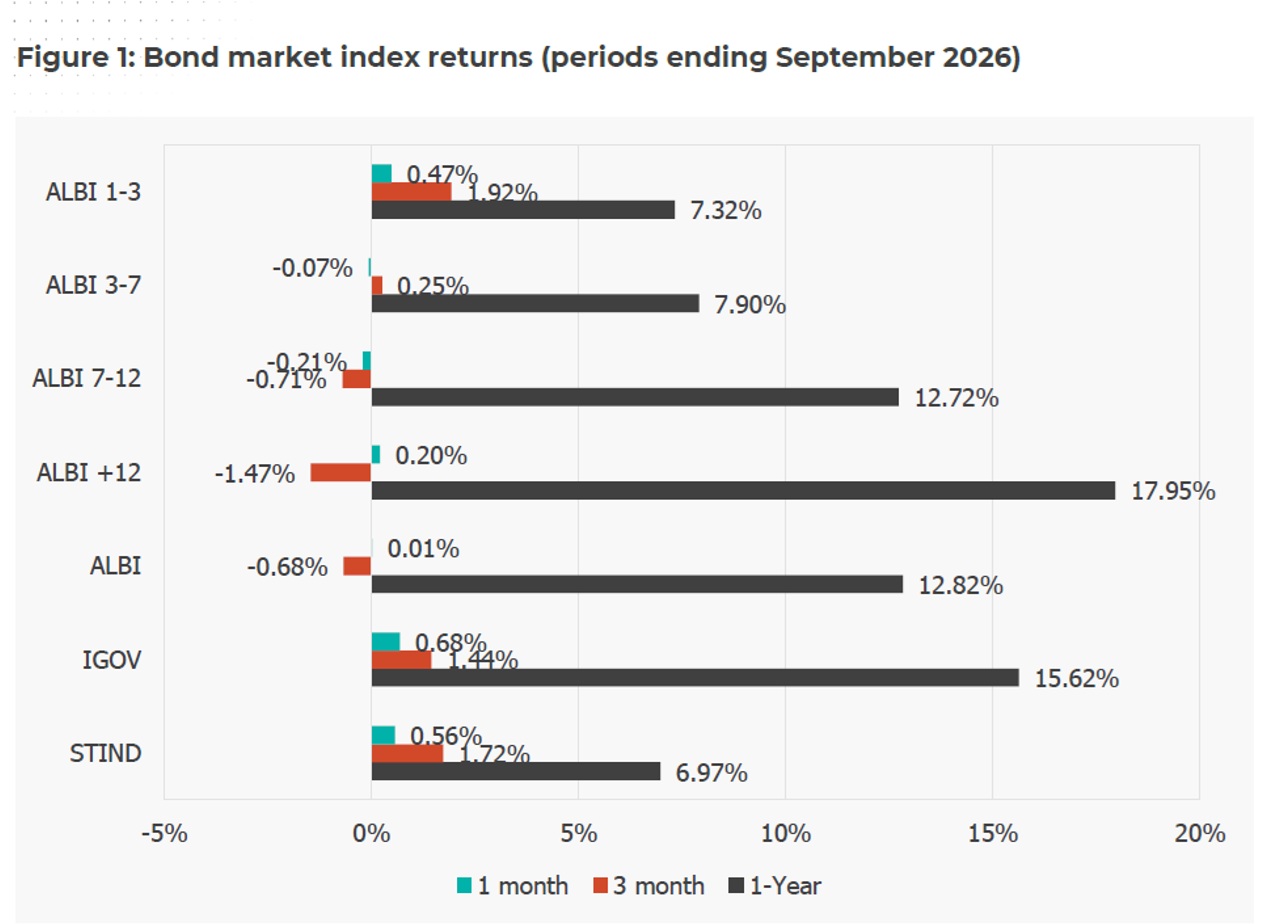
Source: IRESS, Futuregrowth
THE TAKEOUT: The military conflict between the US/Israel and Iran continued to dominate geopolitical headlines in the third quarter. The conflict has spiralled from a “little excursion” at its commencement, to a profound military quagmire with few viable offramps. Crucially, it follows the tariff- and trade-related disruption that characterised much of 2025. These sequential price shocks bear risks of structurally buoying inflation expectations and complicating monetary policy management in a two-paced global economy. Against this challenging backdrop, the Fed and other major developed market central banks were pushed from vigilance into policy action in the quarter. Domestically, the SARB’s MPC submitted to the realities that have weighed on all credible, inflation targeting monetary policy institutions in recent times by unanimously hiking the repo rate by 25 basis points to 7.25% during the quarter. Bearish monetary policy developments were partly counterbalanced by continued signs of fiscal consolidation in our year-to-date tracking of domestic government finances.
Our investment view and strategy
Politics will continue to exert an outsized influence on financial market performance and volatility in the months and years ahead as the Trump administration advances its Make America Great Again agenda. Monetary policy management in the US will be a particularly important watchpoint for us, with the Federal Reserve needing to balance its dual mandate of price stability and maximum employment while also fending off threats to its independence amid heightened political pressure for stimulative monetary policy.
Domestically, the interplay between elevated global real rates, a hawkish monetary policy outlook and seemingly stabilising government finances presents a challenging backdrop for nominal interest rate management. However, accrual remains favourably offered and we continue to accumulate interest rate risk during periodic bouts of market weakness.
We maintain a strategic preference for nominal bonds within the interest-bearing asset class, given their elevated carry and capital return prospects. Notwithstanding the geopolitical uncertainty, inflation carry has waned in recent months, dimming the appeal of tactical allocations to ILBs.
THE TAKEOUT: Our investment strategy aims to balance two objectives: 1) capitalising on the base accrual (carry) on offer, especially relative to cash; and 2) actively managing modified duration to maximise opportunities for periodic capital gains.
ENDS