

































































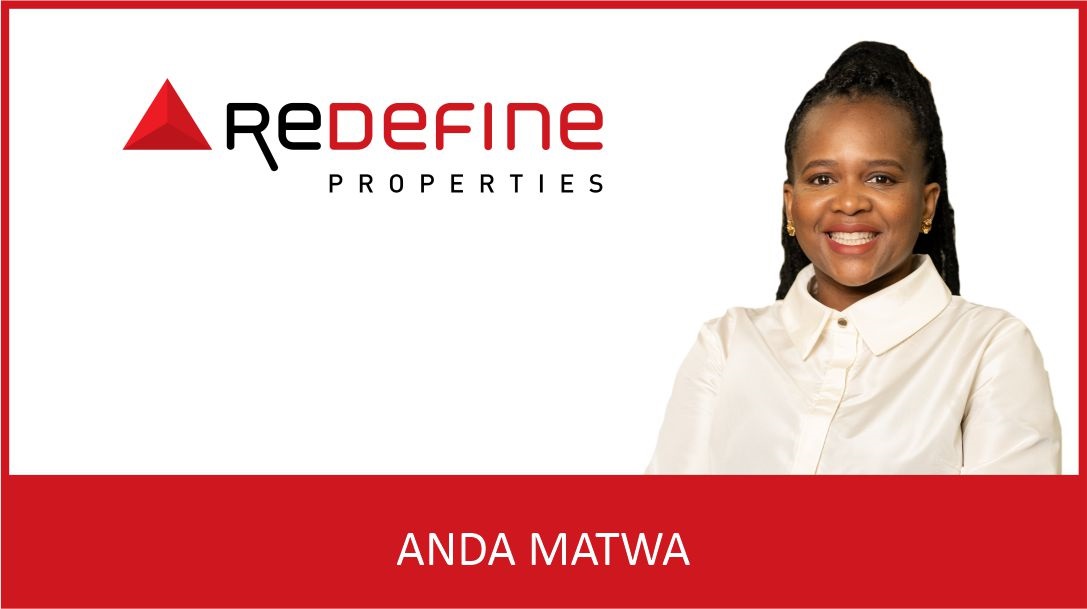
Anda Matwa, Company Secretary at Redefine Properties
There are two types of governance. The first exists on paper, in charters, frameworks, risk registers and board committee terms of reference. It plays a critical role, but it’s nothing without the second type, which shows up in everyday decision-making and the actions that define business activity and continuity.
Poor governance is typically a failure of the second type. In other words, it’s a failure of lived practice. Many stories of corruption, malpractice and mismanagement across South Africa’s business and political environments originate not from written policies, but from how they are applied. We saw this earlier this year in the residential property sector, where judicial courts began to crack down on unlawful decisions made by community scheme boards.
But in any sector, governance is most effective when it’s invisible, embedded in how people work, communicate and decide. In day-to-day operations, governance directs business momentum through clearly mapped authorisation pathways, consistent evaluation, risk adjustment and a commitment to fairness, trust and accountability.
Build a better business using routine
An often-underappreciated element of corporate governance is routine. The weekly asset review, monthly portfolio walkthrough and quarterly stakeholder letter may seem like typical operations, but essentially, they are reinforcing rituals that support governance as a fundamental function of the organisation.
More than that, governance must normalise scrutiny. At each board or committee meeting, executives and team leaders interrogate assumptions. Challenge becomes a habit instead of an event. Asking questions is no longer regarded as a hostile act. In South Africa’s property sector, that kind of culture matters because asset values move quickly and quietly, and conviction is only as useful as the value it ultimately supports.
In company meetings, reviews and discussions, governance shows up in how data is examined, risk is calculated, and decisions are made. Take the example of capital allocation. Disciplined allocation enables visibility over trade-offs between growth, liquidity and income durability. For a real estate investment trust like Redefine, that translates into improved portfolio quality, simplified international joint ventures, and maintenance of a strong balance sheet.
Everyday micro-decisions, repeated over time, shape how the business responds, adapts and performs. Trial and error refine the process. Routines evolve into procedures that align with the company’s code of governance. With that approach, companies take responsibility and set themselves up to grow, adapt and succeed.
Observing decision-making is how you observe risk
Business stakeholders need to not only see the output of governance processes, but also the steps and behaviours that propel them. This visibility builds confidence in how decisions are made and how consistently they are applied. In governance, communications need to be consistent, commitments must be reliable and the reporting has to be of high quality.
All of that is critical, especially in commercial real estate where trust is the foundation on which asset developments, valuations and overall business integrity depend. These factors also enable stakeholders to identify potential risks in organisations and, if a governance-related incident occurs, understand its cause at an operational level.
On the flip side, enhanced visibility enables organisations to adapt, evolve and respond to market-related trends or changes in industry mandates. For example, the adoption of South Africa’s latest corporate governance code, King V, is more straightforward when organisations already have an all-encompassing view of their governance structures. King V disclosure enables comparability among peers by requiring organisations to report on how they have applied the principles using the matrix, thus reducing the need for boilerplate disclosures.
Those underlying disciplines must be prioritised and nurtured. When they are, organisations become more responsible, agile and open to new opportunities, all while minimising potential risk.
Unlocking momentum through governance
There’s a misconception that governance slows things down or is incompatible with a fast-paced business environment or commercial pressures. In other words, governance is not often regarded as a value driver. Addressing that, companies need to prioritise frameworks that enable scenario planning and rapid adaptation. By being able to prepare for and mitigate multiple scenarios simultaneously, leaders can make better and more informed decisions that benefit and protect the organisation.
When decisions are well made and understood, and the authorisation pathways those decisions that follow – things become clearly mapped, and teams and leaders don’t waste time or resources seeking permission or making sure their decisions don’t run afoul. That clarity, and the culture that results from it, becomes a speed multiplier. Companies can add to that multiplier by evolving existing frameworks for streamlined decision-making, which can ultimately improve and enhance workflows throughout their organisations.
What governance looks like in every company is different. But what’s common is its potential to be an enabler of business momentum. Sustained performance is possible, and by influencing the right behaviours, adopting the right practices and reinforcing corporate decision-making from top to bottom, businesses in South Africa can remain accountable, lead by example and grow with confidence.
ENDS