





























































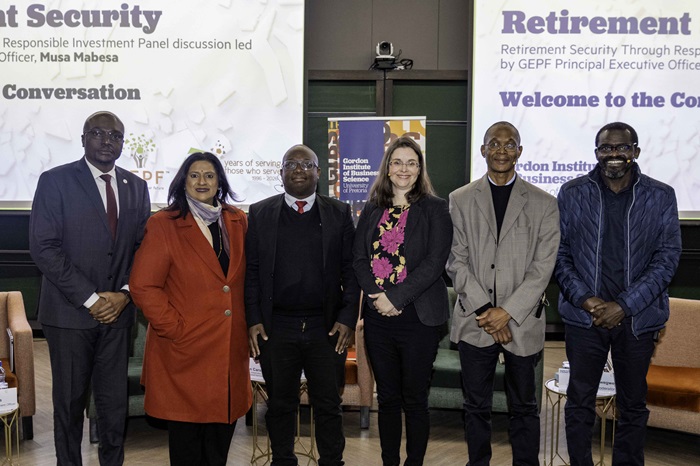
Musa Mabesa, GEPF Principal Executive Officer; & a panel discussion
As the Government Employees Pension Fund (GEPF) marks 30 years of safeguarding the retirement savings of South African public servants, it is using this milestone to help lead an important national conversation about retirement security and inclusive economic growth.
In partnership with the Gordon Institute of Business Science (GIBS), the GEPF yesterday hosted a thought leadership dialogue titled: Retirement Security Through Long-Term Investment: How Pension Capital Drives Inclusive Growth and Long-Term Prosperity in South Africa.
The conversation comes at a sobering time for South Africa as statistics by 10X Retirement Reality Report shows that approximately 6% of South Africans are expected to retire comfortably, raising difficult questions about the country’s savings culture, retirement preparedness and long-term financial resilience and security.
Delivering the keynote address, Musa Mabesa – GEPF Principal Executive Officer, who has led the Fund since 2020 and spent more than a decade in the pension industry, said retirement security had become a national conversation that extends well beyond individual financial planning.
In his address, Mabesa introduced the concept of the Dignity Economy, describing retirement security as a matter of preserving dignity after decades of productive work and ensuring that today’s workers can retire with confidence tomorrow.
“Retirement security is much more than the accumulation of savings. It is about preserving dignity after decades of productive work. It is about building confidence that today’s workers will enjoy financial security tomorrow. When so many South Africans remain unprepared for retirement, this must become a national conversation.”
Welcoming the delegates, Dr Frank Magwegwe from GIBS noted that meaningful progress depends on creating opportunities for informed discussion between academia, government and industry.
“South Africa’s retirement challenges require long-term thinking and shared responsibility. By bringing together different perspectives, we can generate ideas that strengthen policy, improve practice and ultimately deliver better outcomes for future retirees.”
Mabesa highlighted that pension funds are uniquely positioned to act as providers of patient capital, investing in initiatives that create long-term value for both members and the broader economy. From infrastructure and renewable energy to education and housing, he said pension capital has an important role to play in supporting South Africa’s development agenda.
Supporting this point, Mabesa outlined tangible impact of pension capital linked to GEPF investments as at the end of the 2024/25 financial year. The GEPF portfolio contributed to the cumulative creation of 174,491 jobs, including 23,391 opportunities for young people, while adding 2,035.95 megawatts of electricity generation capacity. Pension capital also supported 93 affordable housing projects, financed 10 hospitals and clinics, provided R689 million in student loans and helped deliver 17,008 student beds across South Africa.
The panel discussion, moderated by Dr Frank Magwegwe, GIBS faculty member and personal finance expert, brought together voices from government, academia, pension administration and the investment sector to discuss the future of retirement security in South Africa. Reflecting on the discussion, Magwegwe noted that purpose and meaning remain key drivers of wellbeing in retirement, reinforcing the need to think about retirement as more than a financial outcome.
He challenged attendees to consider what retirement security should look like over the next 30 years and how the industry can continue to deliver sound governance and long-term member outcomes.
Panellists included Basil Maseko from National Treasury, where he serves as Director: Savings and Retirement, Megan Carswell, Independent Trustee and Chair of the Investment & Actuarial Sub-Committee at the Old Mutual SuperFund, Senzo Langa, Chief Investment Officer at Alexforbes and Nalandri (Nancy) Andrews, Vice President of the Institute of Retirement Funds Africa (IRFA).
Throughout the discussion, speakers consistently returned to the common point that South Africa’s retirement challenge cannot be solved by any one institution acting alone. Panellists agreed that retirement security depends on creating a culture of long-term saving, recognising the role pension funds can play as providers of patient capital and ensuring members are equipped with the knowledge they need to make informed financial decisions.
During the dialogue, Andrews noted that retirement security cannot be measured solely by investment performance, but by the outcomes delivered to members.
“Our true measure of success is not in the returns we generate, but whether our members retire with dignity, security and peace of mind.”
She added that improving retirement outcomes will require the retirement industry to strengthen governance, improve financial literacy, enhance member engagement and work collaboratively to address the challenges facing South Africa’s savers.
“My call to action is simple: move beyond discussion and commit to collaboration.”
According to Maseko, retirement outcomes are closely linked to broader economic conditions. “We need coordination on the policy drivers that can generate better outcomes in the economy,” he stressed, adding that unemployment remains one of the biggest challenges affecting retirement security in South Africa.
Speakers also reinforced the importance of member education and engagement, noting that improving retirement outcomes will require greater investment in financial literacy across all stages of a member’s journey.
Carswell highlighted that retirement funds must remain focused on the people they ultimately serve. “The primary purpose of a retirement fund is to provide good outcomes for members in retirement. Members retire within communities, within a society and within a global context.”
She noted that positive retirement outcomes extend beyond individual members, with financially secure retirees continuing to contribute to families, communities and the broader economy.
Langa emphasised the interconnected nature of savings and retirement, noting that financial resilience cannot be separated from broader economic realities. “Savings and retirement are complementary: when people do not have short-term savings, they run to their long-term savings,” he went on to explain.
Another theme that emerged repeatedly throughout the morning was trust. From governance to investment decisions to retirement preparedness, speakers agreed that confidence in retirement institutions remains fundamental to strengthening South Africa’s savings culture.
Closing the dialogue, Mabesa said the discussions reinforced how every investment decision ultimately affects real people, an important reminder for players within the sector.
“The true measure of any retirement system is not the size of its assets. It is whether it delivers dignity. As custodians of retirement savings, we are not simply managing portfolios. We are managing futures.”
ENDS