

































































Mubeen Abdulla, Senior Investment Consultant at Simeka Consultants and Actuaries (Pty) Ltd
Gold has been one of the standout investment stories of recent years, delivering exceptional returns and attracting significant investor attention. Predicting where the gold price goes next is notoriously difficult. For trustees, the more relevant question is how professional asset managers have positioned their portfolios in response to the rally, and why the vast range of manager views on gold mining shares serves as a timely reminder of the value of diversifying across managers within a portfolio.
Why has gold performed so well?
Gold has historically played an important role in diversified portfolios, particularly during periods of economic uncertainty. Its recent rally has been supported by several key trends, including rising government debt, geopolitical uncertainty, emerging market central bank purchases, continued retail investor demand, and concerns around the future path of interest rates.
In recent years, South African (SA) equities have tended to follow the direction of the gold price. In 2025, gold surged 65% in USD terms (45% in ZAR terms, with the difference partly reflecting a stronger rand over the period), while SA equities delivered one of their best years, returning a phenomenal 42%. As of 30 June 2026, both were down.
This performance pattern is no coincidence: as the gold price rose so materially, so did the shares linked to it. Gold shares have nearly doubled their weighting within the SA equity market, from 7.0% (30 June 2023) to 13.7% (30 June 2026) of the FTSE/JSE Capped All Share Index (CAPI), with a similar trend playing out in platinum shares, whose weighting grew from 4.3% to 7.2% over the same period. As a result, retirement fund investors can gain meaningful exposure to gold simply through their SA equity allocation, without needing to invest directly in the physical metal. But given this strong run, an obvious question follows: where does the gold price go from here – and how are professional asset managers positioning in response?
Chart 1: Performance comparison
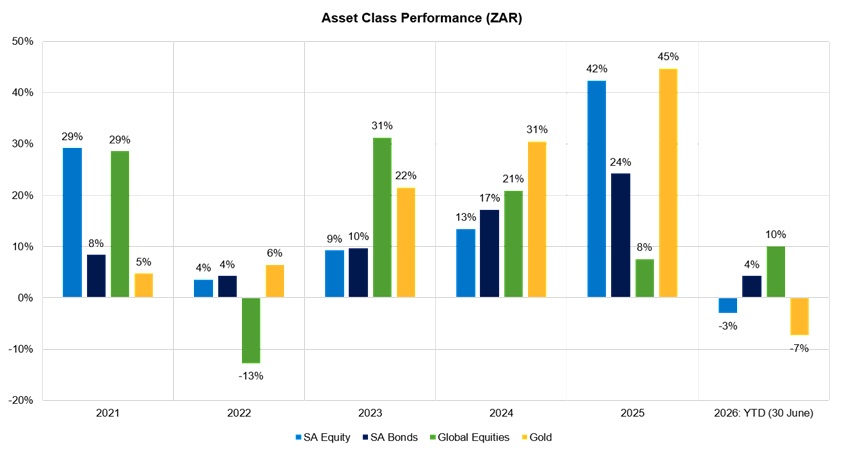
Sources: Morningstar and Simeka Consultants and Actuaries
Forecasting gold is difficult
We surveyed fifteen prominent SA asset managers and asked for their forecast range for the gold price over the next 12 months. Just over half provided a forecast; the remainder did not, citing the uncertainty surrounding the outlook. Of those who responded, all but one provided a relatively wide range rather than a single figure, spanning USD2,500 to USD5,500 per ounce. The one manager who provided a single figure forecast arrived at USD5,000 per ounce, comfortably within that range. For context, the price of gold traded within a range of USD4,000 to USD5,400 per ounce during 2026. The forecast varies from a meaningful decline in the gold price to a further substantial increase, highlighting why building a portfolio around a single forecast may not be the most prudent approach for trustees.
Not providing a forecast is not the same as having no view – as active managers, each must still decide how much exposure to hold in the underlying shares, regardless of whether they choose to commit to a price target. Thus, we posed a more practical question: how much exposure do they actually hold in listed SA gold mining shares within their flagship equity portfolios?
How were asset managers positioned?
Gold allocations ranged from 0% to 16% across managers, with an average allocation of 9.5%, well below the FTSE/JSE CAPI benchmark weighting of 13.7% as of 30 June 2026. Only three of the fifteen managers surveyed held an above-benchmark position in gold shares, while around 80% held below-benchmark positions.
The wide dispersion of exposures reflects differing views on the outlook for gold shares. Managers holding above-benchmark allocations may expect gold shares to continue rising, or view them as an effective hedge against broader market and geopolitical risks. Those holding below-benchmark allocations may not necessarily be negative on gold; this could simply reflect a preference to manage concentration risk, or a belief that more attractive risk-reward opportunities exist elsewhere in their portfolios.
For trustees, the real question is not which manager’s view on gold will ultimately prove correct, but how to construct portfolios that can benefit from these differing perspectives rather than relying on any single one.
Table 1: Gold positioning and forecasts
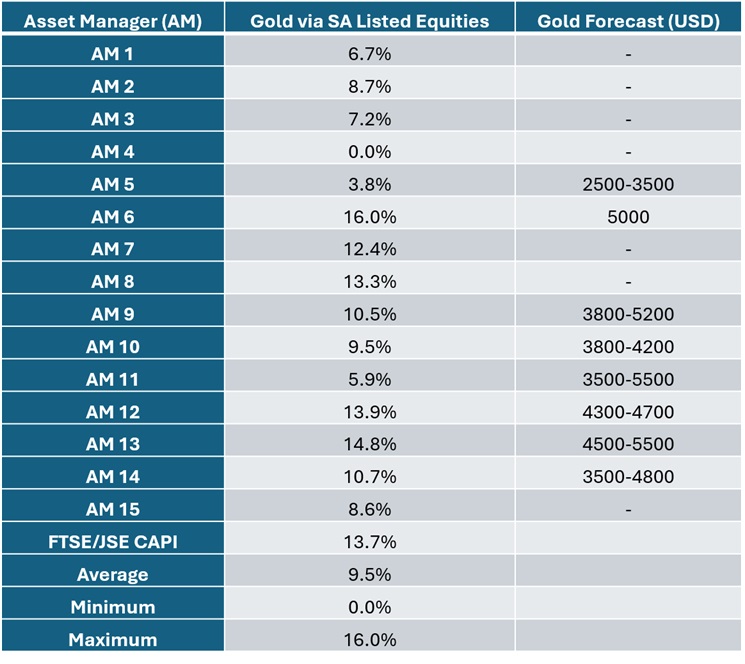
Source: Asset Managers
Portfolio construction implications
The range of gold allocations, from 0% to 16%, illustrates how skilled managers’ positioning around the same opportunity can differ. This is one of the strengths of active management. Because managers reach different conclusions, trustees who appoint a single manager are often unknowingly backing that manager’s specific view. Manager diversification, achieved by combining managers with different investment styles and philosophies, provides a more resilient way of accessing investment opportunities while reducing reliance on any single manager decision dominating the outcome.
If gold shares continue to perform well, managers with larger allocations to the sector are likely to benefit most. Conversely, if gold prices weaken, managers with lower allocations may be better insulated from the downside. By combining managers across this spectrum, trustees avoid having to make a binary call on whether gold will rise or fall, while benefiting from manager diversification and a more resilient portfolio designed to deliver long-term member outcomes across a range of market scenarios.
Conclusion: key takeaway for trustees
The key takeaway is therefore not whether gold will rise or fall from here, but that manager diversification remains one of the most reliable tools trustees have. Combining managers with different views keeps portfolios focused on delivering robust, long-term outcomes for members, rather than attempting to time the market.
Gold serves as a useful case study because it highlights how experienced investment professionals can interpret the same information very differently. While today’s debate centres on gold, tomorrow it may involve other sectors or investment themes. The investment takeaway remains the same: manager diversification helps ensure that portfolio outcomes are not overly dependent on any single investment view.
ENDS