
































































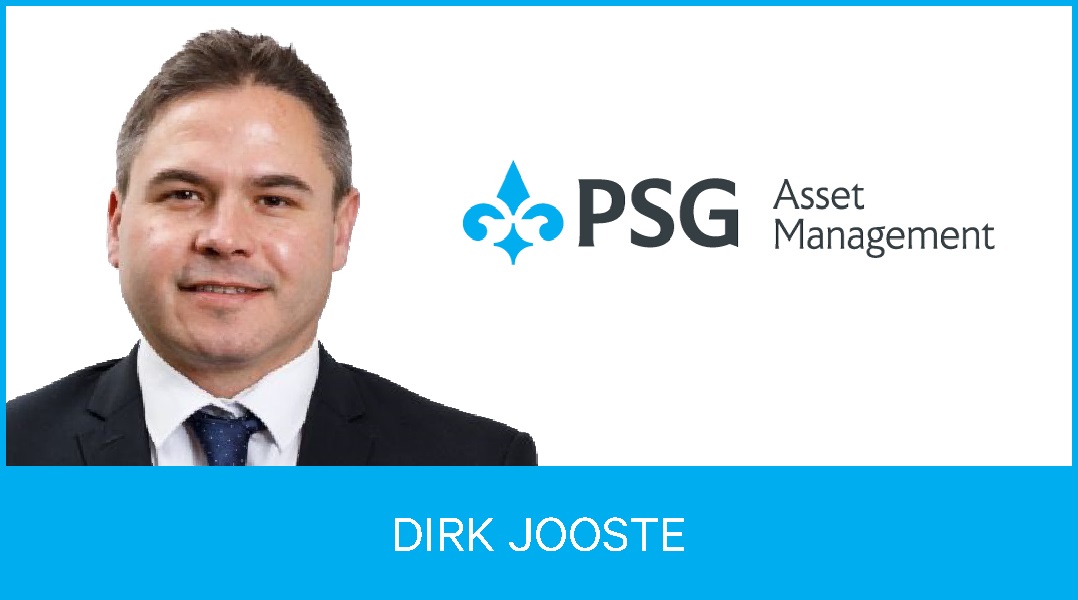
Dirk Jooste, PSG Balanced Fund and PSG Stable Fund Manager, at PSG Asset Management
Active trading declined from 80% in 1995 to just 10% today in the US, signalling an increasing reliance on passive investment strategies. In a world of shifting global power, evolving supply chains and elevated levels of volatility, finding a real active manager is increasingly important to ensure the necessary diversification within portfolios.
This is according to Dirk Jooste, PSG Balanced Fund and PSG Stable Fund Manager at PSG Asset Management. “The world is going through a genuine regime change. Markets are more concentrated and expensive than in decades, driven by the US exceptionalism narrative and, more recently, an artificial intelligence (AI) capex boom of historic scale. But two of the forces that have underpinned US dominance – cheap dollar funding and supportive capital flows – may finally be shifting. This environment highlights the importance of active diversification, not because active managers know what happens next, but because so much is already priced for only one outcome,” says Jooste.
He adds that there is still a long runway for volatility and that investors should not count on the current uncertainty improving any time soon. There is just over 2.4 years of Trump’s current presidential term remaining (884 days as at 19 August 2026). Recent US policy setting has alienated historical allies and fractured old alliances, even as global tensions have escalated. In such an environment, putting the proverbial genie in the back in the bottle and repairing strained global power relationships is unlikely to be a straightforward task. As such, it would be prudent to view the environment that lies ahead as more fractious and liable to disruption, and the importance of diversification comes to the fore.
While this sustained policy uncertainty is not the sole cause of structural shifts already under way – deglobalisation, fiscal dominance, higher-for-longer yields – it is certainly an accelerant. “After an extended period during which interest rates remained artificially low by historical standards in the wake of the post-Global Financial Crisis (GFC), we have seen G7 10-year yields rerate structurally higher.” Jooste explains that the higher cost of capital changes what “safe” looks like. “That’s the ‘new normal’ backdrop for every asset class valuation from here,” he says.
Alongside this, Jooste highlights the dangerous concentration levels within indices, with the top 10 companies now accounting for 39% of the S&P 500’s total market capitalisation. In addition, the US weight in the MSCI World All Country Index has grown to 64%, despite the US only contributing around 25% of global GDP.
Jooste argues that the changing environment requires a level of diversification which only true active management can provide. “Benchmarks are concentrated, which presents a need for new-school diversification. The rising cost of capital will hit expensive, long duration assets first. Sticky inflation means inflation-linked protection and planning for protection to tail risks is a must,” says Jooste. Ironically, asset flows have favoured already-popular areas of the market, like AI and US stocks, driving up their prices further, while many of the sectors and assets that can fare well in a higher-inflation environment continue to be overlooked and remain relatively cheap, giving investors an opportunity to position their portfolios to better navigate tomorrow’s challenges.
This highlights that a considered approach to portfolio construction will be required going forward. Simply replicating indices is unlikely to result in suitably diversified portfolios, given high levels of concentration. However, doing so can be challenging: it can be daunting for investors and many managers alike to make the conscious decision not to include today’s winners that dominate indices, and in reality, many simply end up replicating indices. This is why we believe a trusted and proven investment process is key: we believe that by focusing on mispriced, quality assets that the market is overlooking, it is possible to construct resilient portfolios that are able to navigate a wide variety of outcomes successfully.
ENDS