



































































Matiisetso Madito, Chief of Credit & Bureau Services at Experian South Africa
Against a challenging economic backdrop of rising inflation, fuel price hikes and increased borrowing costs, new data from Experian’s Q2 2026 Consumer Default Index Extended (CDIx) shows that female consumers are displaying notable financial resilience. While South African women hold a smaller share of the country’s total credit exposure, they consistently demonstrate more stable repayment behaviour than the broader market.
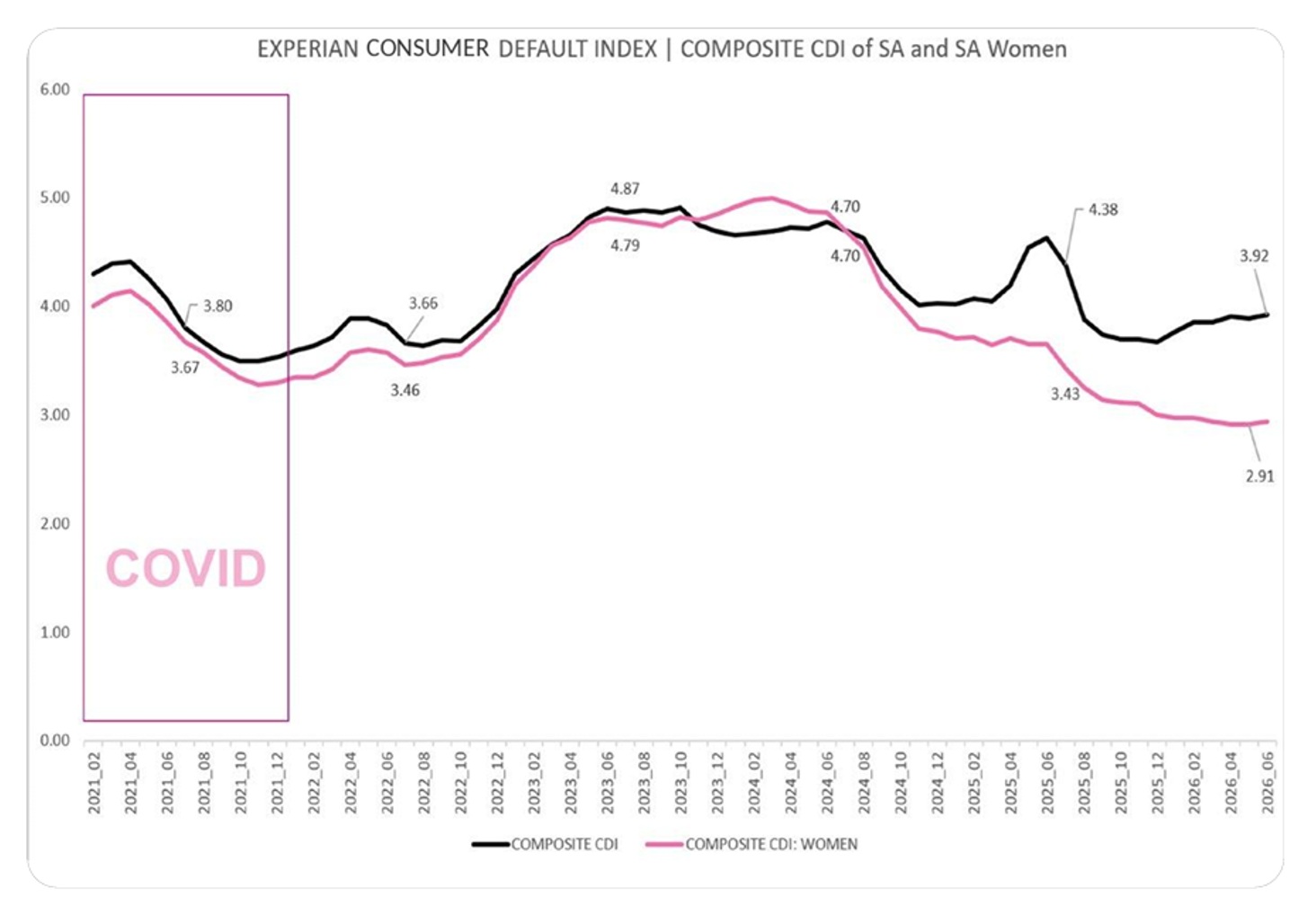
The CDI measures first-time default behaviour across major credit products. Women’s Composite CDI improved in 2025 and remained below the total market CDI into 2026, after briefly exceeding the broader market in 2024. This indicates that, despite having lower overall exposure, women’s credit performance has stabilised in a way that is meaningful in the current economic environment.

This creates a more complex picture of credit participation. Women are active in the credit market, but their exposure remains lower in higher-value secured lending, particularly Home Loans (HL). Female representation in Home Loans moved from 36.7% to 38.2% over five years, while Vehicle Finance (VF) increased from 42% to 45.2%. Although these shifts are modest, they indicate gradual movement in areas of credit that generally carry higher values and longer-term financial commitments.
Retail Loans remain the most widely used credit product among credit-active South African women, with just over half (57%) using Retail Loan products compared with 35% of men. However, because retail credit typically carries lower facility values, it accounts for only 4% of total female credit exposure. By contrast, 62% of women’s outstanding exposure is held in Home Loans, compared with 71% for men. This shows that women’s credit participation cannot be assessed by account ownership alone; product type, facility value and repayment behaviour all shape the overall picture.
This resilience stands out against the wider market context outlined in the Q2 2026 CDIx. The report notes that South African consumers continue to face financial pressure, with CPI rising to 5% and the prime lending rate at 10.5%. The data also indicates increased use of Personal Loans, pointing to greater reliance on unsecured credit among some consumers as they manage ongoing financial pressures.

“The Q2 data paints a vivid picture of a financially pressured South African consumer, making the repayment behaviour of women all the more noteworthy,” says Matiisetso Madito, Chief of Credit & Bureau Services at Experian South Africa. “Women may hold a smaller share of total exposure, particularly in higher-value secured credit, but their ability to manage debt stands out in this current challenging economic environment. t. For lenders, this highlights the need to move beyond a one-dimensional view of credit participation and use granular data to identify pockets of resilience, paving the way for more responsible, sustainable and data-led financial inclusion.”
A more complete view of women’s credit participation
Taken together, the findings show why women’s credit participation should be assessed through multiple lenses. Lower exposure does not necessarily indicate lower creditworthiness, while stronger repayment performance points to the importance of understanding affordability, product mix and risk in combination. This is particularly important as lenders balance growth opportunities with responsible credit decisioning.
For lenders, the findings reinforce the value of more granular consumer insights. Segments with lower exposure may still show reliable repayment patterns, while higher participation in lower-value products can mask opportunities elsewhere in the credit market. More precise data can help institutions assess affordability, identify appropriate products and support consumers in ways that are both commercially sound and sustainable.
“Responsible inclusion is not only about increasing access to credit; it is also about ensuring that access is sustainable and supported by a clear understanding of affordability, behaviour and risk,” adds Madito. “By using data responsibly and ethically, the industry can better identify opportunities to support consumers while helping to protect them from over-indebtedness.”
Read Experian’s full Consumer Default Index for Q2 2026 here.
ENDS