

































































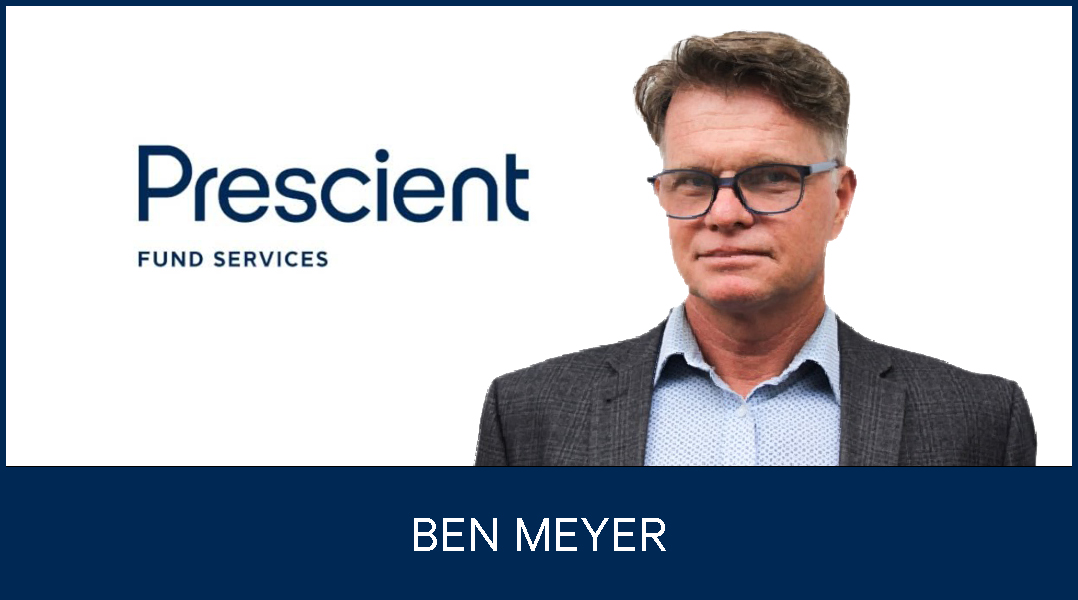
Ben Meyer Managing Director, Prescient Capital Markets
South Africa’s ETF market has entered a new phase of development. Since our last report, it has continued to broaden beyond its traditional passive, index-tracking roots into a more diverse universe that now includes actively managed exchange traded funds (AMETFs) with global feeder exposure, fixed income strategies and balanced portfolios.
Two important factors are driving this growth. Firstly, investors are increasingly looking for transparency, liquidity, cost efficiency and the ability to access diversified strategies through a listed instrument. At the same time, asset managers are recognising that the ETF structure can serve as a new distribution channel alongside traditional collective investment schemes and investment platforms. The ETF market added approximately R60 billion in market capitalisation during 2025 alone.
The result is a market that is no longer defined only by passive, index tracking exposure, but by a wider range of building blocks that can support different investment outcomes. This is evident in the way the JSE’s ETF market has expanded. In 2024, the exchange surpassed 100 listed ETFs and reached a market capitalisation of more than R200 billion, excluding ETNs and AMCs.
Last year, this total ETF market capitalisation increased by a further 29%, adding R60 billion year-on-year. This growth trend is continuing through 2026, with the total number of ETFs listed at 141 and total assets under management of R275 billion.
The most important structural development over this time has been the emergence of AMETFs. The first AMETF was listed on the JSE in May 2023 following changes to the exchange’s listing requirements. Before this, ETFs were required to track a published index, with the exception of commodity ETFs that tracked the price of a specific commodity like gold or platinum. The new framework has allowed portfolio managers to apply investment discretion within a listed vehicle, creating a bridge between the traditional unit trust market and the exchange traded environment.
The speed of adoption has been notable. At the beginning of August 2024, there were 10 AMETFs listed on the JSE. By the end of August 2026, this had increased to 52, with AMETF assets reaching approximately R25 billion. This growth trajectory indicates that AMETFs have moved beyond the proof-of-concept stage and are now becoming an important product category in their own right.
Over the last 12 months, the range of new AMETF listings has also demonstrated the flexibility of the structure.
These listings have included income-focused strategies, multi-asset funds, global feeder strategies and long-only active solutions. Examples include the Amplify Strategic Income Satrix Feeder AMETF, listed in February 2026, which provides investors with exposure. These listings have included income-focused strategies, multi-asset funds, global feeder strategies and long-only active solutions. Examples include the Amplify Strategic Income Satrix Feeder AMETF, listed in February 2026, which provides investors with exposure to an actively managed South African income strategy; the Prescient China Balanced Feeder AMETF, listed in March 2026, which provides exposure to Chinese equity, bonds and money market instruments; and the ETFSA Oyster Global Balanced Prescient AMETF, listed in April 2026, which provides access to a globally diversified multi-asset portfolio. We also saw EasyETFs list three CPI-linked AMETFs in May 2026, namely the EasyETFs CPI + 3 AMETF, EasyETFs CPI + 5 AMETF and EasyETFs CPI + 7 AMETF, offering investors actively managed outcome-based strategies aligned to different risk and return objectives.
Income-focused AMETFs are likely to remain one of the key growth areas as South African investors continue to seek yield, stability and capital preservation. Income AMETFs provide a listed alternative to traditional income unit trusts, while offering the benefits of intraday trading, transparent pricing and access through stockbroking and investment platforms. For investors managing the AMETF structure this may become an increasingly useful tool for blending liquidity, yield, and professional active management.
Balanced and multi-asset AMETFs represent another major growth opportunity. Balanced funds have historically played a central role in the South African savings and retirement market because they provide diversified exposure to equities, bonds, property, cash and offshore assets in a single portfolio. The introduction of balanced AMETFs brings this familiar investment approach into the listed environment.
This is particularly relevant given the size of the South African multi-asset market. The collective investment scheme industry has traditionally had a large allocation to multi-asset portfolios, reflecting the importance of balanced funds in retirement and discretionary savings. AMETFs give asset managers an opportunity to repackage these proven strategies in a format that is easier for certain investors to access and trade.
Long-only active equity strategies should also gain momentum. The AMETF structure allows active equity managers to bring their established investment processes to the listed market, providing investors with access to manager skills in a transparent and tradeable format. This is relevant for both domestic equity strategies and global feeder funds. The listing of AMETF versions of established global equity and global balanced strategies by leading managers shows that the structure is being adopted not only by new entrants, but also by established investment houses looking to broaden access to their capabilities.
Trading activity is another important indicator of ETF market development. As market capitalisation grows and product choice expands, trading volumes and the number of trades should also increase.
A deeper secondary market improves investor confidence, supports more efficient execution, and helps the ETF ecosystem mature. The average trading value of AMETFs at the end of August 2026 was R41 million per day, compared to ETFs of R562 million per day.
The growth of AMETFs is supported by a clear value proposition. For investors, AMETFs offer access to professional active management through a listed instrument. These funds can be bought and sold during the trading day, held through existing brokerage accounts and incorporated into portfolios alongside shares, bonds, and traditional ETFs. For asset managers, AMETFs create an additional route to market and provide a way to reach investors who prefer listed instruments or who operate through platforms where ETFs are already well understood.
Looking ahead, the outlook for South African ETFs remains positive. The market is likely to continue expanding as investors become more familiar with exchange traded products and as asset managers bring more strategies to market. Growth is expected to be strongest in areas where the ETF structure solves a clear access problem or improves investor convenience. These include income funds, balanced funds, global feeder strategies, long-only active funds, and outcome-based portfolios.
Prescient Fund Services expects this momentum tocontinue, supported by a solid pipeline of new listings. The continued development of AMETFs creates an opportunity to broaden investor choice and deepen the South African listed investment market. We are also working with regulators and industry stakeholders to explore the possibility of listing Retail Hedge Fund (RHF) AMETFs in the future. If permitted, RHF AMETFs could represent an important next step in the evolution of the market by providing regulated access to alternative investment strategies through a transparent, listed structure.
The South African ETF market has therefore moved into a new growth phase. Passive ETFs remain an important foundation, but the next chapter is increasingly about active management, broader investment outcomes and more flexible listed access. AMETFs are central to this development. They combine the familiarity of collective investment portfolios with the efficiency of exchange trading, and they are likely to become an increasingly important part of how South African investors access different strategies in the years ahead.
ENDS