
































































Akua Koranteng, Partner at Fund/us
Women-led funds generate stronger returns and social outcomes, so why is it that African-based women-led fund managers continuously face systemic barriers to entry, evidenced repeatedly by “lack of track record recognition, limited access to investor capital and continuous investor bias?” (source: African Business)
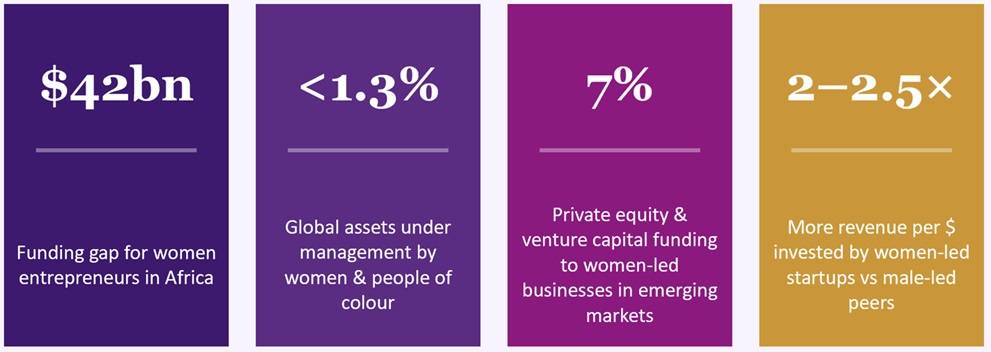
When one takes a moment to absorb the statistics that support the above, the immediate thought, being a female owned fund manager myself, is why would one expect to succeed if; “a. global assets under management by women and people of colour is less than 1.3% and b. 7% is the percentage attributed to private equity and venture capital funding to women-led businesses in emerging markets” (source: Knight Foundation, IFC).
What exactly does Gender Lens Investing look like and what will it take for this to transgress into a reality a lot more progressive than currently observed in South Africa.
Simply put, Gender Lens Investing includes a gender-based factor to the traditional approach of financial analysis, with the actual aim being to direct money to women and in so doing closing the gender gap and supporting investments with stronger returns and better social outcomes. In theory, what this means is that more companies that are started, owned or run by women should be invested in, social infrastructure that improves the daily lives of women and girls (like safer places to live) should be funded and women in top-management roles should be treated fairly to their male counterparts.
In practice, allocators of capital in South Africa should be intentional about Gender Lens Investing. Intentionality comes with:
- Moving beyond B-BBEE compliance scorecards, which sometimes disguise gender imbalances, to demanding of their allocators to back and support female owned fund managers; and
- Supporting female-owned and emerging fund managers by strategically backing emerging manager programs.
The African Women Impact Fund (AWIF) was established by the UN Economic Commission for Africa, UN Women and African Union Commission under the African Women Leadership Network and exists to boost women fund managers with funding (working capital, mentorship and knowledge to drive inclusive growth). In collaboration with the Standard Bank Group, RisCura and MiDA Advisors, the South African mandate deployed via the Telkom Retirement Fund and the Motor Industry Retirement Fund has backed 5 women-led funds. We can only hope that the 5 becomes 50, the 50 becomes 500 and the 500 becomes 5000.
What will it take for the next 50 or 500 or 5000 to succeed? These are my recommendations and practical tips based on my personal experience and observation:
Fund managers
– Monthly expenses, be it personal or operational, are a reality that don’t pause during the fundraising and fund set-up process. Budget for at least 36 months and at most 60 months. Within this time-frame alternative sources of income, where the experience and passion and opportunity allows, include appointment to board and sub-committee positions, lecturing or facilitating advisory work at a fee. If you find an investor who aligns with your vision then nothing stops you from giving up a share of the Manager from the onset.
– Do your home-work by engaging with individuals already in the space. Through enough persistence they may afford you the opportunity of sharing in resources like office space and the likes at a highly discounted rate. Align with service providers passionate about sector inclusivity and participation and who are willing to walk the journey with you to at least 1st close (here I speak specifically of compliance, legal, auditing, ESG and HR support, to mention a few).
– Seek out the Emerging Manager Programs and make sure that you and the team are ready when they are ready to engage with you.
– Build your pipe-line.
– Saving the best for last, don’t wait, just keep at it. A PPM that was drafted 6 months ago or a financial model that was built 1 year ago to back proof of concept, all remain relevant for the journey ahead.
Service providers
– Align with a service provider who will advise you accordingly prior to the journey, during the journey and post 1st close. Sense check their ability to be consistently present by engaging with others who have or continue to utilise their service. Being a very type “A” type of person has helped me suss out the good from the not so good early enough to move on.
– Key service providers from the onset include legal, compliance, ESG and CRM. At a later stage (and to the extent that these are outsourced), and once the fund becomes active, fund administrators, auditors, accountants and HR will need to be appointed.
Investors
– If the answer is no then the answer is no and there will always be valid reasoning behind this (e.g., no funds, no interest in product backing, lack of familiarity with the fund management team), it’s not great to be ignored as a first-time fund manager but it’s also not personal.
– As a fund manager if you need to engage the services of a fundraising assistant then do it, but that said risk vs reward efforts need to be aligned.
Gender-lens investing is not an isolated strategy; it is a relevant framework for capturing growth, driving innovation, and balancing financial returns with social progress. Awareness alone is not enough. Investors should turn their insights into impactful investments.
ENDS