

































































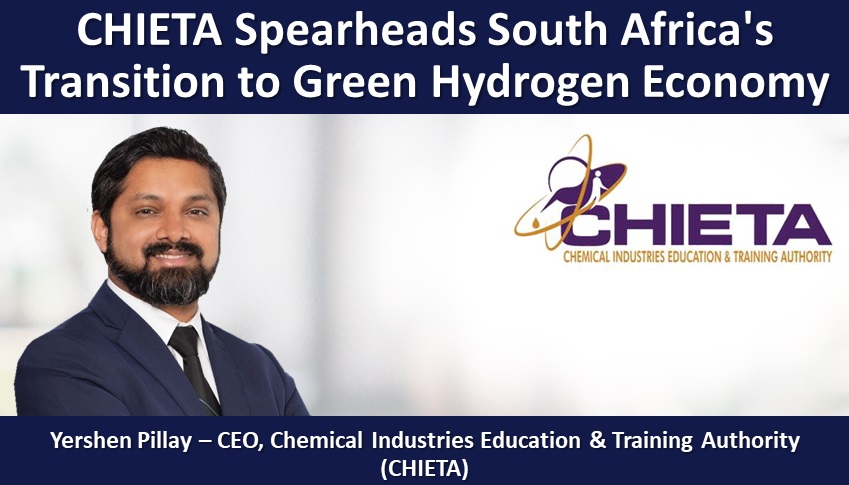
Yershen Pillay – CEO, Chemical Industries Education & Training Authority (CHIETA)
In a pivotal move towards advancing South Africa’s energy transformation, namely transitioning to a Green Hydrogen Economy, the reliance on disruptive technologies and collaboration across the value chain is essential.
With estimations indicating a potential 3.6% addition to South Africa’s GDP by 2050 and the creation of over 370,000 jobs, the transition to a hydrogen economy emerges as a top priority in the nation’s energy agenda. Leveraging South Africa’s deep capital markets and optimal conditions for renewable energy production, including vast land resources and prime wind and solar assets, serves as a cornerstone for driving green hydrogen initiatives forward.
Partnerships between public and private sectors for effective policy and regulatory interventions are deemed pivotal. As South Africa charts its course towards a green hydrogen future, collaboration with academia, TVET colleges, industry, government, and international partners becomes indispensable. The transition to a hydrogen economy necessitates bold aspirations and collaborative efforts from all stakeholders.
In 2024, CHIETA is set to pursue new collaborative partnerships in non-chemical related industries, offering opportunities for impactful programs. Exploring collaborations with the forestry and energy sectors, CHIETA aims to establish a groundbreaking, eco-friendly SMART Skills Centre, marking a significant milestone in advancing green initiatives.
“At CHIETA, we firmly believe that the Hydrogen Economy presents South Africa with opportunities to address existing economic challenges and act as a lever for social justice,” Yershen Pillay. “By creating jobs along the hydrogen economy value chain, we can foster economic growth while simultaneously tackling climate change challenges by reducing greenhouse gas emissions and creating new industries.”
The adoption of the hydrogen economy holds the promise of securing South Africa’s national energy supply, leveraging manufacturing benefits, and understanding safety requirements, all of which will have a direct positive impact on economic growth. Rapidly developing the skills required for the green hydrogen economy is deemed critical for South Africa’s economic development and sustainability
ENDS
About CHIETA
The Chemical Industries Education & Training Authority (CHIETA) is a statutory body that was established by The Skills Development Act 97 of 1998. Our purpose as a SETA is to facilitate skills development in the chemical industries sector and to ensure that skills needs are identified and addressed through a number of initiatives by the SETA and the sector.
We also ensure that skills needs are identified and addressed through various training initiatives in the chemical and manufacturing industries.
Approximately 70 % of the Skills Development Levies (SDL), that are obtained from the chemical industry, are distributed back to member companies through:
- Mandatory Grants
- Discretionary Grants
As a trusted partner in skills development and training for the chemical sector, CHIETA funds the industry for the various occupational programmes as well as certain TVET sector and higher education programmes. In this regard, CHIETA is guided by its well-researched Sector Skills Plan that documents the hard to fill skills and hard to fill positions within the sector.
CHIETA also works in close collaboration with the Quality Council for Trades and Occupations (QCTO) to design and develop occupational qualifications and trades, quality assurance, accreditation, monitoring as well as certification of competent learners.