
















































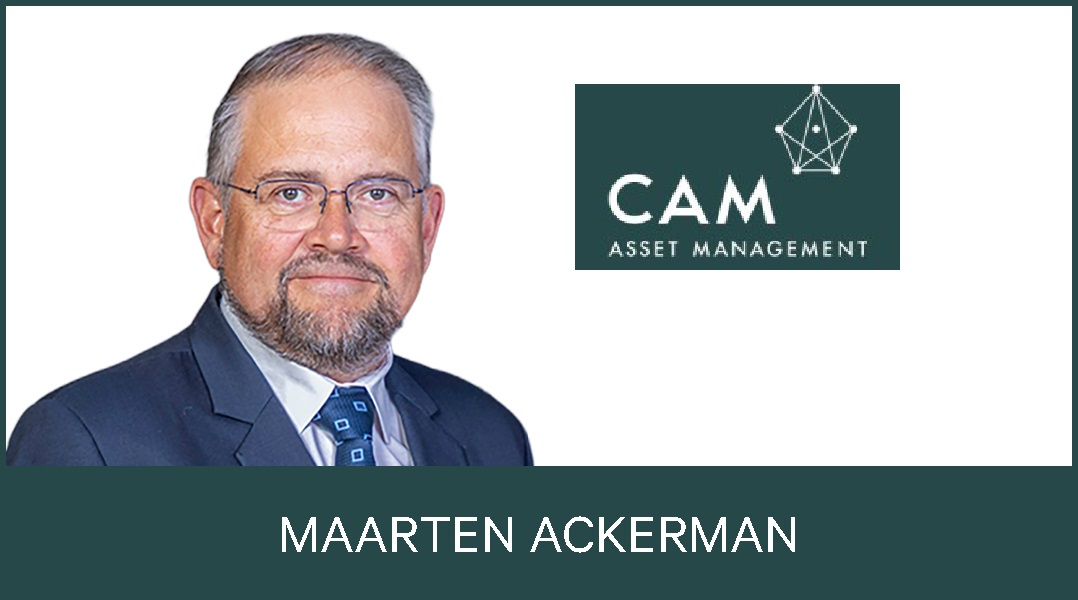
Maarten Ackerman, Chief Economist at CAM Asset Management
The global economy is entering the final months of 2026 in better shape than many anticipated, but ongoing conflict in the Middle East, elevated inflation and tighter monetary policy continue to pose significant risks to the outlook.
According to Maarten Ackerman, Chief Economist at CAM Asset Management, global growth has remained remarkably resilient despite prolonged geopolitical disruption.
“Our base case remains that the Middle East conflict will continue as a prolonged disruption, acting as a headwind to global growth while adding inflationary pressure through higher energy prices, supply-chain disruption and elevated shipping costs,” says Ackerman.
He cautions: “The risk of a more severe escalation cannot be discounted, particularly as additional parties become involved and pressure on strategic energy and shipping infrastructure intensifies. While the outcome of the recent United States (US) midterm elections has brought some measure of calm to markets, reflected in the oil price, it remains too early to determine whether this will be sustained.”
“Any further disruption to energy supply would have significant implications for oil prices, global inflation and investor sentiment.”
Inflation keeps central banks on a tighter path
Ackerman says inflation remains the key policy challenge for central banks. Higher energy prices are only part of the problem. Longer shipping routes, higher conflict-risk insurance and surcharges are keeping freight and goods costs elevated.
“Central banks are responding to inflation driven partly by supply shocks rather than excessive demand. This makes the policy challenge particularly difficult because higher interest rates can constrain growth by increasing borrowing costs, weakening business sentiment and reducing consumer spending.”
Despite these pressures, Ackerman expects global growth to remain near 2.5% over the next 12 months, broadly in line with current International Monetary Fund (IMF) projections.
US remains the engine of global growth
The US continues to outperform many of its peers, supported by three important pillars: technology and artificial intelligence (AI) investment, a manufacturing and industrial recovery and strong consumer spending.
“Without the current surge in AI-related investment, US gross domestic product (GDP) growth would likely be materially weaker. Technology investment is increasingly underpinning economic momentum, corporate profitability and employment.”
However, signs of strain are emerging among consumers as savings rates decline, auto-loan delinquencies rise and higher mortgage rates weigh on housing. Ackerman therefore expects US growth to moderate to approximately 2.2% over the next 12 months as persistent inflation and tighter monetary policy gradually slow activity.
South Africa: Reform progress meets a tougher backdrop
South Africa (SA) entered 2026 from a stronger position than expected, supported by the 2025 commodity cycle, improved government finances, fiscal discipline and improving sentiment among international rating agencies.
Ackerman says conditions have become more challenging. “SA is increasingly facing the consequences of weaker global growth, elevated inflation and fading tailwinds.”
Weakness in mining, manufacturing and trade, alongside pressure on household consumption and government spending, continues to limit growth. Agriculture has also lost momentum amid higher input, fuel, fertiliser and logistics costs.
Fixed investment remains well below the levels required for sustained economic growth above 3% to 4%.
“Gross fixed capital formation remains below 14% of GDP. At those levels, it is difficult to envisage SA sustaining growth much above 1% without a meaningful increase in private-sector investment.”
SARB faces a difficult November decision
The deteriorating inflation outlook will place the South African Reserve Bank (SARB) under renewed pressure when its Monetary Policy Committee (MPC) meets on 19 November.
Ackerman says conditions have deteriorated since the last meeting, when the SARB raised interest rates. Higher oil prices following attacks on parts of Saudi Arabia and renewed pressure on the rand amid a global risk-off environment add risks to domestic fuel prices and inflation.
“With the latest inflation print at 4.5%, inflation is moving towards 5%. There is a strong case for another rate hike,” he says.
Ackerman cautions that the nature of the shock complicates the decision. “There is only so much monetary policy can do to counter a supply-driven inflation shock. Trying to suppress demand in an economy as weak as SA’s risks doing more harm than good.”
He says the SARB may take some comfort from the US Federal Reserve’s (Fed) decision to hold rates at its recent meeting despite relatively sticky inflation.
“This could support a similar approach locally, allowing inflation to run hotter for longer rather than hiking to force it lower. Looking at the bigger picture, I think there is a reasonable chance the SARB could pause rather than hike again.”
Reform provides grounds for cautious optimism
Ackerman nevertheless sees signs that structural reforms are beginning to produce tangible results.
Electricity generation capacity has improved, rail freight volumes are stabilising and public-private participation in port infrastructure is beginning to improve operational efficiency.
“These developments show that reform can deliver results, but infrastructure turnarounds take time. The challenge is to maintain implementation momentum.”
Ackerman expects SA to struggle to grow much above 1% over the next 12 months, although the medium-term outlook is more constructive if reform, political stability and private-sector investment can be sustained.
“For investors, the current environment reinforces the importance of diversification, quality assets and a long-term perspective,” Ackerman concludes. “Geopolitical shocks will continue to create volatility, but global economic resilience, technological investment and the ability of businesses and consumers to adapt mean opportunities remain for disciplined investors willing to look beyond the headlines.”
ENDS