



































































Haroon Bhorat, Chair: Investment Committee, at Sygnia
Global and local concern about the impending El Niño weather shock is on the rise. Coined originally by Peruvian fishermen who noticed that their coastal waters became unusually warm in December – El Niño in Spanish means ‘the child’ – it refers to the ‘Christ child’ over the Christmas period. El Niño is a naturally recurring climate pattern, usually appearing every two to seven years. However, it now occurs in a hotter world – which means climate disruptions around the world are much more severe than before.
Put simply, warm water accumulates in the “wrong” part of the Pacific Ocean, disrupting normal wind and rainfall patterns across the tropics and subtropics. Climate agencies usually classify an El Niño event when sea surface temperatures in the key Niño-3.4 region are at least 0.5°C above average and are expected to remain elevated for several months.
These conditions cause unusual changes in wind, cloud formation and atmospheric pressure, but climate change now elevates these changes, so there is a higher probability of hotter extremes, drought in some regions, floods in others and a more volatile global agricultural system. El Niño has in many ways become climate change’s reminder to us of the severe economic and social costs of rising temperatures on the planet.
The latest forecasts suggest that South Africa may be heading into precisely this risk window. International and local forecasts point to a high probability of El Niño developing through 2026 and potentially persisting into 2027. For South Africa, the timing is crucial, as farmers begin planting summer crops around October. Rainfall in the October to March period determines germination, crop development and final yields. A dry start followed by heat stress in December, January and February will threaten yields from these crops. In our case, El Niño is typically associated with hotter and drier conditions across the summer rainfall regions. This does not mean every El Niño automatically creates a drought. Pre-El Niño soil moisture, existing dam levels, the exact timing of rainfall and the severity of the event all matter as well – so we cannot predict the magnitude of this El Niño’s impact on agriculture as yet.
South Africa’s summer crop belt produces maize, soybeans, sunflower seed, sorghum, groundnuts and dry beans. Maize is the anchor crop in the food value chain – a staple food for households and a key input for animal feed. Maize production volumes and final prices thus serve as a central price signal for food when thinking about the consumer price index (CPI). Specifically, white maize matters directly for human consumption, while yellow maize matters indirectly through animal feed for poultry, pork, beef, dairy and egg farming.
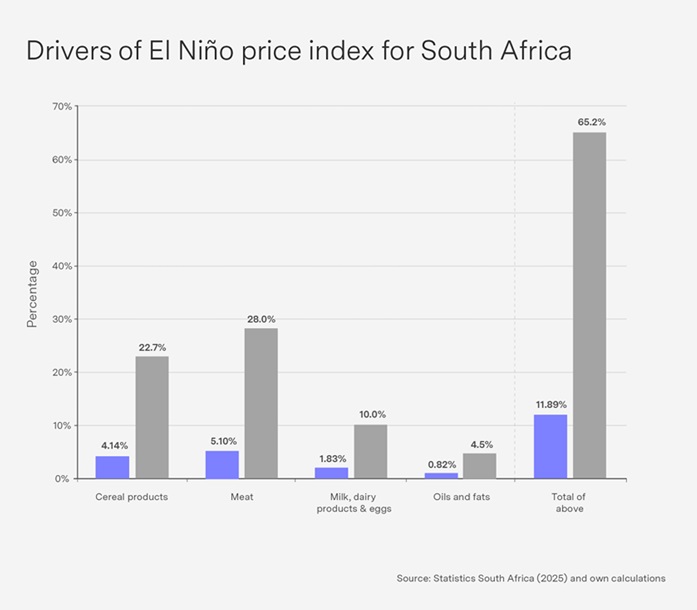
El Niño drought conditions could shock white maize prices and, via the yellow maize channel, the price of poultry, beef, pork, eggs, dairy, cereals and more. The average South African household spends a disproportionate share of their income on food. Conservatively, these ‘El Niño-sensitive’ products constitute about 12% of the average household consumption in South Africa – but notably a huge 65% of all food consumption. And these percentages would be appreciably higher for poor households. So a large El Niño weather shock is likely to cause a significant El Niño food price shock downstream. More careful modelling is required to track an El Niño price index.
The import channel, already susceptible to elevated oil prices, is also vulnerable. When domestic production is weak, South Africa imports maize, wheat, rice, vegetable oils and animal-feed inputs. Putting the not-insignificant detail of the oil price aside, we may also be hit by imported inflation if our domestic production and a number of other major producing regions are affected by El Niño at the same time.
But local experts – notably our very own agriculture guru, Wandile Sihlobo – argue that we may have some short-term buffers. Firstly, South Africa has just come off two strong agricultural seasons, so grain stocks are healthy. Secondly, evidence shows high soil moisture as a consequence of recent good rains, a key mitigant to delayed crops.
Finally, dams in many parts of the country are not starting from crisis levels, as has been the case in previous El Niño events, so there is a water reserve.
The El Niño event is a very important reminder that supply shocks now drive the decision-making of central banks around the world. In the event of an El Niño price shock through the domestic and external supply channels, the South African Reserve Bank (SARB) will have to consider raising rates to avoid second-round price effects, deanchor inflationary expectations and embed wage demands. This will of course threaten the newly minted inflation targeting range.
The policy response from the monetary authorities is dependent on the severity of El Niño. In a mild scenario with good stock levels and limited crop damage, the SARB may look beyond these temporary food-price pressures. In a severe scenario, however, with maize prices rising and food inflation becoming sticky, the SARB would delay rate cuts – and in an extreme case, possibly even implement a hike. In this new world of monetary policy, simply raising rates to curb domestic demand and allow consumption to recover through lower inflation is a rarer occurrence than it used to be. Supply shocks seem to be the new order of the day, raising rates to curb prices, but sacrificing growth. Climate change appears to be turning weather events into a regular monetary-policy variable.
ENDS