


































































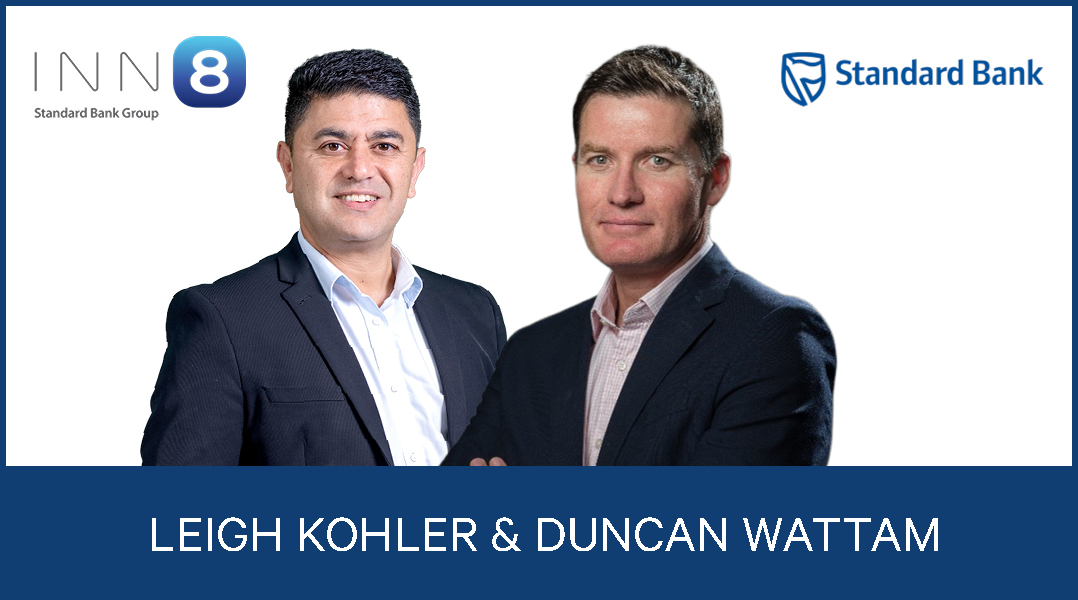
Duncan Wattam, Head of Standard Bank Group Investments & Leigh Kohler, Head of INN8 Invest
On 10 September, more than 1 200 advisers and representatives from 26 asset managers gathered in Johannesburg for the INN8 Invest Summit, where leading global and local investment minds set out how they are rewriting decades-old rules on risk and return. Their message: in a market being reshaped by AI, shifting emerging market dynamics and heightened volatility, many of the strategies investors have relied on for years no longer hold.
Set aside biases rooted in historical investing truths and approach investment with a clean slate. That is the challenge facing the modern investment manager.
The new norm
“Markets have remained volatile amid heightened macroeconomic uncertainty,” said Duncan Wattam, Head of Standard Bank Group Investments at the INN8 Invest Summit on Thursday, 10 September, in Johannesburg. Clients are concerned about ongoing wars, skyrocketing oil prices, equity market swings, the impact of climate change and geopolitical instability.
Wattam, in his closing remarks, said the historical financial services structures, in which banks, insurers and asset managers work in silos is not effective anymore: “clients are starting to demand a holistic approach, where providers can provide for their end-to-end financial needs”
They are also curious about alternative investment opportunities, such as cryptocurrencies and increasingly popular vehicles such as actively managed exchange traded funds (ETFs). They ask AI bots to evaluate the investment advice they receive and are questioning adviser fees.
These factors call for a new investment playbook. Strategies and theories investors have relied on for decades no longer make sense.
The only constant is investors’ need for performance
In his opening discussion, Leigh Kohler, INN8 Invest Head, said: “The one thing that hasn’t changed is that investors want consistent outperformance.”
The investment landscape is rapidly being reshaped by those rewriting the rules. Kohler said: “Investors are looking at pockets of areas within our industry. We’ve seen investors focusing on technology and using artificial intelligence to eke out additional performance or even provide an extra edge in the investment process.”
Key summit takeaways from top investment minds
AI: The next phase of AI-related capital expenditure will have specific beneficiaries
- AI may be inflationary in the short term because of energy and infrastructure constraints, but productivity gains could make it deflationary over time.
- Beyond energy demand and construction delays, valuation uncertainty and falling token prices are shaping the next phase of growth.
- Asian currencies and emerging markets are the biggest beneficiaries of AI-related capital expenditure.
- The global AI boom has propelled Taiwan Semiconductor Manufacturing Company (TSMC) to a 15% weighting in the MSCI Emerging Markets Index.
- In the US, investment in AI data centres is accelerating dramatically.
- Asset managers are using AI to improve research, data architecture and operational productivity.
The character of emerging and developed markets is changing
- The economies included in the definition of “emerging markets” no longer react the same way, regardless of their geographical location.
- One of the world’s top-performing companies, TSMC, is based in Taiwan, an emerging market.
- Studies have found that a global index like the MSCI ACWI Index, which includes 23 developed markets and 24 emerging markets, may be weighted 90% towards developed markets by market cap, but 50% of the companies in the index are in emerging markets.
- US growth concentration in three narrow sectors (defence, health and tech) is an underappreciated risk of developed-market exposure.
South Africa can thrive with 20% fixed investment
- Fixed investment needs to rise sustainably from 13.2% of GDP to between 20% and 30% of GDP to maintain and expand the infrastructure that South Africa’s economic growth depends on.
- The domestic economy is not a rising tide that lifts all boats. An asset manager’s job is to find the individual companies that are growing despite a weak broader economy.
- South African miners can explore and develop much faster with new data from AI technology, revitalising an industry too often written off as being in decline.
- The narrative that mining is a sunset industry is largely tied to gold. However, an industry expert said it is one of those northern sunsets where the sun never goes down.
- Township economies have immense growth potential as internet access enables education – but only if a safe environment is created.
Asset allocation positioning is shifting
- Strategic asset allocation drives between 60% and 90% of portfolio returns; yet, in the last decade, there have been nine “top asset class” rotations, and in eight of those nine periods a different asset class was the top performer.
- The classic 60/40 portfolio model is no longer a guarantee of diversification. Equities and bonds have begun to correlate during downturns, particularly in 2022.
- Fixed-income positioning has shifted towards emerging market duration, currencies and credit opportunities, rather than core developed market bonds.
- SA fixed income has outperformed SA equities by a much wider margin than by which global bonds have outperformed global equities.
The role of stock picking in a portfolio has fundamentally changed
- Asset allocation, rather than stock picking, has become the primary driver of returns because performance across asset classes changes frequently. Only 6% of South African active stock pickers outperformed the market over the last ten years.
- Choosing an ETF, selecting a benchmark, and managing concentration are all active decisions, making the passive/active distinction increasingly irrelevant.
- Technology cannot replace the human judgement involved in qualitative decision-making.
- Over the last two decades, indexation has crossed the 60% threshold for global equities, but differences between indices and benchmarks can produce materially different outcomes.
- Actively managed ETFs are the new growth frontier, with around 30% of the trillion-dollar flow into ETFs in the US over the past three years going to them.
Wattam, in his closing remarks, said the historical investment infrastructure in which banks, insurers and asset managers work in silos is not effective anymore: “It’s all about partnerships.”
He said that is why Standard Bank Group has consolidated all its investment businesses into Standard Bank Investments and Asset Management, after acquiring minority stakes in Liberty four years ago. “It’s about building a diversified team engineered to deliver across all markets and through all cycles,” he added.
The summit’s overarching message was that human judgement and critical thinking remain paramount, even as technology accelerates and the investment industry itself continues to evolve.
ENDS