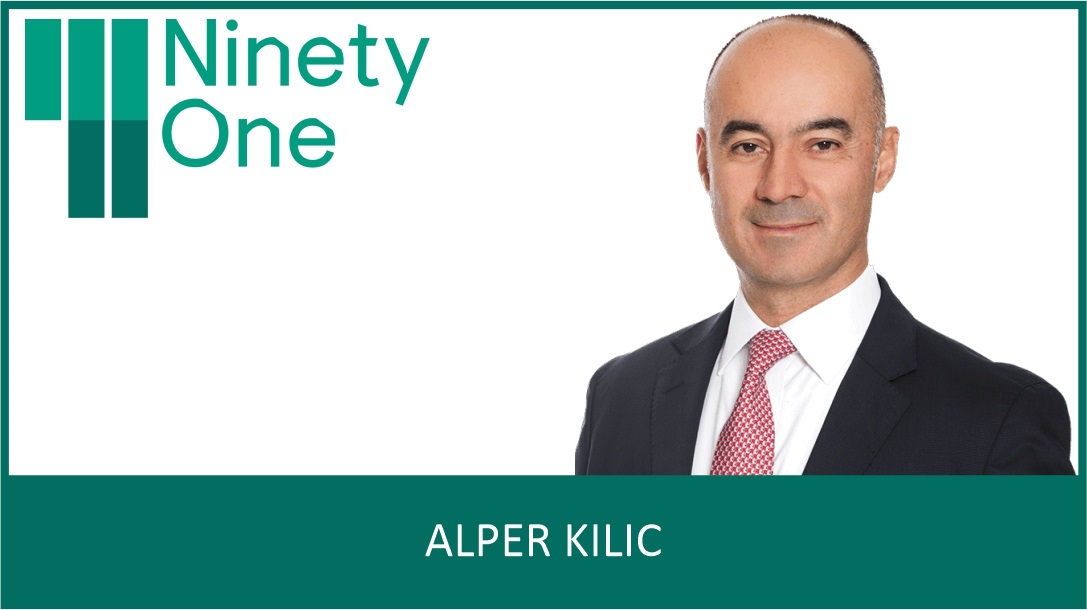























Archie Hart, Co-Portfolio Manager, Emerging Markets Equity; and Varun Laijawalla, Co-Portfolio Manager, Emerging Markets Equity; at Ninety One
The scale of the global artificial intelligence build-out continues to accelerate, redefining expectations for technology investment this decade. When OpenAI revealed its proposed Stargate project earlier this year, the US$500 billion price tag drew widespread scepticism. Yet subsequent supply agreements with AMD, Nvidia and Oracle now point to a far larger capital commitment. These deals imply more than US$1 trillion in AI-related infrastructure spending before 2030 – a trajectory that has sparked debate about how long the cycle can run.
Archie Hart, Co-Portfolio Manager, Emerging Markets Equity at Ninety One: “The most likely outcome is not an abrupt end, but a modest correction that would reprice risk, reset unit economics and pave the way for the next leg of AI valuations. What is already clear is that the coming phase of growth will be defined by hardware: the compute, memory, networking and power systems that make large-scale AI both possible and commercially viable.” Much of this capability is being built by a group of emerging-market companies whose strategic importance has outpaced their valuations. These seven firms – the “Secret Seven” – supply critical technologies across every layer of the AI stack yet trade at meaningful discounts to their developed-market peers. Ninety One argues this represents an opportunity for investors.
Asia’s central role in AI manufacturing
Varun Laijawalla, Co-Portfolio Manager, Emerging Markets Equity: “While the frontier AI models are trained in the United States, the high-end equipment they run on is overwhelmingly manufactured in Asia. Taiwan, South Korea and parts of Southeast Asia form the most concentrated technology production ecosystem in the world. This concentration gives the region an outsized influence over the pace, resilience and security of the world’s most advanced AI capabilities.”
Pushing the hardware frontier: compute and memory
Three companies sit at the heart of the system. TSMC, the world’s largest logic semiconductor manufacturer, effectively sets the ceiling for compute. Its neutral foundry model, rigorous engineering culture and deep integration with Japanese materials suppliers, Dutch lithography tools and American design firms have created a trusted ecosystem that is exceptionally hard to replicate. New facilities, such as the Kumamoto joint venture with Sony and Denso, work because they plug into dense local networks of universities, suppliers and engineering talent. Semiconductor fabrication cannot be lifted and shifted; it rests on institutional foundations that only a handful of companies possess.
Memory now defines the limits of AI throughput. SK Hynix manufactures the high-bandwidth memory that supplies modern GPUs with data, and its leadership is built on years of investment in stacking, thermal management, and yield. OpenAI’s Stargate outline was followed by a strategic supply agreement with SK Hynix and Samsung to secure future HBM output – a signal of how tight supply has become. Memory demand for Stargate alone could exceed twice current industry capacity, and much of next year’s output is already committed under long-term contracts.
Samsung adds scale and breadth, supplying high-bandwidth memory for training large language models, and the memory and storage chips – DRAM and NAND – that hold and move the vast datasets required by AI clusters. The pressure on supply is visible in the market: DRAM prices have more than doubled since early 2025, an unusual move in an industry historically defined by falling unit costs.
Moving data, managing power
Even the most advanced accelerator underperforms if data movement or power stability lags. Accton provides the high-speed switches that connect thousands of GPUs inside hyperscale data centres. Laijawalla said: “As the industry transitions from 400-gigabit networks to 800-gigabit and 1.6-terabit architectures, only a few companies can deliver hardware that remains reliable at the physical limits of switch design.”
Power and cooling have become equally decisive. AI servers draw and dissipate energy at unprecedented levels. Delta Electronics has built expertise in solving this problem. When Nvidia’s power requirements surged from 8 kW to 12 kW in early 2024, Delta re-engineered and scaled new systems in three months, far ahead of rivals. This capability positions the company strongly in the global data-centre UPS market, which is expected to grow from US$4.0 billion in 2024 to US$6.2 billion by 2030.
ASE plays a critical bridging role, sitting within a small group of firms capable of integrating GPUs and high-bandwidth memory into a single functional package. And last but not least, China’s Anji Microelectronics illustrates the depth of Asia’s supply chain. The company produces the slurries and wet chemicals used across advanced-node semiconductor fabrication. As China expands its domestic production, Anji is gaining market share and strengthening regional capabilities in strategically sensitive materials.
The opportunity
Recent dollar weakness also supports the backdrop. After more than a decade of dollar strength and US-dominated equity allocations, flows appear to be broadening – a constructive setting for hardware firms that now sit at the centre of the AI supply chain.
Hart concluded: “Against this backdrop, the Secret Seven offer exposure to the physical limits of the AI cycle at valuations that reflect a conventional emerging-market discount. Many have earnings visibility tied to multi-year customer roadmaps, positions in supply-constrained segments and growing strategic relevance. This imbalance between importance and price is unusual. For investors, it marks an opportunity worth close attention”
ENDS