























Raihan Allie, Fixed Income Portfolio manager at Truffle Asset Management
It starts with “US”
Once a stalwart for financial markets and an enforcer of law and democracy, recent actions by the White House are rapidly creating a low-trust environment globally. Policy decisions are accelerating global polarisation, disrupting established trade channels and sowing seeds of uncertainty and mistrust throughout the international community.
The initial market exuberance following Donald Trump’s return to office is dissipating as his administration isolates the United States and undermines pivotal institutions and global organisations. This approach is creating a growing trust deficit with the rest of the world that may have lasting consequences.
Friend or Foe? No one is spared
The economic uncertainty generated by current US policies affects allies and adversaries alike. While China appears to be the primary target, the administration’s blanket approach is catching even America’s most loyal allies in the crossfire – a strategy that may backfire significantly. It seems some policymakers in Washington have overlooked fundamental economics lessons about the dynamics of multilateral trade in our globalised world.
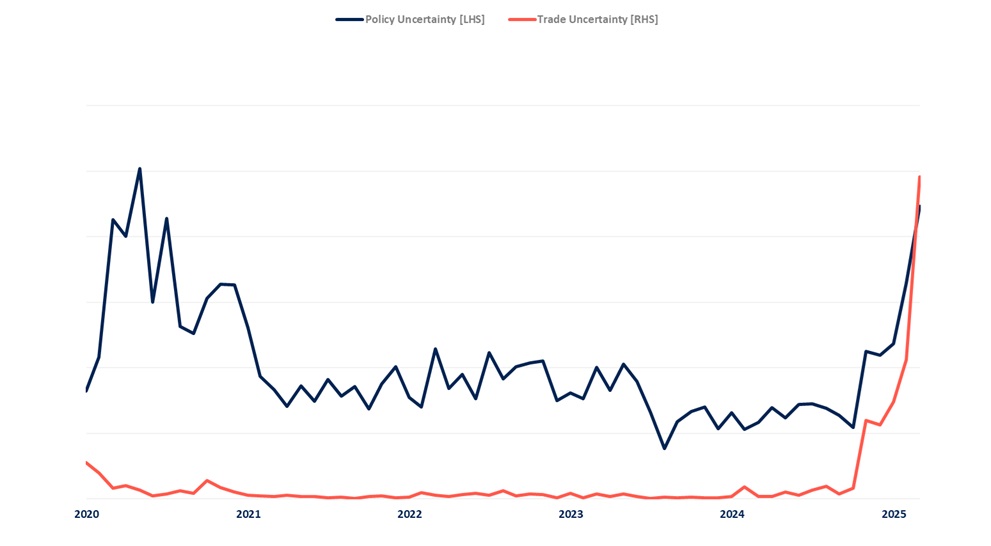
A significant portion of the uncertainty stems from the US stance towards trade, but clarity around all policy areas is becoming increasingly opaque as depicted in the chart below.
Chart 1: US Economic Policy Uncertainty
Source: Baker, Bloom & Davis via Bloomberg
Market response: The Rise and Fall
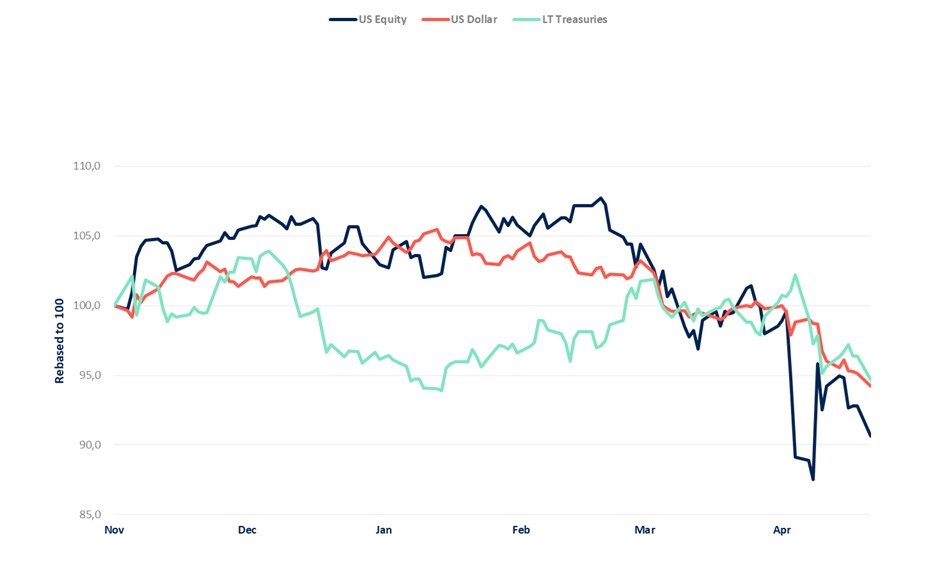
Unsurprisingly, market participants are voting with their capital, retreating from US assets as their country exhibits traits of an unreliable and unpredictable counterparty.
Chart 2: US Asset Performance, since US 2024 elections
Source: Bloomberg
Investor sentiment is waning as traders grow weary of market gyrations. More concerning is the emerging questioning of the dollar and US Treasuries as reliable reserve assets – once an unthinkable proposition.
In recent years, the US has increasingly weaponised financial assets and structures. Russia’s dollar reserves were effectively confiscated when the country was barred from the SWIFT network following its invasion of the Ukraine. More recently suggestions (likely made in jest but nevertheless concerning), have emerged about South Africa potentially facing similar treatment for its diplomatic relationship with Russia and Iran.
Under such circumstances, prudent nations and investors are questioning the sanctity of dollar denominated reserves and pursuing diversification strategies. The Japanese Yen, Swiss Franc, Euro and particularly gold are gaining strength as the world searches for more secure havens. Gold’s recent performance strongly correlates with historical periods when reserve currency status was in question and trust was broken.
“In God we Trust”
This phrase, etched on every US dollar bill, rings increasingly hollow. Historical evidence suggests the US has broken international trust on several significant occasions, making the motto particularly ironic. A notable example was the collapse of the Bretton Woods System in 1971 and the subsequent end of the Gold Standard.
Under the Bretton Woods system back in the 1970’s, the price of a dollar was pegged to gold at $35 per ounce. The promise made by the US government in 1944-45 was straightforward: dollars could be exchanged for gold at a fixed ratio. As scholars like Mayer et al. (1995) have observed, trust develops incrementally through consistent, positive interactions but can be shattered by a single betrayal.
In 1971 President Nixon became the face of such betrayal, when he announced the suspension of dollar-gold convertibility for foreign governments. The market reaction was immediate, with investors indicating “In Gold we Trust”. Over the subsequent years, the dollar was aggressively sold, losing 80% of its value by 1975.
Chart 3: Gold Price in USD

Source: Bloomberg
Stars and Stripes are out of alignment
We now face circumstances remarkably similar to those that ultimately led to the end of Bretton Woods, potentially projecting another rise in gold and decline of the dollar. Parallels to the mid-20th century include:
- US proxy wars on multiple fronts
- Intensifying geopolitical pressures
- Persistent budget deficits and growing debt issuance to fund them
- E Pluribus Unum (“Out of many, one”) – another motto on US currency – is ironically undermined by the rapid pace of money creation, which devalues existing dollars.
- Declining global confidence and sentiment
- Growing relative attractiveness of non-USD assets
What’s becoming increasingly evident, is that nations are diversifying their reserves and assets as the probability rises that the US will continue to weaponise financial assets to achieve geopolitical objectives.
Currently, gold has reached unprecedented heights of $3500, while central banks worldwide continue to diversify away from USD and Treasuries, increasingly stockpiling gold instead.
It ends with “US”
Fortunately, this trust deficit emerges at a time when the US is no longer the only viable financial centre. We’ve recently examined Japan’s growing appeal, [Retiring Japan’s widowmaker] but Europe is now taking centre stage, following its commitment to substantial fiscal stimulus and the easing of financial conditions through its rate cutting cycle.
Is this the end of the dollar as the global reserve currency? Reserve currency status doesn’t vanish overnight – it’s deeply entrenched in the global financial architecture. However, this does not mean the system is unbreakable, and cracks are beginning to show. There is currently no asset class with comparable size or liquidity that can completely replace US Treasuries, providing America with a temporary lifeline.
While this may not mark the imminent end of dollar supremacy, prudent investors and nations may be wise to diversify their holdings as pressure on US assets continues to build.
ENDS