




































































Mark MacSymon CFP® Wealth Manager at Private Client Holdings
Market volatility is the price of admission to the investment system. Yet for most investors, periods of uncertainty feel deeply uncomfortable, emotionally charged, unsettling, and at times overwhelming. In an environment where geopolitical decisions ripple through markets in real time, wealth managers play a critical role not only as portfolio architects but as steady guides through uncertainty.
Volatility feels worse than ever
Volatility itself is nothing new. Markets have always moved in cycles, and periods of drawdown are an inherent feature of long-term wealth creation. What has changed, however, is both the structure of markets and the frequency with which investors experience volatility.
Today’s investors are more exposed than ever before. Portfolios are checked daily, often multiple times a day, while a constant stream of commentary amplifies short-term movements. At the same time, market structure has evolved. A growing proportion of trading activity is driven by non-fundamental participants, contributing to sharper price moves and heightened short-term noise.
This shift is reinforced by a broader collapse in time horizons. As Gloria Mark highlights in Attention Span, adult attention spans have declined by nearly two-thirds over time, which highlights a subtle but profound change in how we process information and make decisions.
In parallel, the average holding period for equities has fallen sharply over the past several decades, from approximately seven years in the 1960s to less than one year after the 2000s. This reflects both a shift toward short-term thinking and the rise of high-frequency, machine-driven trading.
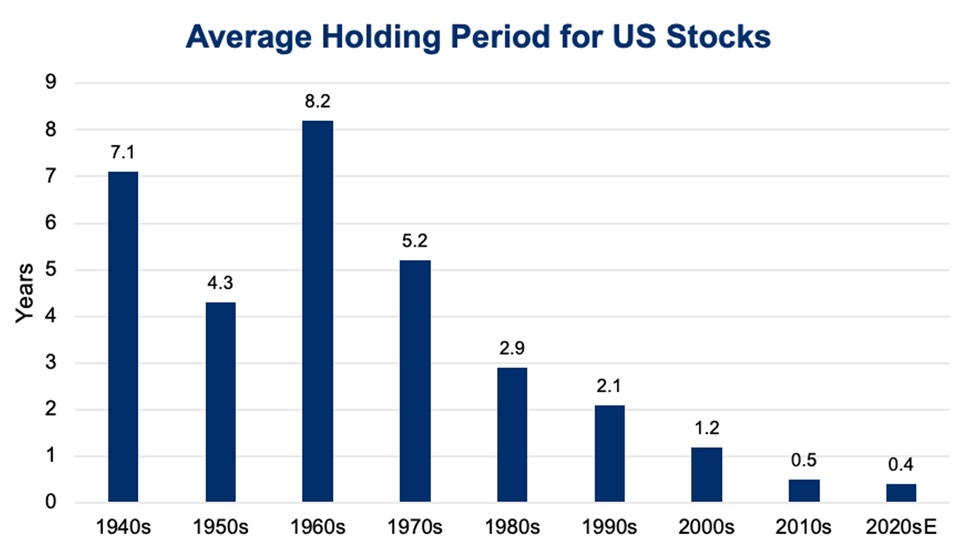
Source: Coronation Fund Managers, NYSE, LPL Financial
When combined with the immediacy of modern information flows, this creates what behavioural scientists describe as “thin slicing” – the tendency to evaluate long-term investments through a short-term lens. The more frequently investors observe their portfolios, the more volatility they perceive and the more intensely they feel it.
The psychology of panic
At the heart of this dynamic lies a powerful behavioural force: loss aversion. Losses hurt more than gains feel good, and during periods of market stress, this instinct can drive investors to abandon well-constructed strategies at precisely the wrong time. Selling into weakness, reducing risk after declines, or retreating to cash may provide short-term emotional relief, but often comes at a significant long-term cost.
History provides a clear lesson. While markets have delivered positive outcomes over the majority of long-term periods, the experience of those returns is uneven. When measured annually, gains dominate. But when viewed monthly, or worse, daily, the proportion of negative outcomes rises sharply. In other words, the more frequently one looks, the more risk one perceives. This behavioural distortion helps explain why investors often struggle to capture the very returns they seek.
Crucially, periods of crisis are not anomalies. They are embedded within long-term upward trends. Investors who remained invested through events such as the Global Financial Crisis or the COVID-19 pandemic participated in the powerful recoveries that followed. Those who exited the market during periods of stress often faced the near-impossible task of re-entering at the right time, frequently missing the strongest phases of recovery.
The real value of a wealth manager
This is where the role of a wealth manager becomes most valuable. In stable markets, portfolio construction and asset allocation dominate the conversation. In volatile markets, however, the emphasis shifts. Behavioural coaching, communication, and perspective become paramount.
Research consistently shows that one of the most valuable services an advisor provides is helping clients remain invested through uncertainty. Experienced wealth managers understand that their role is not to predict short-term market movements, but to prepare clients for them. This preparation begins well before volatility emerges through setting realistic expectations, as well a pre-committing to a decision framework for what responses will be taken when (not if) markets fall.
Discipline is the strategy
Perhaps most importantly, wealth managers help clients reframe their understanding of risk.
This is one of the most effective ways to counter loss aversion – by changing what investors focus on. Short-term market movements are compelling, but they are rarely meaningful. By shifting attention toward long-term goals, real-world outcomes, and personal progress, investing becomes a goal-seeking exercise rather than a performance scoreboard. This reframing fosters resilience and reinforces discipline.
There is also an opportunity, albeit an uncomfortable one, to think differently during periods of stress. While contrarian behaviour is not natural, markets often present their most compelling opportunities when sentiment is at its weakest. Investors who are prepared, both structurally and psychologically, are better positioned to act when others hesitate.
In uncertain markets, calm is not passive. Calm is a deliberate discipline. The true test of an investment strategy is not how it performs in stable conditions, but whether it can be adhered to when conditions deteriorate. A wealth manager who combines behavioural insight, proactive communication, and long-term clarity does more than manage assets. They manage outcomes.
In a world defined by noise, that discipline is often the difference between compounding wealth and compounding regret.
ENDS