































































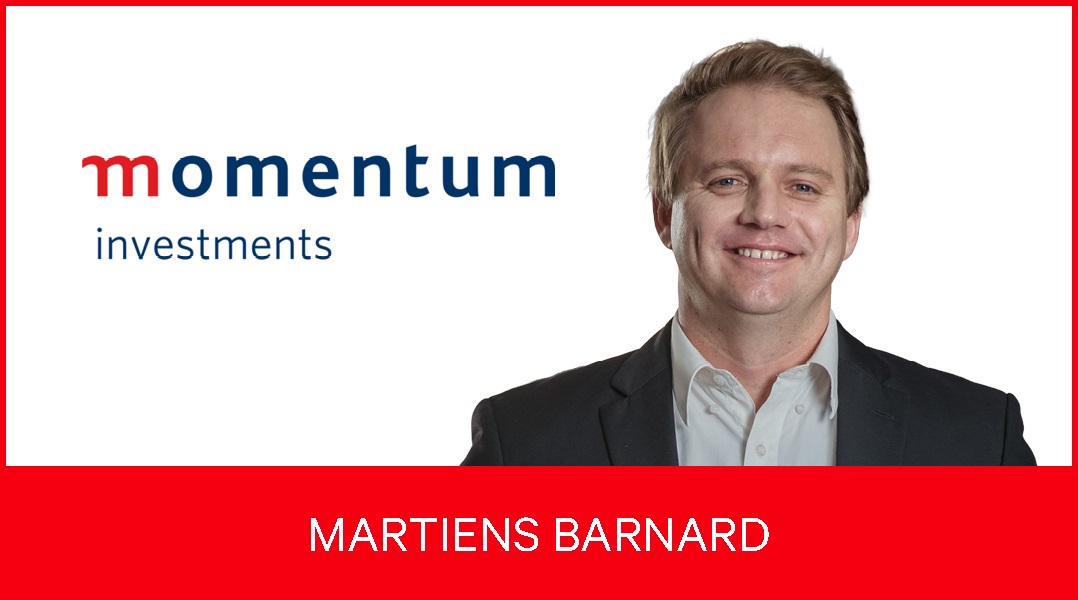
Martiens Barnard, Marketing Actuary at Momentum Investments
Ask most people what they want from retirement, and you’ll usually hear two things: an income they can count on, and something meaningful to leave behind for the people they love. For decades, retirement planning has treated these two goals as opposing goals, as if choosing one automatically means giving up the other.
That idea is beginning to shift. Not because the tension isn’t real, but because the reality is often more nuanced than it may initially seem.
The old trade-off
The usual view is that a life annuity provides guaranteed income for as long as you live, helping protect against the risk of outliving your money. However, depending on the structure, there may be less or no capital available for beneficiaries after your passing.
A living annuity, by comparison, keeps your capital invested in the market, gives you flexibility, and allows for an inheritance. At the same time, income sustainability can be affected by market performance and withdrawal levels.
Given these two options, for many retirees, the choice has traditionally been seen as a balance between income security and leaving a legacy. Momentum’s research into hybrid annuities – living annuities that include a portion guaranteeing income for life – suggests there may be an opportunity to approach this balance differently.
Five risks that don’t live in isolation
To understand why, it helps to look at retirement through the lens of five risks that every retiree faces: drawing down too much income, market underperformance, inflation, longevity, and poor behavioural decisions.
These risks don’t operate independently, they compound each other. A high drawdown rate raises the return you need just to sustain your income, let alone leave anything behind. Market underperformance and sequence risk can erode capital in the long term or at the start of your retirement. Inflation quietly chips away at purchasing power year after year. Behavioural mistakes such as panic selling, chasing returns, or deviating from a plan, destroy value at critical points. Longevity risk extends the timeframe over which all of these pressures need to be managed.
The result is that the sustainability of your income and how much you’re able to leave behind isn’t determined only by which product you choose. It’s determined by how well these five risks are managed together, over the full course of retirement.
The surprising result
Here’s where it gets interesting. When we began modelling hybrid annuity structures, the assumption was that allocating part of your capital to a guaranteed income component would permanently shrink what’s left for your beneficiaries, since that portion is no longer market-linked and available on death. And in the short term, that’s exactly what happens – there’s an initial gap in inheritance value compared to a pure living annuity.
But in some or many instances, that gap doesn’t last. Over time, something different happens.
Because the guaranteed portion of a hybrid annuity is already providing reliable income, less pressure falls on the market-linked portion to fund withdrawals. That reduced pressure allows the remaining invested capital to be preserved – and, in many cases, to grow – more effectively than it would in a pure living annuity.
In the scenarios modelled in our whitepaper, ‘Reimagining retirement, a whitepaper on retirement risks and the rule of thumb’, the market-linked value inside the hybrid annuity doesn’t just recover from its initial shortfall. Later in retirement, it actually overtakes the inheritance value of an equivalent living annuity.
That crossover point tends to arrive later in retirement, but its implications are significant: under realistic return assumptions, the hybrid structure delivered both a more sustainable income stream and a higher long-term inheritance value than the living annuity alone.
Why this happens
The reason for this is that guaranteed income stabilises the whole drawdown strategy. By partially shielding the portfolio from market risk and sequence-of-returns risk – the danger of poor returns landing early in retirement, when they do the most damage – the hybrid structure creates the conditions for capital to actually be preserved, something that’s often undermined in a pure living annuity when markets disappoint or withdrawals run too high.
This doesn’t mean the trade-off disappears. It means it evolves. What looks like a disadvantage at the start of retirement – a smaller initial inheritance value – can become a genuine long-term advantage.
Rethinking the retirement conversation
This opens up a different way of thinking about retirement income. Rather than viewing income security and leaving a legacy as competing priorities, retirees can consider how their retirement income strategy might be structured to support both goals over time.
The two goals reinforce each other more than most people realise. Building a more sustainable income strategy doesn’t just protect your day-to-day living, it also, indirectly, protects the capital you hope to leave behind. Balance isn’t about picking a side. It’s about structuring your income to manage risk, lowering the return you need to sustain it, and build a more resilient path through retirement.
Moving past the binary
This thinking challenges the long-held assumption that retirement success means maximising either income or inheritance – never both.
The real focus should be on sustainability. A retirement income strategy built to hold up over time is one that’s far more likely to support both what you need today and what you hope to leave behind tomorrow.
That means moving away from binary thinking, and toward an integrated approach, one that balances certainty, flexibility and legacy, rather than sacrificing one for the other.
In a retirement landscape where uncertainty is the only real constant, it’s possible to build a different kind of strategy: one that gives you a reliable income today, while still preserving something meaningful for the people who come after you.
Download the full Reimagining retirement whitepaper here.
ENDS