




































































Debra Slabber, Director: Portfolio Specialist at Morningstar South Africa
2025 started off on an interesting, somewhat different note than most investors anticipated. There are signs of a stock market correction, growth stocks are getting beaten up, bonds are resuming their role, recession worries resurfacing, and international stocks are outperforming.
Things have been really good for a long time (especially when it comes to US large cap growth stocks), and when a trend persists long enough, investors tend to extrapolate that far into the future. And when everyone believes the same thing, markets often become overbought as the collective thinking feeds into prices. Today a narrative shift appears to be underway and some of the frothy parts of the market have begun to move in an opposite direction. Developed market equities ex US, as well as emerging market equities are outperforming on a year-to-date basis as shown below.
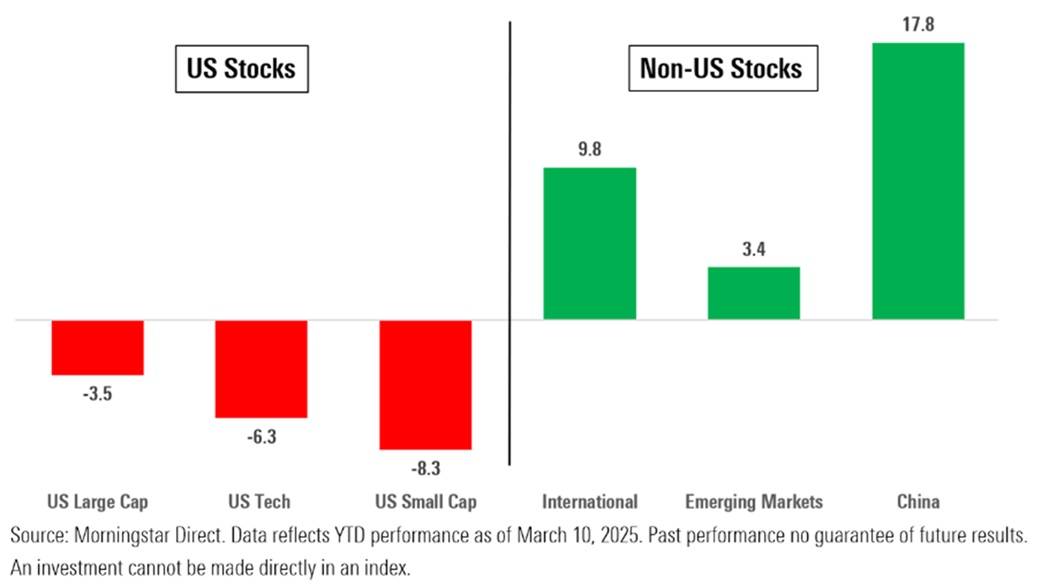
It is, however, extremely important to caveat that these numbers are very short-term – disciplined investing is about decades, not months. But it does raise an interesting question. Will the trend persist? We don’t know. But what we do know is:
- Corrections are normal
- Volatility and sell-offs create opportunities
- Starting expectations and starting valuations matter
- Diversification is underrated
Corrections are normal
Market declines are inevitable, even if their timing and causes are unpredictable. While the current turmoil might feel unsettling, it is important to remember that market corrections are a normal part of the financial landscape. This recent pullback is largely driven by declining valuation multiples, not just external factors like the tariff tantrum.
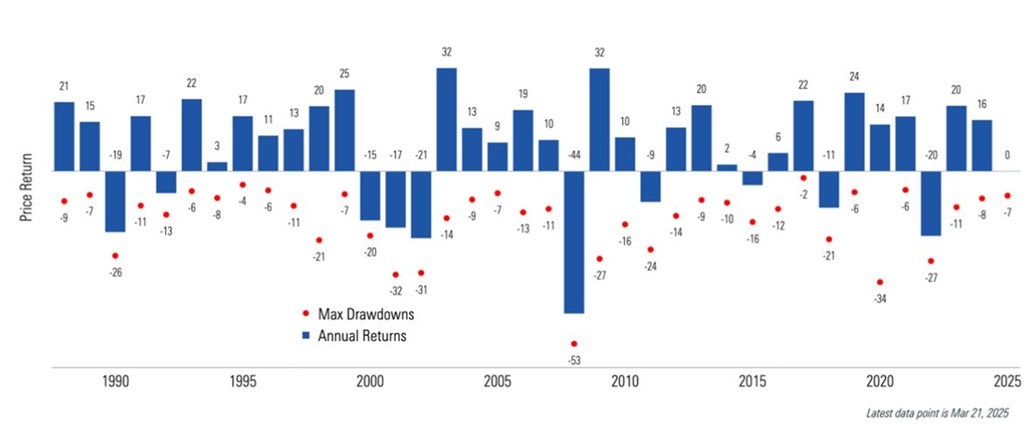
The following graph shows global equity and global bond returns on a calendar year basis and the maximum drawdown in each of those years. What is evident is that drawdowns are a completely normal part of investing. Staying invested for long periods of time does not shield you from drawdowns and sell-offs. In fact, the longer your time horizon, the more drawdowns and sell-offs you are going to have to endure.
Volatility and sell-offs create opportunities
When noise levels are amplified, volatility is present and uncertainty levels are high, mispricings often occur. And these market dislocations give active managers like ourselves opportunities to deploy capital to areas where there are discrepancies between price and value.
As the market continues to sell off today, our playbook at Morningstar remains unchanged: buying assets that trade at a discount to our estimate of intrinsic value. Simple, but not easy as Warren Buffet will say.
Some recent examples of how we deployed capital for our clients is to introduce a position in Latin America, increase US Small Cap exposure and increasing broad European equity exposure.
Starting expectations and starting valuations matter
Starting expectations are arguably one of the biggest factors that determine investment outcomes. When expectations are high, outperforming becomes more difficult, and the opposite is also true. And we have seen this play out in history multiple times.
Valuations are a good proxy for long-term expected returns and we pay careful attention to this when building portfolios. At the same time, we must recognise that, over the short term, valuations have little predictive value as to returns. In fact, at the one-year horizon, they have virtually no predictive value, which means that even historically high valuations can go even higher. This brings me to my next point – why diversification matters.
Diversification is underrated
One of the most effective ways to stay invested is through diversification—and right now, it’s working. A diversified portfolio is not experiencing the same turbulence portrayed in the headlines. Even though we are experiencing a sell-off in parts of the markets, other areas are performing much better – like bonds, emerging market equities led by China and non-US equities.
The path to investing success will always come with periods of stomach-churning volatility, and diversification aims to make those periods more manageable. This correction will pass—like others before it—and another one will eventually take its place. The key is to have a plan that keeps you invested at a risk level and time horizon aligned with your goals.
The upside of down
Investor Bill Miller famously said, “When I am asked what I worry about in the market, the answer usually is ‘nothing,’ because everyone else in the market seems to spend an inordinate amount of time worrying, and so all of the relevant worries seem to be covered.”
So instead of being paralysed by the headlines do the following:
1. Check to see if your overall asset allocation makes sense. The mix of stocks, bonds, and cash in your portfolio should be driven by your investment time horizon and risk tolerance, not what might happen with factors outside of your control.
2. Don’t get too carried away with “safe haven” assets. The price of gold has soared, partly because of aggressive purchasing by central banks. Although gold has historically fared well as a safe haven during times of market turmoil, it’s not a “low-risk” asset. In fact, its volatility is about on par with the equity market overall.
3. Have an investment partner like Morningstar that can identify mispricings on your behalf. For investors with a long-term perspective, short-term market volatility is a distraction that’s better off ignored. While the market could be in for a bumpy ride, it’s best to stay the course and avoid making any major portfolio changes based on the latest headlines.
ENDS