

































































Victor Bucarizza, Executive Partner & Wealth Manager at GIB Group
Recent retirement fund data has come out depicting a clear trend in the world of the ‘two-pot’ retirement system – that is that people are repeatedly withdrawing their savings pot as soon as it becomes available (March each year). In fact, some surveys have suggested that as much as 80% of members who emptied their savings component this year intend to do so again next year when the funds become available.
These data have been cited as proof that the two-pot system is putting South Africans’ retirement under pressure. This criticism is understandable but seems to miss the forest for the trees. In practical and behavioural terms, this is exactly what the two-pot system was designed to do – ensure a large degree of preservation (the retirement component) while allowing access to a smaller pot (savings component). This improves drastically on the previous system which allowed a full withdrawal of pension and provident fund money upon exit from employment; leaving individuals who withdrew to start from zero every time they began new employment.
It seems clear that South Africans are in need of money and any opportunity to access lump-sums is understandably taken up (a function of our economic disparity, lower financial education levels, cost of living and looking after dependents). Previously, this did not happen annually, but rather when people would exit employment, we even saw devastating times during COVID when individuals would resign just to gain access to their retirement fund. This same behaviour is showing up under the ‘two-pot’ system but this time with well thought-out guardrails.
The graph below shows the outcome of retirement savings for the same investor under the two different regimes, assuming a R1 000 monthly contribution at a 10% growth rate.
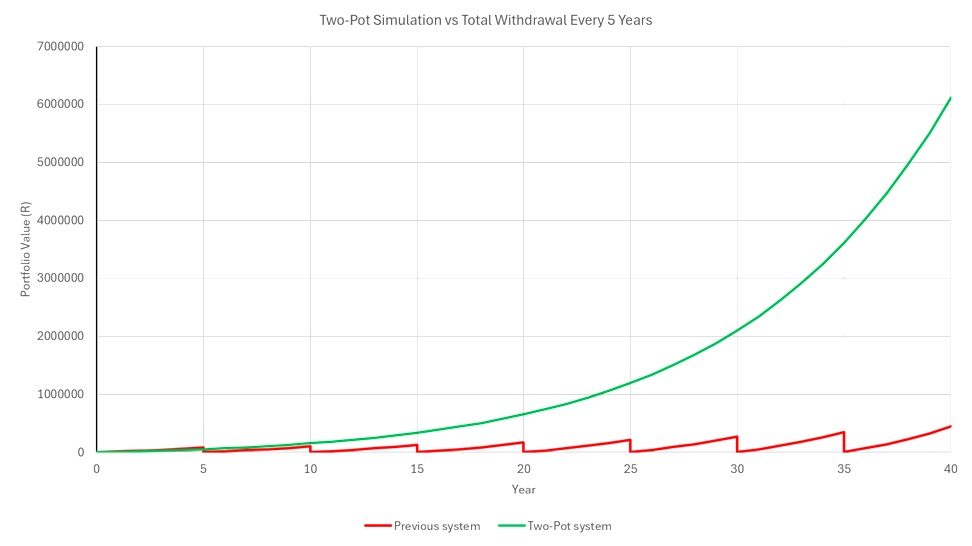
Chart Assumptions:
- Contribution: R1 000 monthly
- Growth rate: 10%
- Previous system: full amount withdrawn every 5 years
- Two-Pot system: savings component withdrawn every year; therefore, only the retirement component compounds
The key takeaway here is that the two-pot system would leave the individual who takes the opportunity to withdraw when they can over 13 times better off than their same behaviour under the previous system.
The new system allows for minor leaks but protects against catastrophic bursts – it is negligence-proof. Even someone intentionally trying to destroy their retirement savings in the two-pot system, would be left with a decent retirement.
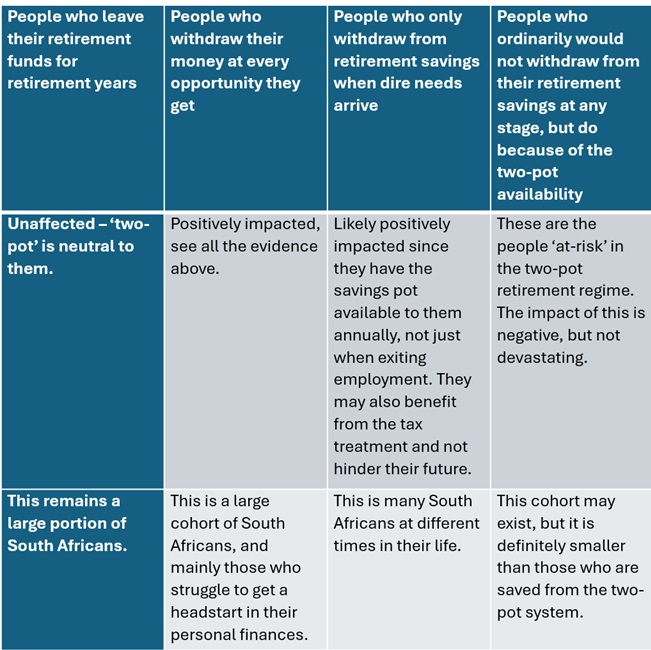
The matrix of two-pot withdrawals
The tax on withdrawal is much better than previously
Under the previous system, when one made a withdrawal from their retirement savings, they were taxed according to the ‘withdrawal tax table’ which is generally a gentler tax rate than the income tax table (which is the tax table applied to two-pot withdrawals). However, this has three important impacts:
1. Since one receives a tax-deduction on contributions into their retirement fund, this tax simply reverses that tax-deduction, in most cases, leaving the individual as tax neutral (assuming they withdraw in the same year, or are in the same tax bracket). The effect is as if they never actually invested in their retirement fund, they simply took the money.
2. The withdrawal tax table is a cumulative table, which means that previous withdrawals taken are added to your current withdrawal and taxed. This means that one has to pay the price for their younger (less wise) self withdrawing money, and they continue to pay that price to a larger extent every time they would return to draw again. This would also carry forward to their actual retirement, where their retirement lump-sum that is tax-free may be diminished or fully depleted because of poor past decisions.
3. Lastly, under the scenarios where people lose their job and income, the savings pot withdrawal that they make to keep themselves financially afloat is applied to the income tax table, whereby they may have no other income that year, therefore the savings pot withdrawal tax is more forgiving and in fact they may be able to withdraw the full amount tax-free regardless of prior withdrawals and despite a potentially sizeable amount being taken.
There is greater incentive to contribute more
Previously, the lack of accessibility to retirement funds (mostly retirement annuities) created slight hesitancy around how much one would be willing to contribute, especially in younger years; the ideal time to be investing. Under the two-pot regime, one could look to increase their contribution by as much as half and still be “locked-in” by the same amount as the previous system e.g. someone who previously invested R1000 monthly, can contribute R1500 now and have access to that additional R500 contribution since it is going into their “savings pot”, and the original R1000 is going into their “retirement pot”.
This means that some investors may even end up improving their retirement outcomes by contributing greater amounts; even if they end up withdrawing some of those higher contributions down the road, they are in a better position for leaving any “extra contributions” invested.
A major criticism for retirement funds in the past was the lock-in effect. Younger people in particular could not fathom multiple decades without access to their savings. These younger investors stand to benefit the most from investing good amounts early on. The two-pot system curbs this concern to a certain extent.
The trouble with the introduction of the two-pot system
The transition to the two-pot system, of which we are still in the early stages, creates some discomfort, since investors are left juggling multiple systems. However, as time progresses, the system will cleanse itself of the old regime – as people retire or withdraw their vested component (the old system money) – and the two-pot system will remain with greater clarity and simplicity.
The world of finance is already complex, and two regimes twisting through each other at the same time adds to that complexity, and in turn the discomfort that individuals feel. The benefit is that every new contribution that enters the retirement eco-system now is fully in the two-pot regime, and investors should be encouraged to invest more than before, given the improvements on this system.
More than money is preserved
The growth of one’s individual (retirement) wealth has positive personal knock-on effects that stem from the personal sense of progression beyond simply career, but personal financial journey. An individual entering a new job at the age of 40 can feel a sense of shame if they do this without any strong financial net (wealth) behind them. The same person entering a new chapter in their career, can also look back at the real current financial impact of their career gone-by, in the form of a healthy retirement pot.
The lack of access here also becomes a feature, whereby these individuals cannot drain their reserves to pay for predatory loans, over-spend on a lifestyle level-up, or support every family member asking for money to the detriment of their own financial position.
ENDS