





































































Adriaan Pask, CIO at PSG Wealth
Money management has never been more generationally divided than it is today, with access to markets, information, and investment products expanding at an unprecedented pace. While previous generations typically relied on a narrower set of asset classes that included listed equities, bonds, and property, younger investors today are entering a financial ecosystem defined by choice, speed and complexity.
Greater access and choice
Investment markets are more accessible than ever before, and younger clients now have exposure to instruments and strategies that were previously unavailable, or that were only accessible to institutions and high-net-worth investors.
The range of investment options has also expanded meaningfully. Alongside traditional asset classes, investors now have access to cryptocurrencies, initial public offering (IPO) participation platforms, various types of exchange-traded funds (ETFs) and, increasingly, private market investments. These developments have broadened the investable universe, and with it, the range of potential client outcomes.
Variety adds complexity
The expansion in investment options introduces a material increase in complexity and risk. Greater choice does not automatically translate into better outcomes. In many cases, it increases the likelihood of highly fragmented portfolios, unintended concentration risk, exposure to assets whose valuation dynamics and liquidity profiles are not fully understood and, as a consequence, client outcomes that may differ meaningfully from expectations. By way of example, cryptocurrencies are innovative investments, but they remain highly volatile and structurally different from traditional asset classes. Similarly, IPO participation and thematic investing can encourage narrative-driven allocation decisions that may not be grounded in long-term fundamentals.
Research by JP Morgan found that the range of outcomes among non-core real estate, private market assets and hedge funds is materially wider than those of more traditional large-cap equities and bonds. This while also showing that traditional large-cap equities typically outperform the newer generation of asset classes. From that perspective, the research suggests that more optionality has inadvertently reduced risk-adjusted returns for investors significantly. This emphasises the view that one must prioritise the long-term reliability of an asset’s ability to achieve the required client objectives over the short-term novelty that is often presented by newer offerings.
Public and private manager dispersion
Based on returns from 4Q15 – 4Q25*
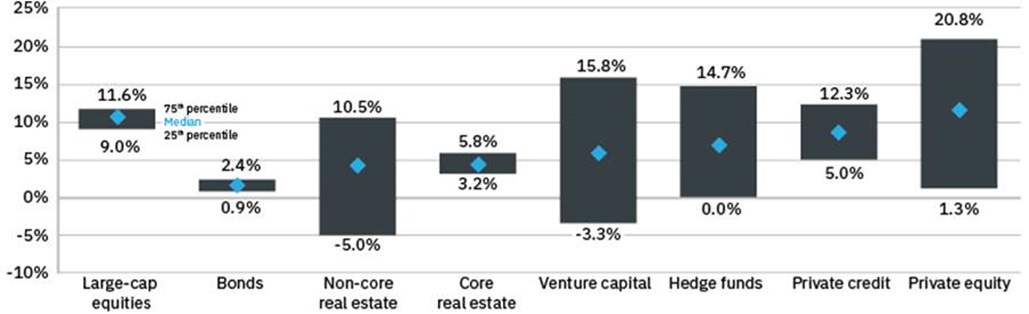
*Manager dispersion is based on annual returns over the ten-year period ending 3Q25 for core real estate. Manager dispersion is based on the ten-year internal rate of return (IRR) ending 3Q25 for: private Credit, Non-core Real Estate, Private Equity and Venture Capital. Source: JP Morgan
Intergenerational differences in decision-making
The way investment decisions are formed has also evolved. For many younger investors, portfolios are increasingly influenced by digital platforms, social sentiment and real-time information flows, rather than traditional adviser-led frameworks or long-term research cycles. While new technology improves engagement and responsiveness, it can also shorten investment horizons and increase behavioural volatility.
Older generations, by contrast, tend to rely more heavily on structured and proven processes shaped by them having experienced multiple market cycles. This often translates into a stronger emphasis on capital preservation, income generation and disciplined asset allocation. While this approach can sometimes be slower to incorporate high-frequency innovation, it generally supports more consistent long-term risk management. Options must therefore be weighed against the risks of overexposure to complexity, reduced transparency and behavioural decision-making biases.
New investment ideas should not be adopted in isolation
While new investment options hold opportunity, they should be evaluated through the lens of a broader financial planning framework focused on achieving specific outcomes.
At the same time, it is important not to dismiss innovation as speculative by default. When appropriately understood and positioned, newer asset classes and technologies can enhance diversification and improve long-term portfolio efficiency. The objective is not to limit access, but to ensure that access is matched with appropriate guidance and risk awareness.
Investors and advisers can build portfolios that are not only more adaptive to change, but also more resilient across cycles. In an increasingly complex financial landscape, that balance will be central to building sustainable, intergenerational wealth.
ENDS