




















































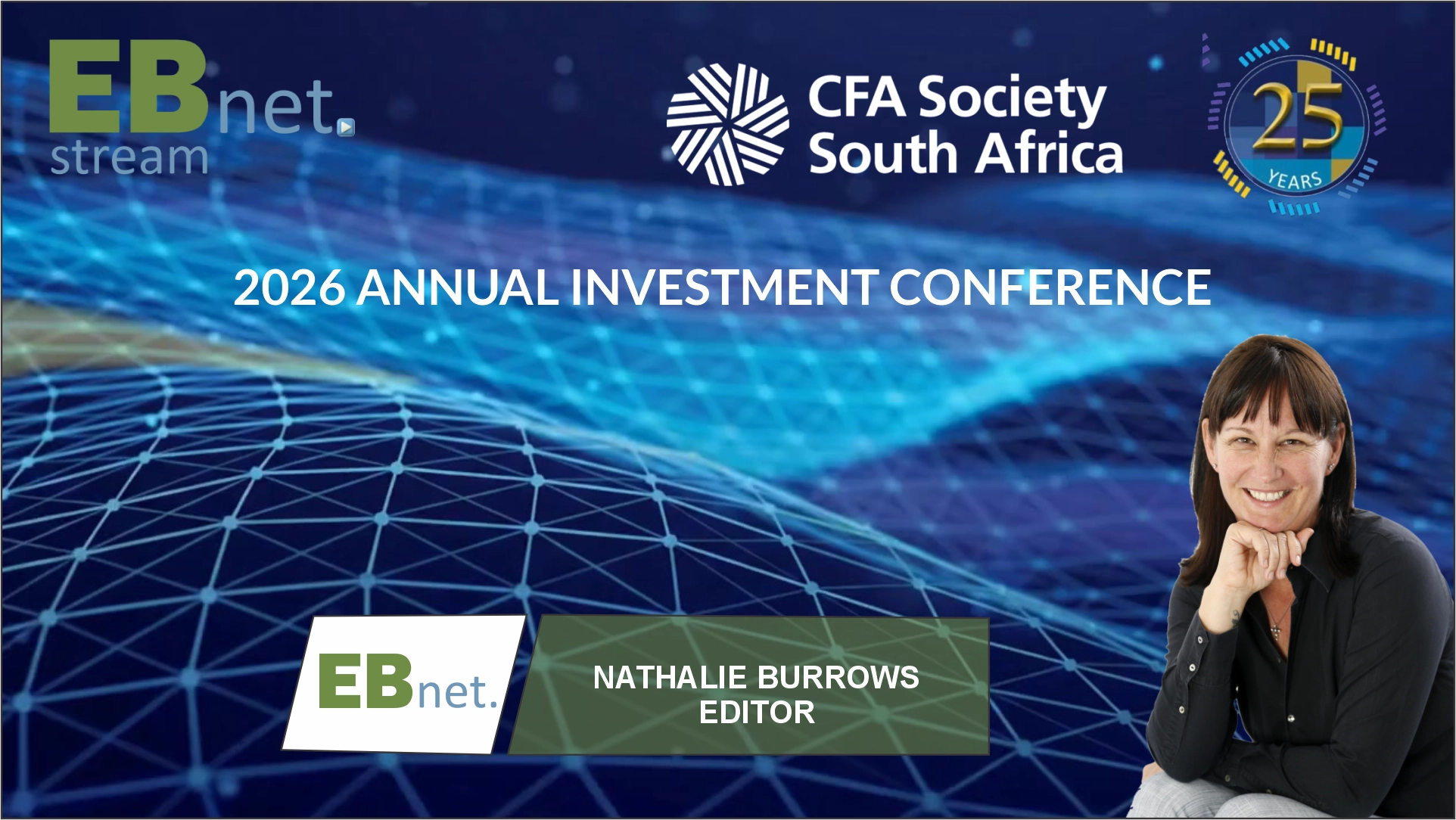
Nathalie Burrows, Editor at EBnet
At yesterday’s CFA Society South Africa’s annual investment conference in Johannesburg, the message was clear: investors, trustees and advisors can’t afford to stand still. Against a backdrop of geopolitical fracture, market concentration and rapid technological change, the theme of the conference “Multilateralism to multipolarity” set the stage for intentional dialogue on what’s next for Africa. And one of the key takeaways from the day was a sincere intention for more purposeful collaboration across Africa.
The event also marked CFA Society South Africa’s 25th anniversary. This milestone offered a useful lens on how far the profession has come, and how much more it needs to do to build trust, deepen skills and widen participation in investment management.
A profession built on trust
Loyiso Kula, CEO of CFA Society South Africa, shared how the society has grown from a small group of founders in 2001 to 2 900 CFA charterholders in South Africa today, of whom roughly 2 200 are members of the local society. The society now ranks among the top 20 in the EMEA region and has expanded its footprint across Southern Africa, with chapters in Zimbabwe, Zambia, Botswana, Malawi and Namibia.
But the anniversary was not merely about celebrating scale. Kula returned repeatedly to the question of trust: the professional, ethical and technical foundations required when people’s savings, retirement outcomes and financial futures are at stake.
In a market increasingly crowded by digital tools, social media commentary and so-called “finfluencers”, professional standards matter more, not less. For ordinary investors, the value of the CFA designation lies in knowing that the person responsible for their money has both the technical toolkit and an ethical obligation to act responsibly.
This point carries weight for retirement funds. Trustees and members are not simply making abstract, hypothetical asset allocation choices; they are making decisions that will affect the adequacy and security of retirement savings over decades.
Africa needs its own investment conversation
The conference theme reflected a world marked by political, economic and climate uncertainty, as well as the growing polarisation of societies and policymaking. Geopolitical developments have become impossible for the investment community to ignore, shaping both market outcomes and the real economy.
Yet the response should not be to see Africa only through the lens of global risk. The conference highlighted the need for a distinctly African investment conversation — one that recognises the continent’s scale, diversity and potential, while identifying opportunities for practical collaboration.
One of my personal highlights was hearing from Mbakisi Gopolong, Chief Investment Officer at the Debswana Pension Fund in Botswana, and Immanuel Kadhila, Chief Investment Officer at the Government Institutions Pension Fund in Namibia. If you thought market concentration in SA was a limiting factor for investors, in Namibia they have 12 locally listed companies, in Botswana it’s 25. That drives home the point of how important South Africa is for the Southern African trading region.
The investment case for Africa right now feels like a watershed moment for the continent. What are we going to do with the resources we have? Are we going to use our rare earth minerals to grow wealth in Africa, or send that wealth elsewhere? How will be exponentialise the demographic dividend that will emerge in the next 10 years?
At the same time, how will we mitigate the risks we face?
This calls for deliberate unity. Much was mentioned of the current silo’d reality, where each country’s industries and regulators working in isolation.
It was great to hear that the CFA Society South Africa is working with CFA societies in Nigeria, Ghana, Egypt, Mauritius and East Africa. A future collaborative project is expected to examine the risk premium attached to African markets, a subject with implications for the cost of capital and the ability of African businesses and projects to attract investment.
Private markets: Education before allocation
Private markets and pension funds were among the most practical discussions of the day. Raazia Ganie, vice-president of CFA Society South Africa, said the central barriers to greater pension fund participation are not necessarily a lack of opportunity, but a lack of confidence and understanding.
An audience poll during the private markets session identified trustee education and liquidity as the dominant concerns. These are not trivial issues. Private market investments require boards and advisors to interrogate valuation methods, fee structures, due diligence processes, governance arrangements and the trade-off between long term return potential and access to capital.
Ganie’s point was that education must extend across the full decision making chain. Trustees are ultimately accountable, but consultants, advisors and other gatekeepers also need enough knowledge to assess opportunities properly. Avoiding an asset class because it is poorly understood may be prudent in the short term, but it should not become a permanent substitute for building capability.
The discussion also challenged the assumption that private markets must always mean an inflexible 10- to 15-year commitment. Newer structures, blended finance approaches and liquidity mechanisms can give retirement funds more options than many trustees may realise. That does not eliminate risk, but it does make a more nuanced discussion possible.
The practical takeaway for boards was refreshingly direct: keep an open mind, ask the necessary questions and start carefully. A measured initial allocation or smaller investment can be a constructive way to develop institutional knowledge without treating members’ money as a gamble.
“Passive” is not passive
Nerina Visser of ETFSA, and Presidents Council Representative, Middle East & Africa, took aim at one of the investment industry’s most persistent labels: passive investing. Her argument was simple: there is no such thing as a wholly passive investment process.
Every index based strategy contains decisions: the investment universe, the selection criteria, the weighting methodology and the rebalancing or review frequency. Investors, too, make active choices when selecting an index, a market, a fund, a jurisdiction or a particular investment objective.
This matters because index investing is sometimes portrayed as a backward looking or mechanical alternative to active management. Visser argued that properly understood, index-based investing is a dynamic, rules-based system. The index evolves as markets evolve, regularly replacing yesterday’s leaders with companies that meet its criteria today.
For pension funds and retail investors alike, the broader message was to distinguish between investment behaviour and investment construction. An investor can be patient and disciplined – “passive” in behaviour – while the underlying index remains active, responsive and systematically maintained.
I still can’t help thinking that AI driven investment decision making is the new passive. But that’s a conversation for another day.
For trustees, decision makers and industry professionals, my key takeaway from this year’s CFA conference is the need to invest in education. And that doesn’t have to mean a formal course or workshop. Interact and collaborate. Don’t be afraid to ask questions and then don’t be too arrogant to really listen to the answers.
And for the profession, CFA Society South Africa’s 25 year milestone is a reminder that investment management has a responsibility far beyond returns: to build capability, uphold standards and ensure that African capital increasingly works for African opportunity.
You can catch the vibes, the interviews and hear from those who attended this year’s CFA Conference here.
ENDS