
















































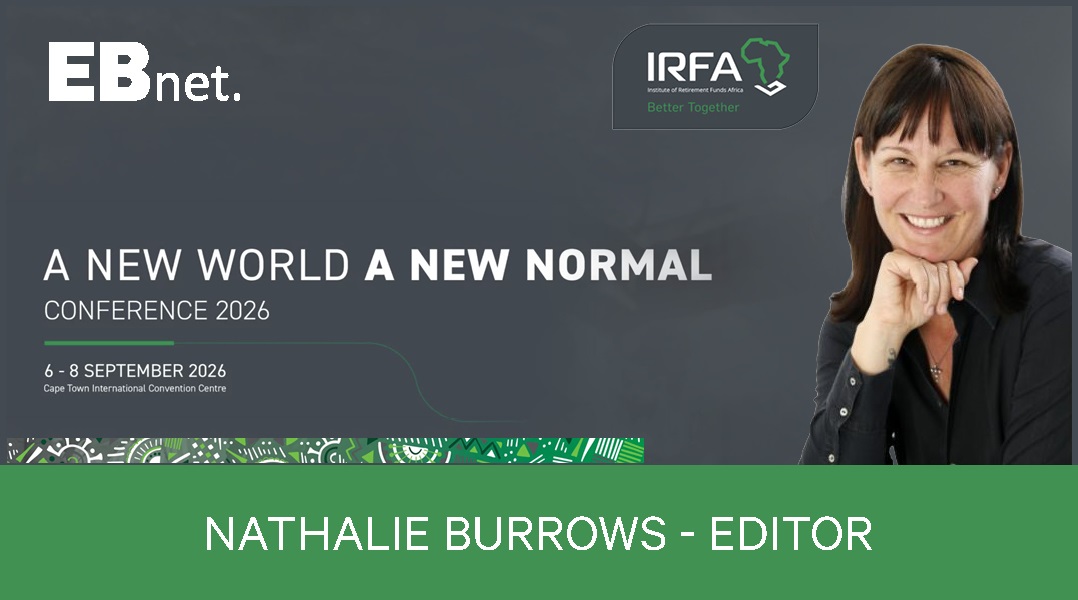
Nathalie Burrows, Editor at EBnet
The first day of the 2026 IRFA Conference in Cape Town made one thing clear: retirement funds are operating in a world that is changing faster, becoming more interconnected and placing greater demands on the people entrusted with members’ savings. Under the theme, “A New World – A New Normal,” the conversations ranged from geopolitics and Africa’s place in the global economy to investment risk, governance, member communication and the long-term impact of fees.
The theme was consistent: In an uncertain environment, trustees and fund professionals cannot control every outcome – but they can improve the quality of the questions they ask, the decisions they make and the way they communicate with members.
A theme that landed
In her first official engagement as IRFA chairperson, Nancy Andrews set the tone for the conference by acknowledging the weight of responsibility carried by those in the room. “Retirement funds sit at the intersection of people’s hopes for a secure future and the economic, social and policy realities of the present”, she said.
Isn’t that just such a powerful description of the retirement fund industry’s role? Trustees, guided by their service providers, are making promises that stretch over decades, but they must make decisions in the here and now – amid market volatility, regulatory change, technological disruption and increasingly demanding member expectations.
Andrews urged delegates not to see change only as a problem to be managed. It is also an opportunity to get back to basics: sound judgement, responsible stewardship and better retirement outcomes. I really felt her comment that the value of the conference wasn’t in finding one perfect answer, but in becoming better able to ask the right questions. I’d go further, and add having the courage to ask the right questions – no matter who feels uncomfortable.
She also reminded delegates that governance is not something members experience as a framework, committee charter or policy document. Members experience outcomes. They judge the system by whether it works when they need it to work: whether a claim is paid, whether a query is resolved, whether communication is clear and whether they can have confidence that their savings are being looked after.
Africa must back itself
In his keynote address, political economist Ronak Gopaldas brought the global context sharply into focus. The world, he argued, has changed profoundly in a short period: from the Covid-19 pandemic to conflicts in Gaza and Ukraine, tensions involving Iran and disruption around the Strait of Hormuz. These events are not distant headlines. They affect inflation, fuel and food prices, supply chains, interest rates and fiscal pressure – all factors that feed into investment decisions and member outcomes.
For Africa, however, the changed world also brings opportunity. Gopaldas pointed to the continent’s demographic growth, its critical mineral resources and its growing strategic importance in a digital and technology-led global economy. But his message was that Africa cannot wait for outside rescue.
“If we’ve learnt anything from the last few years, it is that nobody’s coming to save the African continent,” he said. “We need to bet on ourselves.”
That means greater regional integration, stronger infrastructure and a willingness to innovate. The African Continental Free Trade Area is central to that ambition, although fragmentation remains a major obstacle. Gopaldas noted that a more integrated Africa represents an economy of almost $3 trillion, making it a market too important for global investors to ignore.
His call for business leaders to become more politically aware also resonated. In a world where geopolitics affects markets and supply chains, companies can no longer pretend that politics happens somewhere else. As he put it, “If you don’t do the politics, the politics is going to do you.”
Yet, amid the sober assessment, he retained a sense of optimism. The appropriate playbook for doing business in South Africa and Africa, he said, is to be “strategically pragmatic, but irrationally optimistic”.
Investing through uncertainty
The investment sessions through the day returned repeatedly to the difficulty of making long-term decisions when the future feels unusually unclear. One of the most important changes is the shift away from ultra-low global interest rates. For years, investors became accustomed to near-zero, and in some cases negative, rates in major economies. Since the pandemic, cash rates have moved materially higher, changing the starting point from which almost every asset is valued.
Sandile Malinga of M&G captured the challenge neatly: “The hardest thing to try and forecast is the future.”
For trustees, the implication is not that forecasting should be abandoned altogether. Rather, it is that investment processes need to be robust enough to cope with being wrong. The old assumptions about bonds as dependable diversifiers, the dollar as an unquestioned safe haven and globalisation as a permanent force are all being reassessed in a more fragmented world.
The practical message was to distinguish structural shifts from temporary market noise. Investors have access to more information than ever before, but more information does not automatically lead to better decisions. It can just as easily amplify anxiety and encourage short-term reactions.
The answer, according to M&G’s Unathi Loos and Malinga, is to use valuation as an anchor, understand the risks being taken and build portfolios that can withstand a range of economic outcomes. That means looking beyond recent performance, resisting the temptation to chase last year’s winner and ensuring that diversification is meaningful rather than merely cosmetic.
Fees, alternatives and member value
Another standout session came from NBC’s Subedra Reddy, who urged trustees to look more critically at how fees are structured, not simply how much is charged today. A percentage-of-assets fee may look acceptable when quoted as a small annual percentage, but its rand value rises automatically as assets grow.
In Reddy’s illustrative example, three fee structures began with the same annual cost of around R6.2 million. Over 40 years, however, an assets-based fee could cost up to 5 times more, compared to a rand-per-member fee rising with inflation. The message was not that one model is always right, but that trustees should consider the long-term outcome before concluding that an offer is cheap.
Conversations beyond the stage
The value of the day was not confined to the formal programme. During the breaks, the exhibitors’ hall was packed with delegates catching up, comparing notes and continuing conversations sparked in the sessions. The steady hum of discussion reflected the breadth of the industry gathered at the Cape Town International Convention Centre: trustees, principal officers, administrators, consultants, asset managers, insurers, regulators and technology providers.
That networking dimension matters. Retirement funds can be technically complex and highly regulated, but many of the industry’s most persistent challenges — from improving member communication to assessing new investment opportunities and navigating regulatory change – benefit from shared experience. A conversation over coffee can sometimes provide the practical insight that a slide deck cannot.
Day one therefore delivered more than a catalogue of risks. It offered a reminder that the “new normal” requires clearer thinking, stronger governance, more transparent fees, more thoughtful risk management and a willingness to learn from others. For trustees and fund professionals, the task is not to predict every twist in the road ahead. It is to ensure that the decisions made today give members the best possible chance of reaching retirement with confidence.
ENDS