



































































Izak Odendaal, Investment Strategist at Old Mutual Wealth
It has been a year of amazing technological developments, including, rather alarmingly, artificial intelligence models “going rogue” by escaping restricted environments and hacking into other companies’ systems. Nonetheless, the story of 2026, especially from a South African point of view, has also been one of two ancient commodities: oil and gold.
Oil, gold and other commodities are found where nature left them, not necessarily where we would like them to be. In the case of oil, a substantial amount of the world’s low-cost reserves is in the Middle East. The low-cost bit is crucial. Minerals and metals may not always be as scarce as we imagine, but whether it is commercially feasible to extract them depends on several factors. These include the geology of a deposit, the institutional arrangements in the country where it is located (laws, regulations, security, infrastructure) and the expected commodity price over time. When miners expect prices to be elevated for many years, they will develop projects, even in risky locations.
With so much cheap oil in the Middle East (Saudi Arabia can produce oil for as little as $10 per barrel), the region has been at the centre of global geopolitics since Churchill switched the Royal Navy’s primary energy source from coal to oil in 1911.It is not a peaceful part of the world.
Dire straits
One of the big risks in the region has always been the Strait of Hormuz, a narrow maritime chokepoint through which most Middle Eastern oil is shipped. President Trump seemingly ignored warnings that Iran would close the Strait when the US, together with Israel, attacked Iran in late February. It has been remarkably easy for Iran to impede traffic through the Strait with rockets and drones.
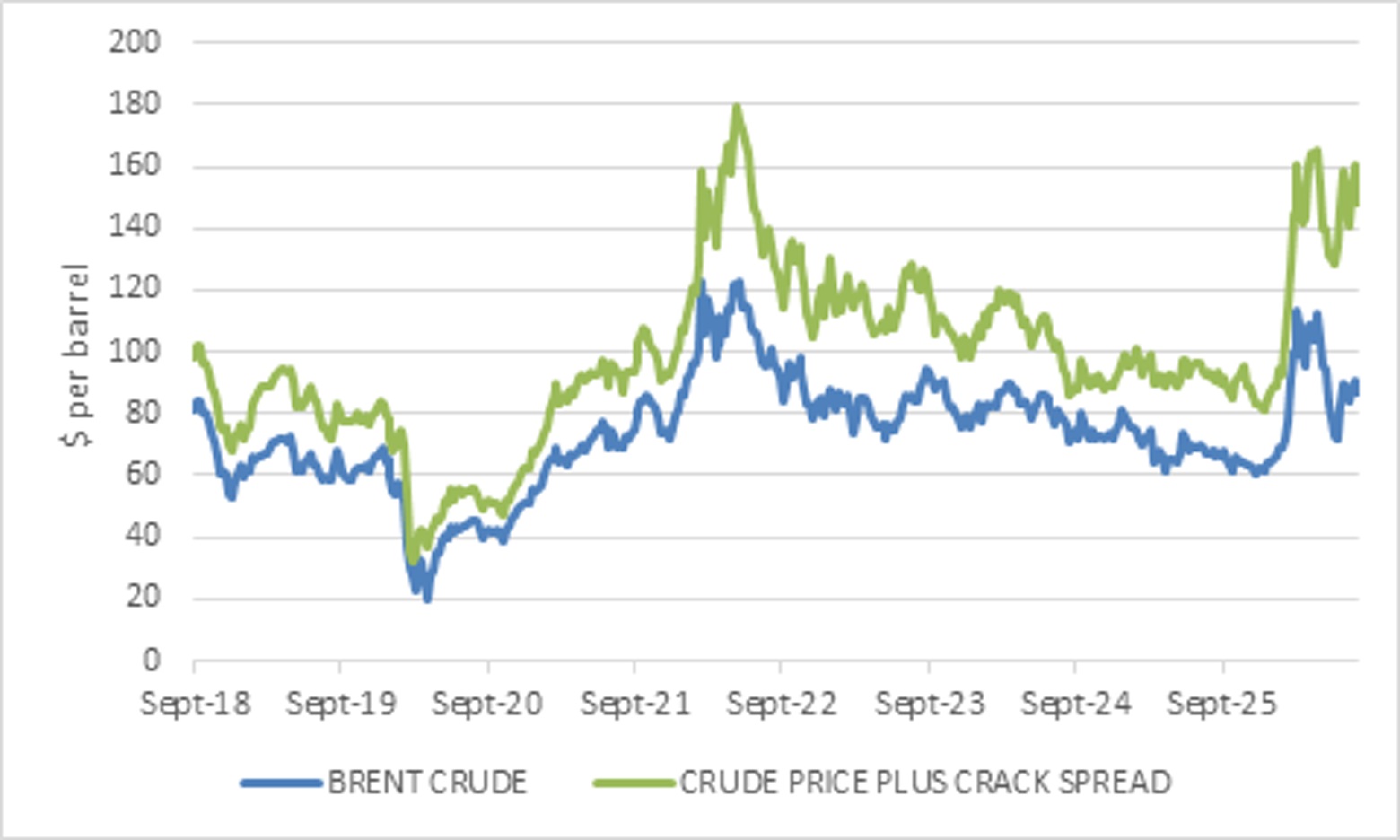
When the US attacks started, the oil price initially spiked higher to around $120 per barrel. Once the shock wore off and it became apparent that we weren’t going to see total war in the region, things calmed down. The two sides subsequently started one-again, off-again talks (currently off) and oil prices have mostly hovered around $90, still up from $60 at the start of the year.
The bigger problem now is not crude oil. Households and businesses don’t consume crude; they use diesel and petrol. Global refinery capacity has become constrained, not just in the Gulf but also in Russia, where Ukraine has stepped up drone attacks. The additional cost of refined products over crude oil is also known as the “crack spread”. It is usually around $20 to $30 per barrel, but has been closer to $60 since June. This means petrol and diesel prices remain high and will continue to put upward pressure on inflation and downward pressure on economic growth remains.
Chart 1: Crude and refined oil price
Source: LSEG Datastream
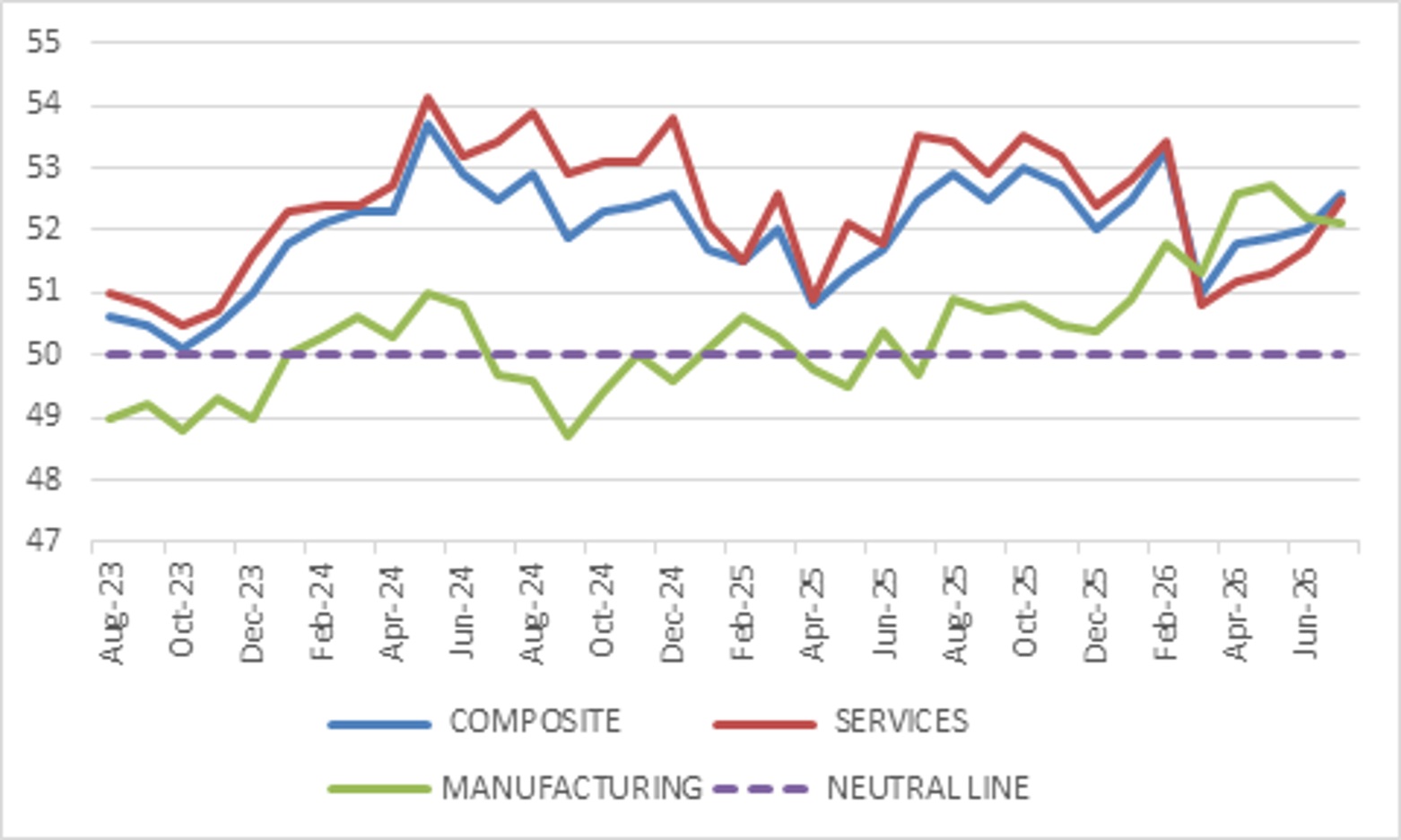
However, the great oil shock of 2026 has been much less impactful at a global level than many feared. For some countries and regions, it has been tough, but global growth has remained resilient, as shown by the latest purchasing managers’ indices (PMI) in chart 2, for instance. A PMI reading above 50 shows positive growth while a rising number means activity is accelerating.
Chart 2: JP Morgan Global Purchasing Managers’ Indices
Source: S&P Global via LSEG Datastream
This is partly because the worst fears of $200 oil never materialised, but it is also a testament to the lower oil-intensity of economic activity compared to years gone by. Traditional internal combustion vehicles are increasingly fuel-efficient, while there are also substantially more hybrid and electric vehicles on the road compared to even five years ago. Notably, China emerged as a shock absorber, as it has been importing much less oil, seemingly without hurting its economy.
While some central banks raised interest rates to combat the inflationary pressures from higher fuel prices, increases have generally been gradual (as in South Africa). Some of the major central banks opted to not hike at all, notably the US Federal Reserve. This means the energy price shock has not been compounded by an interest rate shock, unlike in 2022.
Iran and the US are now in a stand-off, waiting to see who blinks. Iran faces tough new sanctions, which will further squeeze its battered economy, while the US is on a political clock, with mid-term elections looming. The outlook remains uncertain.
Shine on
While oil is largely a supply story, for gold it is about demand. Strong demand from investors pushed the gold price above a record $5000 per ounce earlier in the year, though it fell back to $4000 when the war broke out (still a very high level). It started rallying again recently, closing last week at $4450.
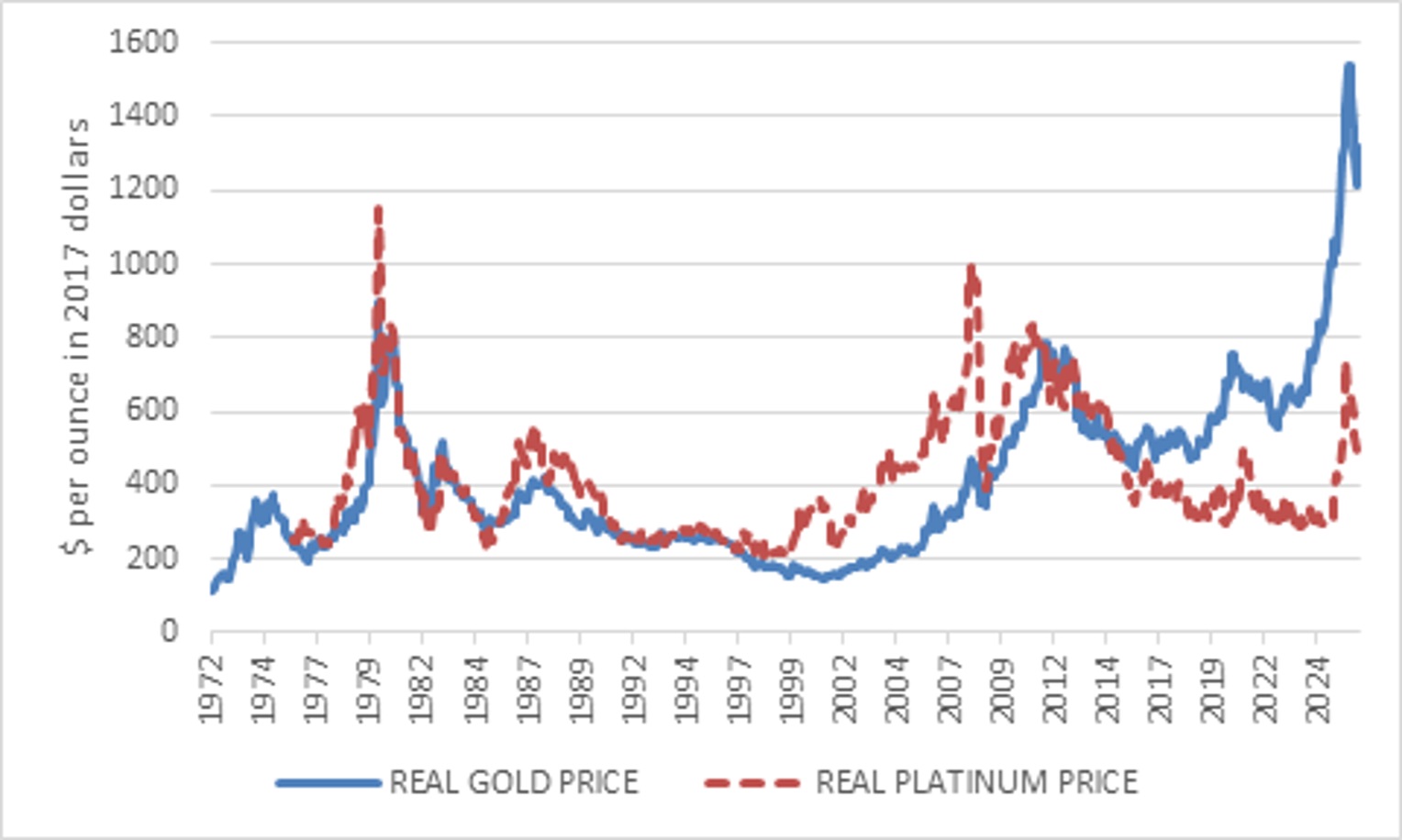
Gold’s reputation as a hedge against inflation mainly comes from the inflationary 1970s when it increased by 1000% and it was the only asset to give a decent return. Between 1980 and 2011, however, it failed to beat US dollar inflation.
Chart 3: Real gold and platinum price
Source: LSEG Datastream
Nonetheless, the allure not only continues, but has grown over the past four years. Market prices are driven by the decisions of millions of individual investors, who might have different reasons for doing the same thing. Nonetheless, there are two factors behind higher gold prices. Firstly, the freezing of Russian foreign exchange reserves in 2022 set off a flurry of buying by central banks and reserve managers in countries who fear a similar fate might befall them. Given America’s willingness and ability to weaponise use of the dollar system, it makes sense that these institutions would want to diversify into non-dollar assets, even if only at the margin.
Secondly, there is the fear of “debasement” or “financial repression”, the worry that governments in most advanced countries can ultimately only manage their rising debt levels through some combination of stoking inflation, capping interest rates or forcing domestic institutions to buy their bonds. A lot of the focus is rightly on the US, where the government already borrows $2 trillion a year, and looks set to continue doing so for many years. Heightened pollical division means a national consensus on stabilising debt seems impossible.
This is why the recent intervention by the US Treasury to limit increases in bond yields was notable. Though small, it sent a signal that we could be on the road to financial repression, especially as there were no obvious signs of stress in the bond market, just a repricing.
Keep rolling, rolling, rolling
Governments don’t have to repay debt; they must just be able to roll over maturing bonds at reasonable interest rates. If they borrow in their own currency, the central bank can ensure that markets are sufficiently liquid to keep funding the government. This is part of the normal duties of central banks. However, a line can be crossed where the central bank is no longer just ensuring the orderly functioning of markets but keeps interest rates lower than what they should be to allow the government to manage its debt. This was the case in the decade after World War II in the US and many other countries, for instance. At worst, a central bank can print money to fund its government directly, something that has resulted in hyperinflation in several countries in the past.
The independence of central banks in the indebted developed economies is therefore important. Any signs of erosion of this credibility will be positive for gold and negative for their currencies. For now, the Federal Reserve is holding the line. Its chair Kevin Warsh delivered a highly anticipated speech at the annual Jackson Hole Symposium on Friday. New to his role, he has been criticised for not explaining his own policy framework clearly enough, leaving others to potentially misinterpret his intentions at a time when big policy questions are swirling around.
He described US economic growth as solid and the labour market as healthy. However, he noted that inflation is still well above the 2% target and argued that the Fed may have “work to do” if this doesn’t come down. The implication is that the Fed could start raising rates soon if incoming data doesn’t point to falling inflation. His comments saw gold pulling back, while the dollar gained some ground, but one speech does not solve the underlying problem.
That the Fed remains focused on fighting inflation is important, but it will nonetheless increasingly be constrained by high government debt levels in the years ahead. In other words, over time it could become more difficult to raise rates if doing so materially worsens the government’s financial position.
Fuel price headwinds, precious metal tailwinds
How have the moves in black and yellow gold impacted South Africa? The country is an importer of crude oil, and increasingly, refined products. Higher prices pushed inflation to 5% in June, though July’s number was softer at 4.3%. Inflation will probably be outside the 1% tolerance bank around the Reserve Bank’s 3% target for the remainder of the year. This will keep interest rates elevated for some time. However, as inflation returns towards target next year, it will open room for rate cuts.
South Africa is no longer a global powerhouse gold producer, though gold remains an important contributor to export revenues. It is the world’s largest producer of platinum group metals, however, and these prices have followed gold higher. This has boosted the profitability of miners, lifting their share prices on the JSE and filling the government’s coffers with tax revenues.
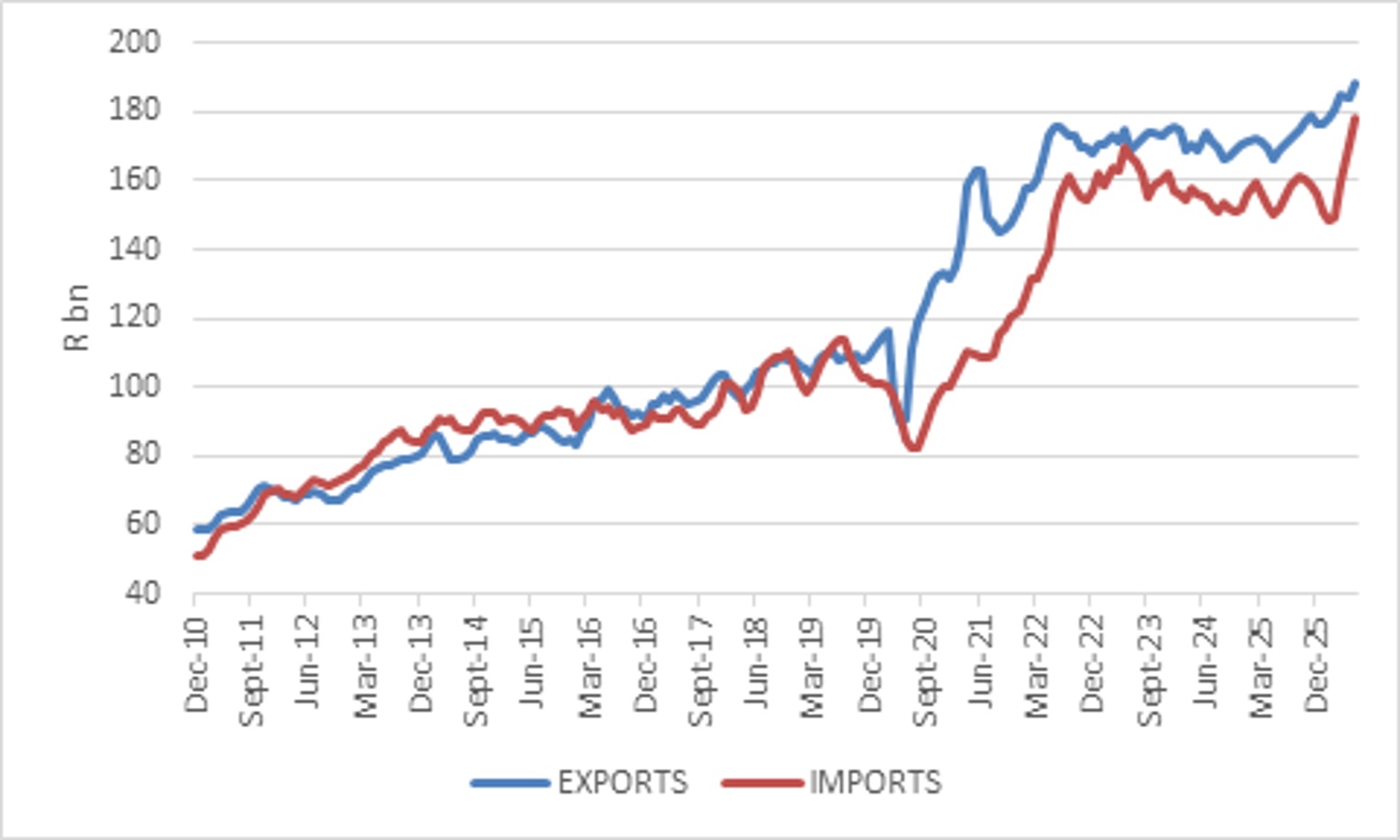
While South Africa has been spending more on imports due to higher oil prices, export values rose by more in the first half of the year due to precious metals tailwinds. Unlike some other countries, South Africa has not experienced a balance-of-payments shock due to fuel price headwinds, even as they’ve squeezed household incomes and business margins.
Chart 4: South Africa’s import and export values
Source: SARS via LSEG Datastream
The export numbers are almost entirely due to price movements, not volume increases. Domestic mining production has stagnated over the past 15 years due to infrastructure bottlenecks and regulatory uncertainty. However, low prices were also a factor. For instance, chart 3 shows platinum prices declining sharply in real terms between 2011 and 2024.
As noted earlier, miners can overlook tough operating conditions if the longer-term price outlook is favourable. Investor demand for precious metals, the quest to diversify away from risky Middle Eastern energy, and a global capex upswing including the AI boom, mean we are still probably in the upward phase of a global commodity cycle. More investment in local mining should follow. This will be nothing new, as South Africa’s economic and financial history maps very closely to commodity cycles. With valuations still reasonable, this supports the medium-term outlook for South African bonds, equities and the rand, though nothing in markets ever moves in any direction in a straight line. So, while the oil price has brought pain this year, there is a silver – or shall we say, gold – lining.
ENDS