


































































Izak Odendaal, Investment Strategist at Old Mutual Wealth
July is over and August is here. July was named for Julius Ceasar not long after his assassination in 44 BCE. August was named after Augustus (Octavian), Caesar’s successor and the first emperor of Rome, in 8 BCE. Legend has it that Augustus added an extra day to August so that “his” month would be the same length as his predecessors’, but that is just a story. Among Julius Caesar’s many accomplishments was the introduction of the Julian calendar. Although it was amended by Pope Gregory in 1558 to change the way leap years are calculated (the Gregorian calendar omits three leap years every 400 years, the last time was 1900 and the next time will be 2100), it is remarkable that someone who lived 2 000 years ago would broadly recognise the way we think and measure time today in terms of days, weeks, months and years.
The division of minutes and hours into 60 units traces back to the ancient Babylonians, Egyptians and Greeks, but it could only be practically implemented with mechanical clocks, notably after the development of the pendulum clock in 1656 by Dutch scientist Christiaan Huygens. Nonetheless, broadly speaking there is a centuries-long continuity in the way people think about the progression of time. Sometimes, however, when a lot is going on it feels like time speeds up. Vladimir Lenin, giddy with revolutionary fervour, captured this idea in his famous quote that “there are decades where nothing happens; and there are weeks where decades happen.”
An eventful week
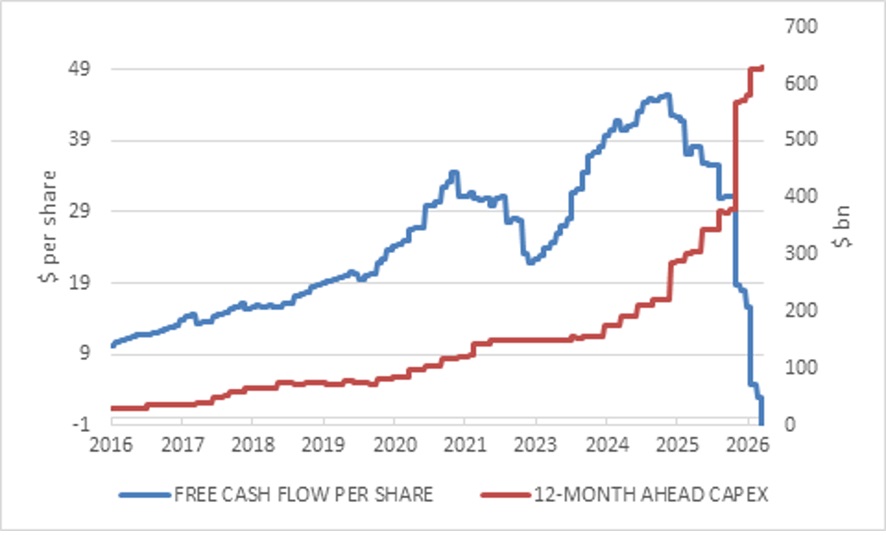
The last week saw a truly Leninesque week in markets, capping what has been a volatile month for global equities and bonds. Let’s start with equities. The first half of the year saw strong equity gains across many markets, only briefly disrupted by the US-Israeli attacks on Iran and subsequent oil price surge. The main reason was the massive capital spending boom related to artificial intelligence (AI). Hundreds of billions of dollars are being poured into datacentres to train and run the ever-growing suite of AI models. The staggering increase in capex spending can be seen in chart 1, though it only shows the biggest so-called hyperscalers (Alphabet, Amazon, Meta and Microsoft). This spending is income for other firms and supports economic growth.
Chart 1: Hyperscalers’ free cash flow and capital expenditure
Source: LSEG Datastream
Indeed, relative to the size of the US economy where most of the spending is happening, the last time we saw such a capex boom was probably when the railways were built in the 19th century. The railway mania was economically transformative, but financially ruinous for many investors who thought it would make them rich. Mostly, only those who bought railway securities at a discount after the crash (the biggest one was in 1873) made money.
This question remains top of mind. Everyone can see that AI will change how the economy functions. What they can’t see clearly is who the ultimate winners and losers will be, and what users will be prepared to pay for it. Thinking of the railways again, they remain essential today but capture only a small part of the economic value they create. Most of it goes to the users. The same is true of electricity, another transformative technology and crucial part of the modern economy, that is nonetheless treated as an afterthought (unless of course, the power goes out). Electricity utilities only make up around 2% of the market cap of the S&P 500, but if they were to disappear suddenly, the other 98% would also collapse (the massive electricity demands of AI is a topic for another day).
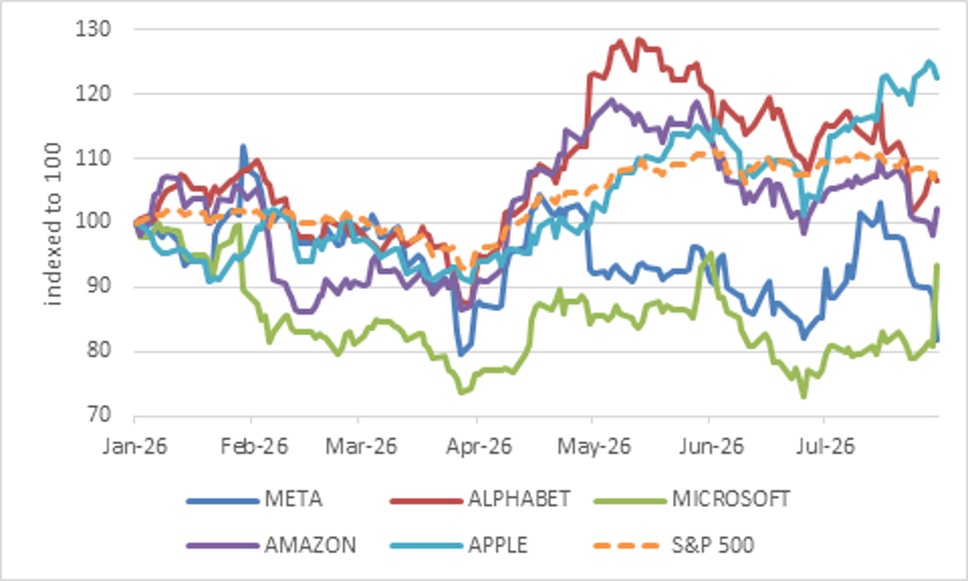
Could AI one day similarly be a commodity and an afterthought? Or will we end up in the winner-takes-all world of internet platform businesses, where there is often only one big conqueror (Alphabet in search, Meta in social media, Amazon in ecommerce, Microsoft in enterprise software, Apple in consumer tech). If the latter, the current pace of spending makes sense, since in winner-takes-all industries, where there are increasing rather than diminishing returns to scale, the payoff for coming out on top is enormous. However, in a commodified world with low barriers to entry, being better than your competitors does not necessarily lead to significant market share. The improvement of open-access Chinese models is of note in this regard. As investors have grappled with these questions, the share prices of the hyperscalers and other software firms have tread water for most of the year (chart 3).
For a while, the big winners instead were the chipmakers, who provide the proverbial “picks and shovels” for the AI buildout. It is often said that in the gold booms of the 1800s, only those selling the equipment consistently made fortunes, while for prospectors it was hit and miss. Chipmakers have seen massive revenue growth, and the pipeline of new business is strong. But this is a famously cyclical industry, as rising profits encourage capacity expansion and attracts competition. Often, the new supply hits the market around the same time as demand shifts because of a new technological breakthrough, or when spending on chips slows.
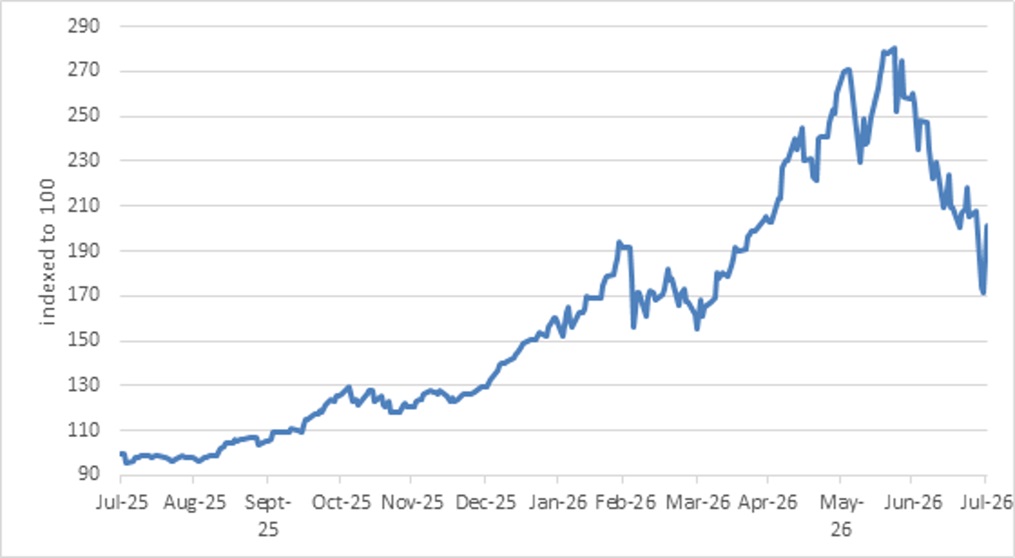
In Korea, home of two major chipmakers, Samsung and SK Hynix, massive gains reversed in recent weeks. The surge in the benchmark Kospi Index, which more than doubled over the past 12 months, was fuelled by speculative buying by retail investors, amplified by debt, including leveraged ETFs. These products boost returns on the way up but also made the losses much worse.
Chart 2: Korean Kospi Index in won
Source: LSEG Datastream
Media reports tell of many distraught Korean investors who piled in near the top, betting on the rapid rise continuing. It is a tale as old as time. While ancient Rome didn’t have stock markets, there is plenty of evidence of speculative financial behaviour and if Caesar or Augustus were around today, they would recognise that while technology has changed dramatically, human nature hasn’t. The stock market is probably the greatest wealth-creating machine humanity has built, but its engine is compound growth, not quick riches. This requires time, patience and discipline.
Professional investors are not always immune to the lure of easy gains, and some of the recent selling may have been worsened by a big hedge fund, Situational Awareness, getting into trouble with leveraged AI bets. After it was bought out by a rival, markets stabilised on Friday.
Chart 3: Hyperscalers’ share prices in dollars
Source: LSEG Datastream
It also helped greatly that the market liked Amazon and Microsoft’s results. Microsoft reported strong revenue growth for cloud computing, which is used by frontier AI labs (notably OpenAI, which is not listed), and in paying customers for its own AI product, Copilot. Its share price surged, with Bloomberg reporting that the 16% gain on Thursday translates into a $450 billion increase in market value, the most ever in a day (there are several stock exchanges where the entire market is worth less than $450 billion). The market loved its results, partly because it shows a path to earning a decent return on the roughly $145 billion of capex for the 2026 financial year. In contrast, Facebook owner Meta’s capex guidance is in the same ballpark, but its shares sold off heavily since this number keeps rising, and it is unclear how the company will turn all this spending into a profit. Investors appear to be increasingly discerning, suggesting that the phase where anything AI-related automatically rallies might be over.
Borrowing bonanza
The initial wave of AI capex was funded by the considerable internal financial resources of the large tech firms, but this is now under pressure as chart 1 shows. Therefore, they are increasingly issuing equities after a decade of buybacks. This means the supply of shares increases relative to demand. They are also turning to debt, with Wall Street banks like Morgan Stanley estimating that around half of the AI-related outlays will be funded by borrowing in the coming years, implying several hundreds of billions of dollars per year.
This is where the bond market comes in. The increase in company borrowing comes at a time when governments in the US, Europe and Japan are also borrowing more. While there is more than enough money to go around for now, it is natural that there would be upward pressure on borrowing costs – rising bond yields – over time.
Bond yields will also respond to central bank policy and the inflation outlook. A resumption of hostilities in the Gulf has pushed the Brent oil price up around 20% in the month of July. And while the closing price of $87 per barrel is not extreme in absolute terms, it will create some renewed upward pressure on inflation rates, not least because the price of refined products like diesel have risen much faster than crude oil. It remains a tricky environment for central banks, who are caught between the risk of overreacting to what might be a temporary problem, and the risk of letting inflation become entrenched. So far, they’ve moved cautiously, and over the past two weeks, the European Central Bank, the Bank of England, the Bank of Japan, the SA Reserve Bank and the US Federal Reserve kept rates unchanged.
The latter is the most important of the lot, and while its decision last week was expected, the market reaction was not. Its new chair Kevin Warsh wants the Fed to communicate less about its future intentions, which means more guesswork for investors, and therefore potentially less risk-taking. Fair enough. But since becoming chair, he has also noted his commitment to bringing inflation down to target, which many market participants took as an indication that rates would have to rise. US inflation has been above the 2% target for five years now. Some of it is due to temporary factors like the fuel price spike and import tariffs, but elevated and sticky service inflation that is unrelated to fuel or tariffs is a problem.
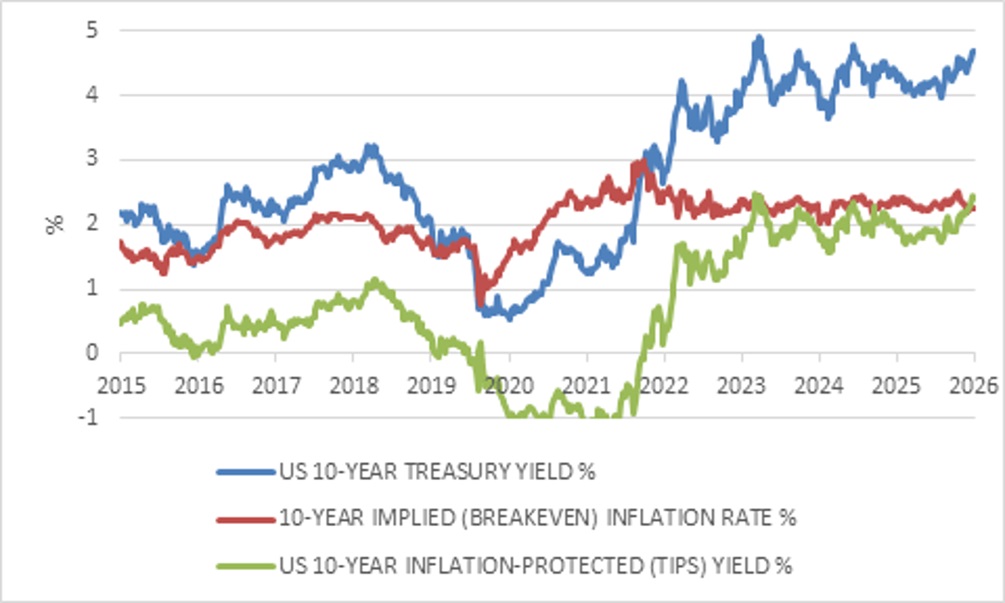
However, during last week’s press conference, Warsh made several dovish comments that implied he does not favour of rate hikes. This pulled short-dated yields, which are closely tied to the policy rate, lower. However, long-dated yields rose to a 19-year high in the case of the 30-year bond yield. As Warsh himself noted, and indeed seemed to welcome, higher longer-dated yields are form of policy tightening. US mortgage rates are linked to bond yields, unlike in South Africa where they follow the central bank’s policy rate. He might therefore be satisfied with the outcome, but if it is tighter policy you’re after, why not raise rates? Or explicitly lay out another plan for getting inflation under control?
Chart 4: US nominal and real bond yields, %
Source: LSEG Datastream
Ultimately, while it is debatable whether the Fed should raise rates now – the latest inflation print was a bit lower, reducing any urgency to move – it should never be up for debate that it will be prepared to raise rates in future if needed. If markets stop believing that the Fed is truly committed to its 2% inflation target, we are in a new regime. The consequence will be even higher long-term bond yields, and a weaker US dollar.
For now, however, despite a lot of head scratching last week, markets don’t seem to price in such a shift yet. The implied or breakeven inflation rate calculated as the difference between nominal and inflation protected bond yields shown in chart 4 has not risen substantially. The market still believes inflation will stabilise. What we do see is higher real (inflation-protected) yields, suggesting that we’re in a higher-for-longer interest rate environment. The Fed might not be hiking, but it also doesn’t seem likely that they’ll cut. This in turn could start putting pressure on elevated equity valuations which, together with the ongoing AI uncertainty, implies market volatility ahead.
However, this is not a “Beware the Ides of March” warning, as Julius Caeser famously received a month before his murder. For while the seer Spurinna examined her sacrificial omens and gave a very specific warning to Caesar that his life would be in grave danger for the next 30 days, no economist, analyst or commentator can predict when the market cycle will turn, either up or down. That means the sensible approach is to remain invested but be conscious of the fact that more expensive investments tend to fall harder in a correction and that an appropriate spread of assets will cushion the blow. And as years go by, what feels like intense volatility in the moment will ultimately just be a squiggle on a chart. Rome wasn’t built in a day, as the old saying goes.
ENDS