



































































Izak Odendaal, Chief Investment Strategist at Old Mutual Wealth
Inflation concerns are rising again as an escalation of the US-Iran war puts renewed upward pressure on oil prices. The cost of a barrel of Brent crude briefly rose above $100 for the first time since late May as not one but two crucial waterways for oil transport are under attack. Iran has effectively closed the Strait of Hormuz again, while its allies in Yemen, the Houthis, attacked shipping in the Bab-al Mandeb Strait. The latter impacts Saudi Arabia’s ability to export oil from Yanbu on its western coast. Saudi oil will now have to travel through the Suez Canal and around South Africa to reach Asian markets, a much longer and more costly exercise.
Where things go to from here is anyone’s guess, but broadly there appear to be three possibilities. One is that the US steps up its blockade of Iran but scales back military action. This will lead to higher oil prices until Iran’s fragile economy crumbles and its leaders capitulate. However, it will also require a degree of patience that US President Trump has never shown. It also means elevated petrol prices for American voters with mid-term elections a mere three months away. Option two is that the US dramatically steps up military action to force open the Strait of Hormuz. This would probably have to include the deployment of soldiers, an escalation of an already unpopular war that could be politically toxic. There is also no guarantee that it would work. This means that the third option, a renewal of negotiations, remains most likely. Indeed, hostilities were paused over the weekend to allow for talks. Oil prices were lower on Monday morning, but still substantially higher than the start of the month. This is compounded by recent Ukrainian attacks on Russian refineries, which have squeezed global supplies of refined products, especially diesel. Economic activity will therefore face renewed downward pressure, while inflation rates will rise.
Central banks typically don’t respond immediately to higher fuel prices, since it is a pure supply shock. They care more about how fuel influences other prices, which is called the second-round effect. Since these can become self-fulfilling, part of what central banks aim to do is use their words and actions to convince people that, even after an initial higher jump, inflation will eventually fall back to target. Interest rate increases are part of the process to “anchor” these expectations of future inflation. However, so far, the evidence of second-round effects has been limited.
Calm core
Chart 1 shows core inflation rates, excluding fuel and food prices, across major developed markets. They’ve been relatively well behaved, certainly compared to what happened in 2022. Then, the Russian invasion of Ukraine war also caused a jump in fuel prices, but it followed a sustained increase in the prices of other goods and services as the world exited Covid lockdowns. The war merely added fuel to the inflation fire of, if you excuse the pun.
Chart 1: Core inflation rates in developed economies

Source: LSEG Datastream
The current episode is therefore quite different, and even if oil prices increase further, it is very unlikely to mimic the extent of the 2021/22 cycle. It also follows that the interest rate response will be much milder.
For instance, of the four economies in Chart 1, the European Central Bank raised rates once by 25 basis points this year and kept policy unchanged at its meeting last week. The Bank of Japan also raised rates once to a three decade-high of 1% but would probably have done so anyway. The Bank of England and US Federal Reserve have not increased rates this year. The Fed’s actions matter greatly for the global economy and markets. Its new chair, Kevin Warsh, has repeatedly said the institution is committed to ‘price stability’ (low inflation) but said very little about how that will be achieved. The fact that core inflation declined slightly in June to 2.6% buys him and his colleagues some time. It is very clear that the Fed has not been dogmatic about returning to the 2% target on a short timeline. Being flexible and pragmatic has its advantages, but at some point, people will question whether the goal posts haven’t been permanently shifted. The other thing to bear in mind is that US mortgage rates are tied to long-term government bond yields, not the Fed’s policy rate. With the 30-year US Treasury yield hitting 5.1% last week, the highest level since 2007, there will be downward pressure on housing activity regardless of what the Fed does next.
Chart 2: South African inflation and interest rates

Sources: Stats SA and SA Reserve Bank
Rates surprise
The South African Reserve Bank, meanwhile, faces the added complication of achieving a new 3% target. The Monetary Policy Committee (MPC) raised its policy rate once this year but left it unchanged at 7% last week in a surprise decision. The market expected an increase, not just because of recent gains in global crude oil prices. June’s inflation data, released earlier in the week, also showed that core inflation increased alongside headline inflation. While the increase in headline inflation to 5% in June from 4.5% in May was largely due to fuel inflation, the increase in core inflation to 4% suggests some passthrough from higher fuel prices to other goods and services. Food inflation risks are to the upside, given global fertiliser prices and the potential impact of a strong El Nino event. Two of the six MPC members favoured an increase, so a September hike is possible.
On the other hand, there is a case for staying on hold to assess the incoming data. The Reserve Bank’s policy rate remains elevated in real terms even with higher inflation, unlike the four central banks noted above. The rand has also been relatively stable throughout the Gulf war, unusually for a time of global anxiety, though it fell sharply after the rate announcement since the market was positioned for a rate hike that would increase the attractiveness of holding rands.
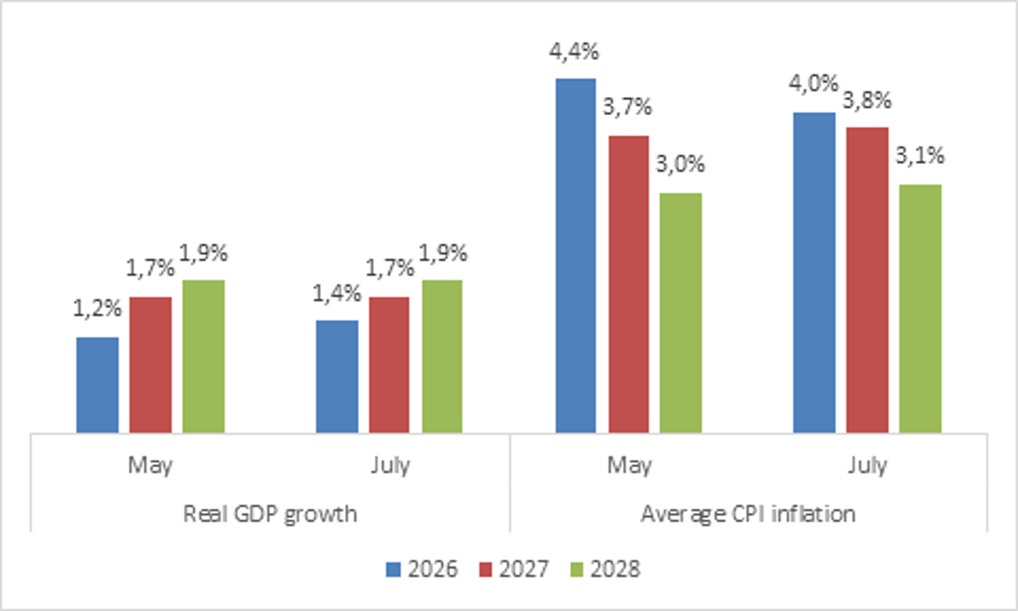
Chart 3: South Africa inflation and growth forecast
Source: SA Reserve Bank, May and July MPC meetings
The Reserve Bank’s latest forecast shows it expects inflation to average 4% this year, a bit lower than what it expected in May. However, it now projects that inflation will take longer to return to the 3% target than previously expected, only by the first quarter of 2028. This suggests that it could take a bit longer for the first rate cut to arrive. This forecast is subject to revision as the global situation evolves. These projections are a bit more optimistic about economic growth this year, with the improving trend over the medium term still intact.
Zooming out
While the near-term inflation outlook is uncertain, it is also important to ask questions over the longer-term view. Even if oil prices stay where they are around $100, by the middle of next year inflation rates will decline. That is because we measure inflation as the 12-month change of the consumer price index (or equivalent). Fuel will still be expensive, but inflation measures the rate of change and that will have declined. The question then is, what is next?
When it comes to the main developed economies, the question is whether inflation has moved higher on a structural basis. Chart 1 gives hints that this may be the case, with core inflation rates running between 2% and 3% after the Covid-related volatility, compared to 1% to 2% in the decade before the pandemic. That period was characterised by a demand shortfall, deaveraging in the private sector, and excess of savings relative to investment opportunities. Central banks turned to unorthodox policies such as zero or negative interest rates and quantitative easing to raise inflation towards 2%.
In contrast, the post-Covid world can better be characterised by supply constraints (including energy), increased borrowing, and rising capital investment spending, notably the AI boom. The demographic crunch across the rich world will also intensify, leading potentially to shortages of workers and upward pressure on wages. Moreover, governments and companies are likely to increasingly focus on security of supply. South Africa’s minerals minister noted last week that he wants to see larger emergency fuel stockpiles, for instance. These sorts of buffers are useful in a crisis but come at the cost of reduced efficiency. Put differently, while globalisation was disinflationary, its gradual unravelling could be inflationary.
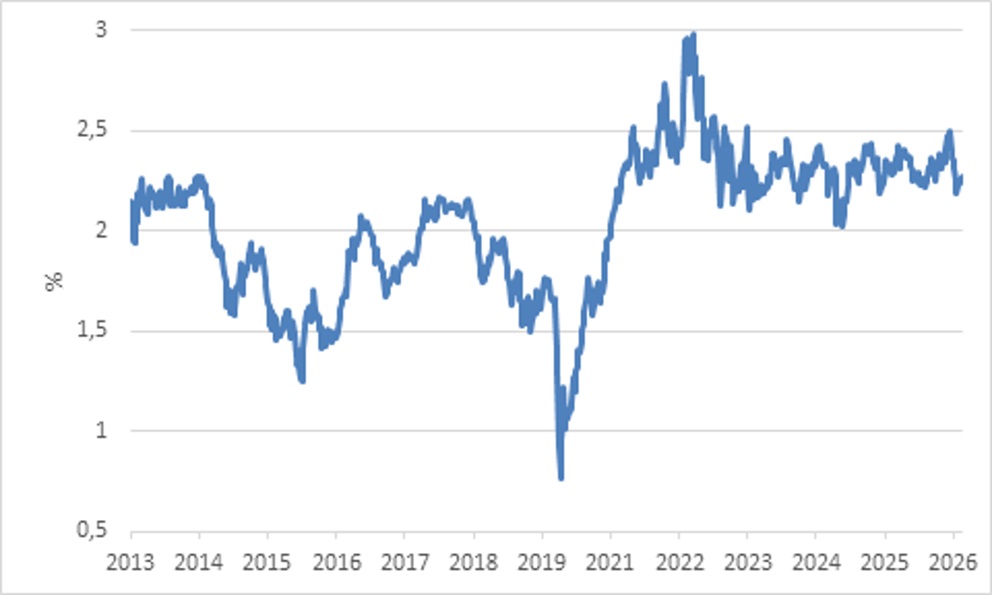
On the other hand, AI and other technological breakthroughs could still pull in the opposite direction, improving productivity and lowering inflation. Kevin Warsh is a keen proponent of this view. For now, markets are not discounting dramatically higher inflation. Chart 4 shows the implied inflation rate from the difference between 10-year nominal bond yields and the yields of inflation-linked bonds in the US. It suggests that inflation is expected to run somewhat higher than before Covid over the next decade, but not substantially so.
Chart 4: US 10-year breakeven inflation rates, %
Source: LSEG Datastream
For South Africa, the longer-term inflation outlook is shaped by the Reserve Bank’s commitment to achieving 3% inflation. Getting there will not be straightforward. It remains highly ironic that the government has chosen a 3% inflation target, but public sector entities, notably Eskom and municipalities, are the biggest culprits in pushing through massive price increases that are double or triple the targeted inflation rate. However, the more we all become accustomed to the idea of 3%, the more difficult it will be for these entities to simply force these cost increases on to consumers.
While the 3% target implies elevated interest rates over the next six to 12 months, they can decline to structurally lower levels thereafter, with the policy rate (formerly known as the repo rate) settling around 5.5% to 6%, though there will always be cycles. Lower interest rates will in turn be positive for local interest-rate sensitive assets, including bonds, property and financial shares. Given that these all still trade on elevated yields, the longer-term return prospects are enticing. Convergence between the inflation rate of South Africa and its trading partners over time also implies that the persistent loss of competitiveness will ease, and the currency will be more stable.
Some might see this as being far-fetched, but so was the idea of achieving a 3% to 6% inflation target when it was first introduced in 2000 given that inflation was consistently in the double digits in the 1970s, 1980s and 1990s.
In other words, the current moment is both very unsettled and unsettling, and oil prices could well increase further, putting upward pressure on inflation and squeezing the real incomes of businesses and consumers. There is not much that can be done about that, other than trading in for a more fuel-efficient vehicle perhaps. However, we shouldn’t lose sight of the longer-term picture, which in South Africa’s case is positive.
ENDS