






















































Izak Odendaal, Investment Strategist at Old Mutual Wealth
Synopsis
- The US Federal Reserve hiked its policy rate for the first time since early 2022.
- While inflation remains elevated, it hasn’t materially changed since the previous policy meeting. What has changed is how the Fed reacts to inflation and the US economy.
- That change is probably largely due to the sharp rise in bond yields in recent weeks.
- Rate hikes don’t automatically hurt equities; it depends on why the central bank is raising interest rates. Often, equities take it as a sign of solid economic growth.
- Nonetheless, a higher-for-longer interest rate environment will put pressure on leveraged investors and business models.
- A Fed rate hike doesn’t automatically result in a SARB hike, but it does tend to weigh heavily in local central bank’s thinking.
In any sophisticated economy, there are many different types of interest rates. Some are controlled by central banks and determined by a committee decision, others are decided by banks, while some interest rates are set by the collective wisdom (or madness) of the market. Typically, when interest rates rise it tends to weigh on economic activity as new borrowing becomes more expensive or existing borrowers pay more. Changes in interest rates will also have an impact on financial markets, though not always in a straightforward fashion. That is because interest rates can either rise for “good” or “bad” reasons from the point of view of an investor. It would be bad for rates to rise in response to high inflation, but falling rates could be equally concerning if the economy experiences a downturn.
The easiest way to understand the difference between market-based interest rates, like bond yields, and the central bank’s policy rate is to picture a dog walker talking a bunch of pooches out for a stroll. Dogs on a short leash will stay close to the walker, while those on a long leash will move more erratically, though they are all broadly heading in the same direction. In this example, the dog walker is the central bank, who determines where everyone is headed. The dogs on a short leash are short-dated bonds and money market instruments, whose rates will be very close to the central bank’s policy rate. The dogs on the extended leashes are the bond yields with various longer maturities. They will be anchored by the central bank’s policy rate but will get distracted by the far-off scents of long-term growth, inflation and fiscal policy.
Chart 1: Various US interest rates

Source: LSEG Datastream
Sometimes, to switch metaphors slightly, the tail wags the dog. In other words, rather than the market responding to the central bank, the central bank responds to the market. This often happens in emerging economies, where global market turmoil forces central banks to raise interest rates to stabilise the exchange rate, even if the domestic economy needs lower borrowing costs. Last week’s rate increase by the US Federal Reserve had hints of the tail wagging its owner, with many commentators arguing that the move was forced by rising bond yields.
Chart 2: US policy interest rate and inflation

Source: LSEG Datastream
Yes, recent oil price increases will cause higher inflation in the short term, but it is hard to make the case that the medium-term inflation outlook has deteriorated substantially since the July meeting when the FOMC left rates unchanged. Inflation remains well above the Fed’s target, but the underlying picture is not getting unambiguously worse. In some areas, things were getting better. Chart 2 shows two different inflation measures, the “core” and “median” version of the personal consumption expenditure (PCE) index that the Fed targets. They’ve been moving in different directions recently. Meanwhile, estimates of inflation expectations derived from the bond market have been broadly stable.
In a different climate, the Fed could argue the merits of remaining patient, especially since inflationary pressures have largely emanated from supply shocks (tariffs and oil prices) which central banks can do little about. In the same week, grappling with similar inflation dynamics, though a weaker economy, the Bank of England kept rates unchanged.
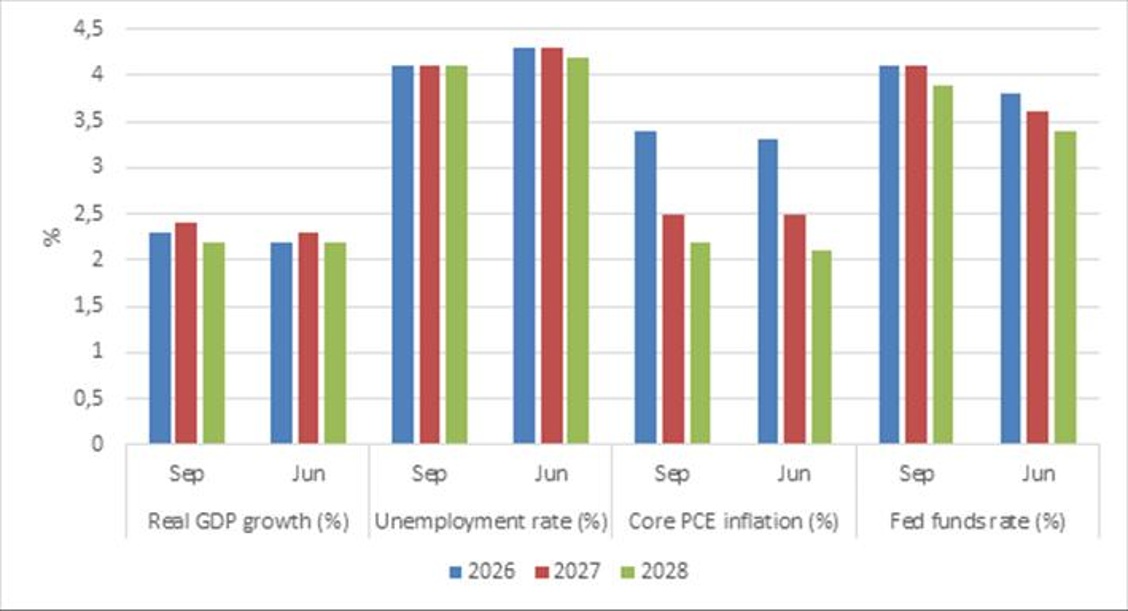
The quarterly summary of projections of Fed officials, known colloquially as the dot plot, shows only slightly faster economic growth, and a small deterioration in the inflation outlook between the June and September version. However, the interest rate projection has shifted more decisively, reflecting a different reaction function to the underlying data. Again, it is hard to escape the conclusion that the relentless sell-off in long-dated bonds, driving up the benchmark 10-year yield above 5%, forced the Fed’s hand.
Chart 3: Fed summary of economic projections (median)
Source: Federal Reserve
Political pressure
Fed Chair Kevin Warsh’s predecessor, Jerome Powell, came under intense pressure from the White House to cut rates. For Warsh to increase rates seven weeks before the midterm election is therefore brave, but it helps that he had unanimous support from the Open Markets Committee (in the previous meeting, only three members favoured a hike). The reason most major central banks were given explicit independence is to absorb this kind of political pressure without buckling. Politicians will almost always prefer lower interest rates (especially when they were real estate developers earlier in their careers) and that has historically resulted in inflation being too high and volatile. The reassertion of Fed independence is a boost for the overall credibility of US policymaking that has deteriorated substantially in the second Trump administration. The Fed cannot make up for the White House’s erratic actions, but can be the grown up in the room, the same way the South African Reserve Bank was the last bastion of policy credibility in the state capture years. As in South Africa, this credibility might have to be paid for with higher rates.
Counting cockroaches
There are two questions that follow. Will the Fed raise rates even further, and what will the impact be on the US economy and beyond? In terms of the first question, it is sometimes noted that central bank rate changes are like cockroaches: there is seldom only one. Central banks usually prefer to move in a sequence of rate cuts or hikes.
The dot plot summary shows that most officials think at least one more hike will be necessary, while Warsh sounded more hawkish than expected in the post-meeting press conference. Indeed, he has been more of an inflation hawk than many expected since his appointment by President Trump. However, some caution is needed. Warsh doesn’t participate in the dot plot exercise, reducing its value. He is also deliberately trying to say as little as possible about what he thinks will happen in future. In fact, he wants to say as little as possible in general and cut the length of the press conference to only 30 minutes.
Therefore, it seems likely to be a shallow hiking cycle, nothing like the 2022 to 2024 rates shock that sent the equity market down 20% and the trade-weighted dollar up 20%. The equity market might wobble as investors price in the new interest rate reality, but for now it’s supported by very strong earnings growth. Indeed, when considering whether this hike is for “good” or “bad”
it is at least partly for good reasons, given the strength of the US economy, at least on the surface. Nonetheless, in a higher-for-longer rates environment, leveraged investors and business models will face pressure.
Which brings us to the second question: will a rate hike slow the economy and therefore put pressure on earnings? One or two rate increases are unlikely to have much impact as key borrowing rates in the US are not directly linked to the policy rate (they are dogs on long leashes). Corporate borrowing has also shifted away from banks to the bond market and private credit funds. And unlike South Africa, where mortgage rates follow the Reserve Bank’s policy rate on a very short leash, US mortgage rates follow bond yields. To the extent that the Fed hike stabilises the bond market, the impact could even be slightly positive.
However, a bit like a dog chasing its tail, we should also circle back to note that the US housing market is already struggling because borrowing costs increased sharply in 2022 and have stayed high ever since. There are pockets of weakness in the US economy which limit how far the Fed can hike. Spending by affluent consumers remains strong, but lower income cohorts are struggling and will be squeezed even more by rising fuel prices.
MPC implications
What are the implications for the SA Reserve Bank’s Monetary Policy Committee (MPC) meeting this week? The MPC often follows or even pre-empts the Fed, though not always. The main reason it would is if there is downward pressure on the rand. Simply put, if the gap between SA and US interest rates changes too much, money will flow to where the risk-adjusted return is better. US hiking cycles therefore normally hurt the rand by attracting money into the US. However, the rand has been stable, trading in a range of around R16.00 to R16.30 over the past few weeks even as US interest rate expectations shifted.
Chart 4: South Africa inflation expectations

Source: The Bureau for Economic Research
The Bureau for Economic Research’s latest inflation expectations survey, released last week, shows that the South African public is not expecting a sustained acceleration in price growth. In fact, the third quarter numbers were a touch lower than in the second quarter. The MPC will want to see a more durable decline towards 3% before it considers cutting rates, but the fact that expectations are not rising sharply as they did in 2021 is encouraging. As with other monetary policymakers, the MPC knows that it cannot do anything about higher fuel prices per se. All it can do is try to prevent a situation where price pressures jump from fuel to other goods and services, and from there to other items.
Lastly, the current Reserve Bank policy rate at 7% is well above even a pessimistic inflation assumption, meaning that real rates are positive. Most of the SARB’s work is done already, and anything that happens at future meetings will be a tweak. Perhaps there will only be one cockroach (the hike in May) after all.
Mountain climbing
A final question is then where rates settle once the fuel price shock fades out of the system, which it surely will at some point as geopolitical sanity prevails. In South Africa, the medium-term trajectory points to lower rates, as inflation should drift towards 3%. While interest rates will always move in cycles, the longer-term trend should be lower if inflation declines on a structural basis. This downhill descent should benefit the local economy and support a rerating of domestic asset classes. For the US, the interest rate picture still looks likely to be more like the 1990s than the 2010s, with moves up and down but hovering around a higher baseline level. The Table Mountain shape of the US rates cycle in the 1990s is visible in chart 1, while the 2010s saw rates pinned down near zero. For investors, it is important to understand that this global higher-for-longer interest rate environment comes with complications, especially in areas where debt levels have increased, but also reflects the positive fact of global economic resilience and strong levels of capital expenditure.
ENDS