


































































Izak Odendaal, Investment Strategist at Old Mutual Wealth
- A sell-off in the government bond market can cause substantial problems for the real economy, resulting in negative feedback loops.
- The situation in France is particularly worrying, highlighting the need for a fiscal package that assuages market fears.
- However, since the spike in global fuel prices is behind the surge in bond yields, a resolution of the conflict in the Gulf will calm things down significantly.
- This is a difficult backdrop for next week’s Medium Term Budget Policy Statement, but South Africa is already taking the bitter medicine of stabilising government debt levels.
- Therefore, South African bonds remain attractive to patient investors even if bonds are under pressure internationally.
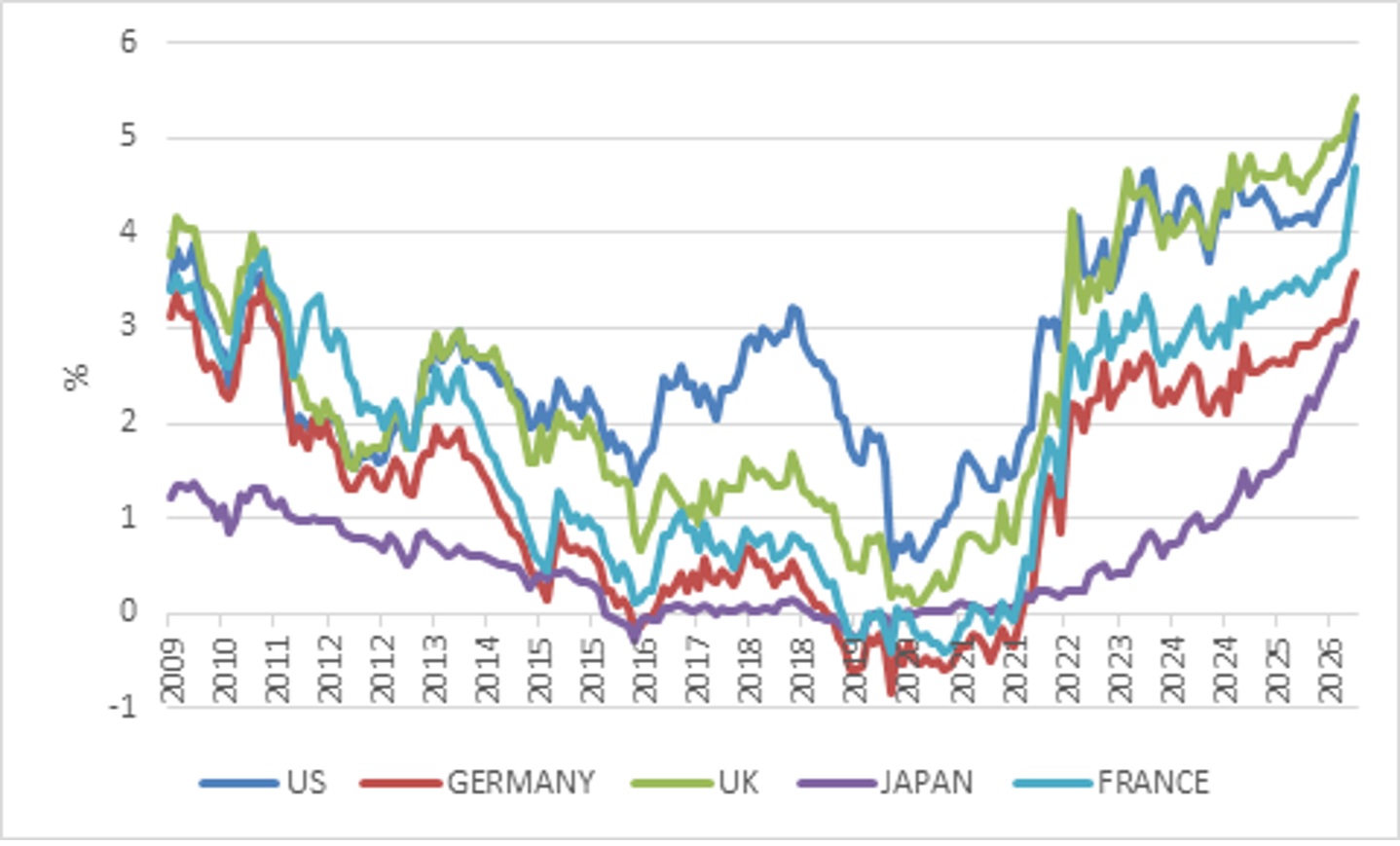
Government bond yields have increased across the world this year. Surging oil prices raise inflationary pressures at a time when growth has been relatively strong, leading to central bank rate hikes. Some countries are more exposed than others, however.
What makes a government bond sell-off more devastating than declines in other markets is the self-fulfilling quality. When yields rise (bond prices fall), the government’s interest burden will also climb as new debt is issued at higher borrowing costs. This reduces its perceived creditworthiness, leading to investors demanding more compensation for the risk, further pushing up yields. Higher yields on government bonds typically also raise borrowing costs in the private sector, weighing on economic activity and tax revenues. This further worsens the government’s creditworthiness. To make matters worse, in many countries, the banking sector is a big holder of government bonds. As yields rise and bond prices fall, bank balance sheets weaken. In extreme cases, they cut back on lending, weakening the broader economy. This dynamic is known as the “doom loop” between sovereign and bank balance sheets.
Chart 1: 10-year government bond yields
Source: LSEG Datastream
Sacre Bleu!
The one country whose bonds have sold off particularly severely in recent months is France. Investors have singled it out for three broad reasons.
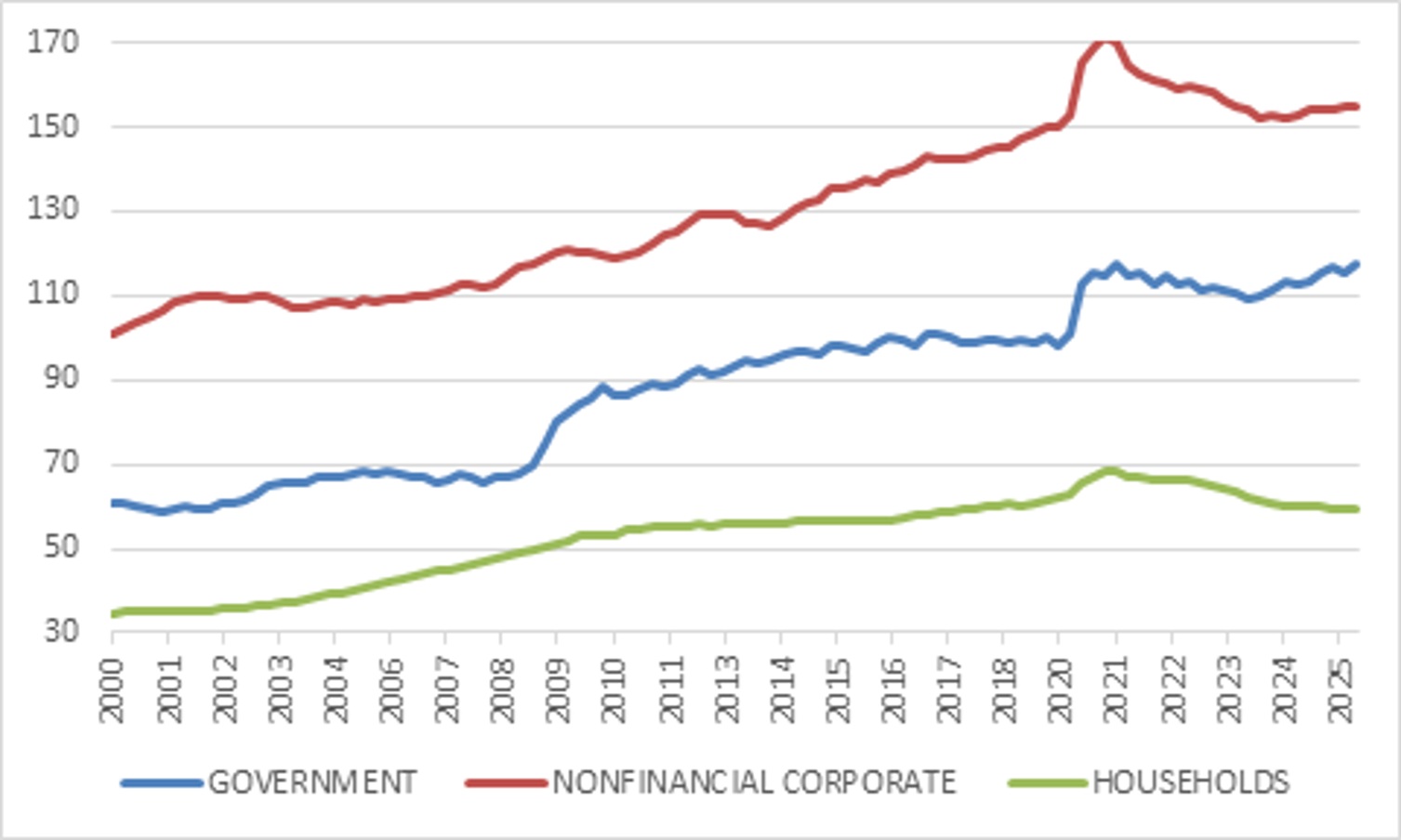
Firstly, its debt levels are high. France’s government debt-to-GDP ratio is already one of the highest in the developed world, around 120%. Its budget deficit, the annual gap between spending and tax revenues, is expected to be 5.4% of GDP this year, meaning public debt is set to continue growing. Corporate debt levels are also particularly high, and though some blue-chip French companies’ bonds trade at yields below those of government bonds, an unusual development, borrowing costs have risen across the board.
Chart 2: France debt-to-GDP ratios
Source: Bank for International Settlements
Secondly, countries across the developed world have ageing populations, but France’s average retirement age is below the European average, while its pension system is both more generous and less funded than most European countries. Therefore, beyond today’s difficulties, the longer-term picture is problematic. Previous attempts at pension reform including raising the official retirement age have run into massive political discontent.
Thirdly, and speaking of politics, uncertainty is high. President Macron’s party does not have a majority in Parliament and therefore struggles to even pass a budget, never mind implement deep reform. The next election is in April, a long time to have a rudderless government when decisive action is needed. But the election itself is also not a comforting prospect for investors. The front-runner, Marine Le Pen, is often characterised as falling on the far right and populist end of the spectrum. While she recently said she plans to shrink the deficit once in power, she has also said she wants to lower the retirement age, which will make things worse.
Raising taxes to stabilise government borrowing will be difficult and unpopular, since France’s tax-to-GDP ratio is among the highest in the world. Moreover, the ongoing riots in high schools across the country show how difficult it is to cut back on government spending. The protesting students blame poor conditions and a lack of teachers on budget cuts. It is a reminder that fiscal crises don’t always show up in the markets. They sometimes manifest in the streets.
Déjà vu all over again
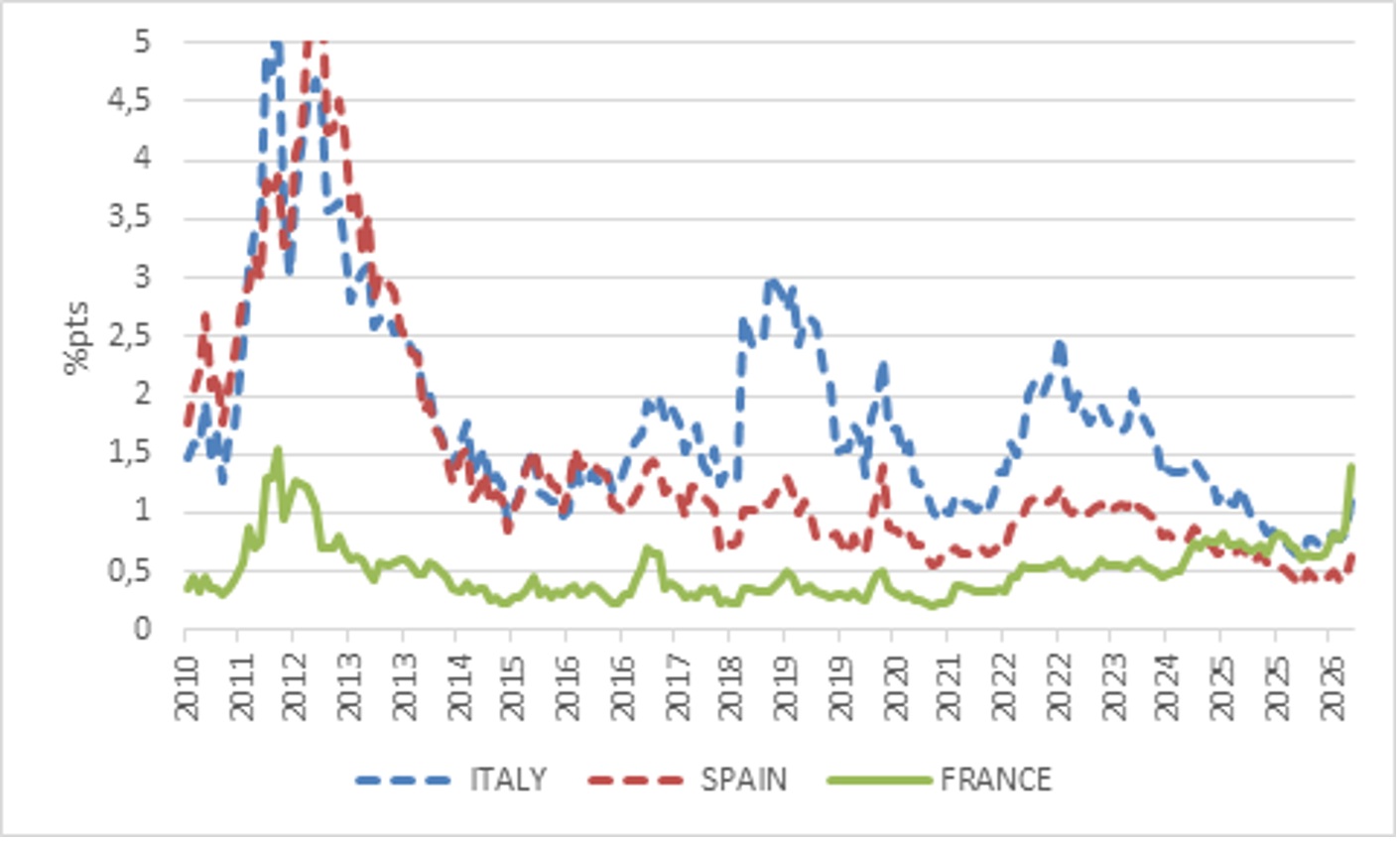
France shares the European Central Bank (ECB) with 20 other countries. Therefore, theoretically, its yields should be anchored by ECB rate expectations and be similar to other countries in the bloc. If its bonds trade very differently, it points to investors’ perceptions of its creditworthiness. Chart 2 shows the “spread” between the borrowing costs of Italy, Spain and France, over Germany’s, with the latter considered the safest credit in the eurozone. Higher spreads indicate greater investor perceptions of risk and declining creditworthiness. France’s bond yields are now almost 1.5 percentage points above Germany’s, higher than Spain or Italy’s, despite the latter’s reputation as a weak credit.
This evokes the 2010-12 fiscal crisis that started in Greece and spilled over to Spain, Portugal and Italy. Already the euro has fallen to the lowest level against the dollar since May 2025, though, apart from France, the recent increase in spreads is nothing near as bad as 14 years ago
Resolving the 2010-12 crisis took hard work and tough reforms, including International Monetary Fund support that came with strict conditions. However, the key moment was the famous July 2012 declaration that the European Central Bank (ECB) would do “whatever it takes” to prevent a break-up of the single currency. That was enough to calm investor fears, and as bond yields receded, fiscal sustainability improved.
Chart 3: Spreads of 10-year government bond yields over Germany’s
Source: LSEG Datastream
However, the fuel price shock of 2026 means the ECB has been raising interest rates and it continues to sell some of the bonds it acquired in previous rounds of monetary easing (a process known as quantitative tightening). The ECB was also prepared to do “whatever it takes” in 2012 because the affected countries had already committed to deep spending cuts, something that is not on the table in France today.
Nonetheless, this is not a repeat of the 2010-12 crisis – not yet at least – for three reasons. Firstly, difficult lessons were learned back then. It resulted in deeper European integration and the development of crisis-fighting mechanisms. Such events can also force politicians to make difficult decisions they would otherwise prefer to avoid. Whether they can do so in the next few months remains to be seen. The fear that one or more countries would choose to exit the euro and doom the entire single currency was front and centre in the 2010-12 crisis. However, the euro was a mere 11 years old then, while it will celebrate its 28th birthday in January. It has become deeply entrenched and memories of the “good old days” when countries could devalue their individual currencies as an escape valve have faded. Most ordinary Europeans voice support for the currency, and even politicians like Le Pen, who view the European Union as overbearing, express no desire to leave the single currency.
Secondly, it was a balance of payments crisis, as much as a fiscal crisis. Greece, Spain, Portugal, and to a lesser extent, Italy, all went into the 2010 episode with large current account deficits, leaving them vulnerable to capital flight which was exactly what happened. Today, most of these countries run current account surpluses, while France’s current account deficit is small.
Finally, since the surge in oil prices triggered the global bond sell off, a decline in energy prices will go a long way to ease the pressure on France and other countries. However, if the conflict in the Middle East drags on, things could get worse.
No room for complacency
It is against this difficult backdrop that South Africa’s fiscal policy will come under scrutiny next week when the Medium-Term Budget Policy Statement (MTBPS) is delivered in Parliament. South Africa and France are very different countries facing different situations, but the one thing we can say about the former is that it has been taking the bitter medicine of fiscal consolidation, attempting to stabilise debt levels and reduce government borrowing. It has also implemented growth-enhancing reforms, since faster economic growth will organically deliver more tax revenues and therefore reduce the need for the government to borrow. Progress has been slow but already recognised by the market and ratings agencies.
South African government bonds and the rand are weaker in recent months, unsurprising given the global turmoil, but the changes are modest overall. The rand is flat against the US dollar for the year to date, while the 10-year government bond yield is 70 basis points higher since 1 January 2026. It is 50 basis points lower than 1 January 2025, whereas France’s equivalent yield is 150 basis points higher.
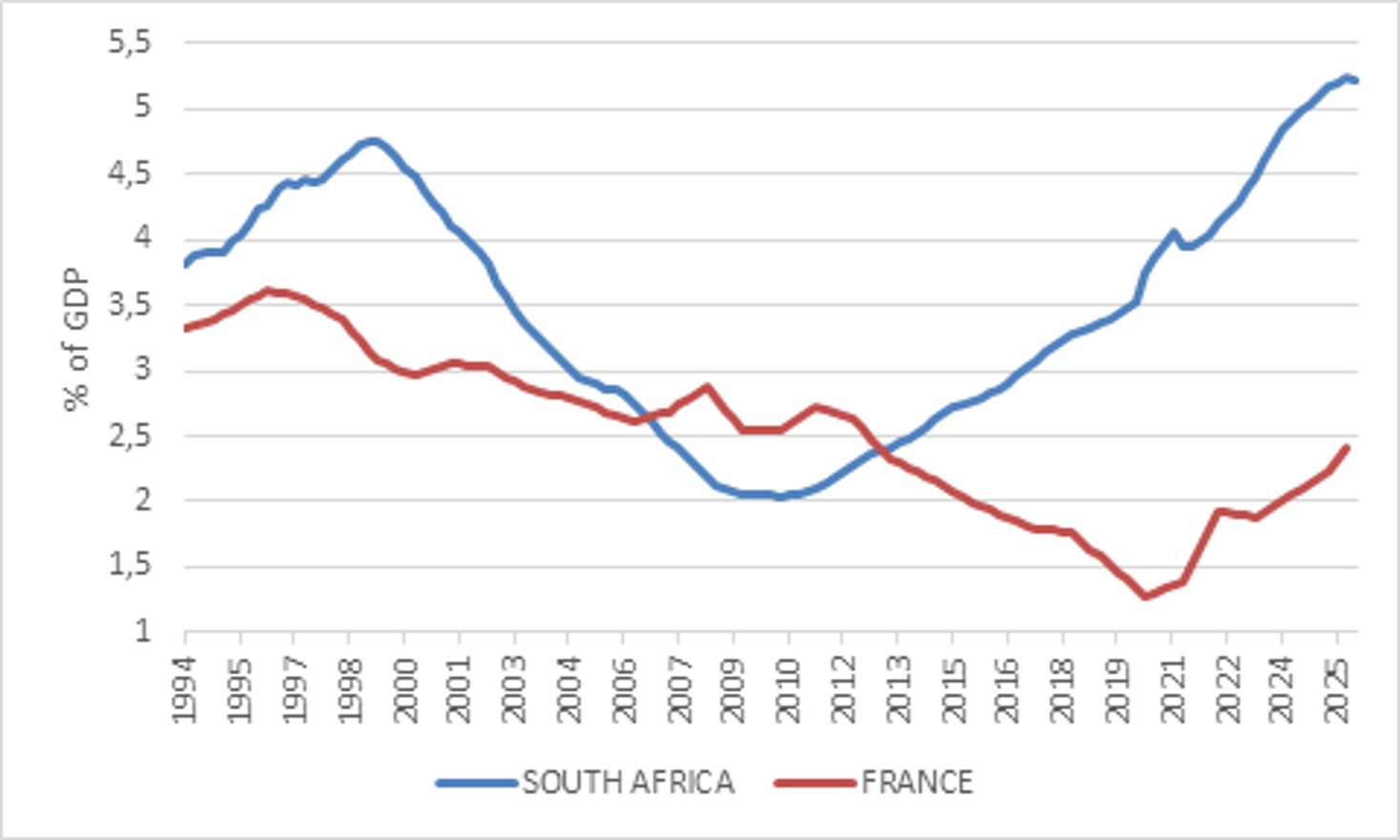
Chart 4: Government interest payments as % of GDP
Source: LSEG Datastream
South Africa might have a lower debt-to-GDP ratio than France at around 80%, but its interest burden is much higher as chart 4 shows, and only recently started stabilising. Therefore, there is no room for complacency. The MTBPS is likely to stick to the priorities laid out in the February Budget, namely running an increasing primary surplus, and gradually shifting more spending towards capex. However, the growth outlook for the domestic economy will be downgraded from February’s estimates, due to the fuel price shock and two Reserve Bank rate hikes. While the government extended some tax relief by temporarily cutting the fuel levy, elevated precious metals prices are supporting overall tax revenues, meaning that the overall Budget targets are still on track.
This is pure luck, of course. Sound fiscal policy should therefore create room to absorb shocks like the Iran War without relying on a bail-out from the gold price. Neither France nor South Africa have these buffers now. Indeed, very few countries do at a time when global public debt levels are at record highs.
In summary, there is a lot of uncertainty. The sell-off of government bonds across the world can still cause substantial problems in the real economy. However, since the spike in global fuel prices is behind the surge in bond yields, a resolution of the conflict in the Gulf will calm things down significantly. The situation in France is particularly worrying, and it will need to come up with a fiscal package that tempers market fears, and soon. Politics matters. On the other side of the world, an election result in Brazil has seen bond and equity prices rally as the leader in the presidential race is seen as business-friendly and committed to budget cuts (whatever else one might think about the Bolsonaro clan). It is comforting that South Africa’s fiscal policy is on the right track, even if much work still needs to be done. South African government bonds have been wobbly this year due to the global environment, but with attractive yields, improving fundamentals and a central bank that is strongly committed to its 3% inflation target, patient investors can still expect solid medium-term real returns. Just hold on to your hat in the meantime.
ENDS