





































































Izak Odendaal, Investment Strategist at Old Mutual Wealth
- The global bond sell-off has deepened, raising yields and borrowing costs for governments and corporations.
- There is no single explanation, several things have happened at once, some good, some bad.
- Stronger economic growth is a good reason for higher rates, while oil prices rising above $100 per barrel is a more concerning one.
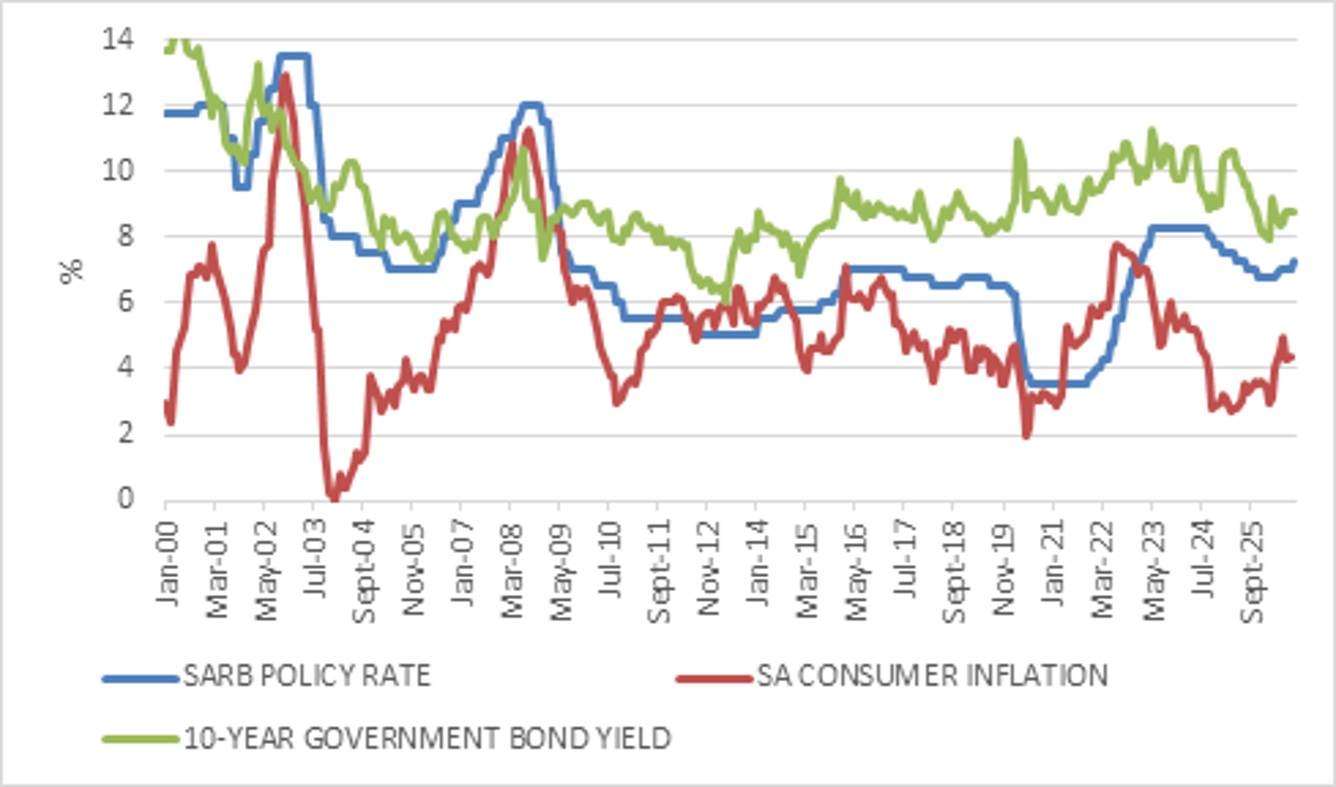
- Against this difficult backdrop, the South African Reserve Bank raised its policy rate to 7.25%.
- While the inflation outlook has deteriorated in the short term, the Reserve Bank still expects a return to target by late next year.
- Since inflation is largely due to supply disruptions rather than strong demand, the hiking cycle is likely to be muted, and attention will turn to cuts early next year.
- In the meantime, yield-seeking investors are increasingly spoiled for choice.
James Bond’s favourite drink is a vodka martini, shaken, not stirred. For government bonds, a cocktail of factors has pushed yields higher again. There is much debate over which reason is more important, but the net result is that bond investors are feeling punch-drunk after a week in which government borrowing costs for several major governments hit multi-year highs.
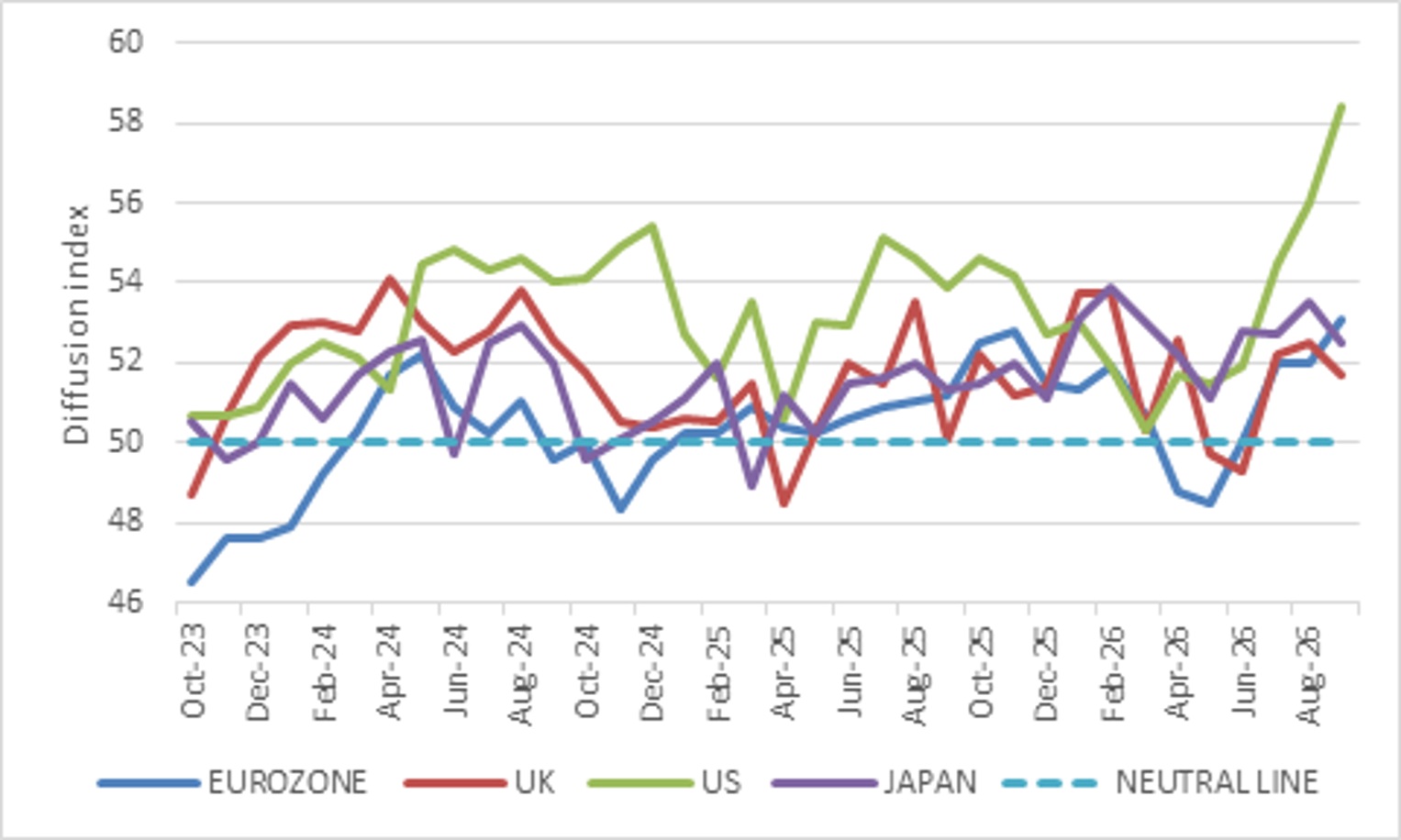
In the short term, strain emanates from two distinct areas: inflation and growth. Oil above $100 per barrel and a global diesel shortage have reignited inflation fears. Bonds hate inflation, but the inflation expectations embedded in the bond market, the difference between nominal and real yields, have not moved all that much. Most of the increase in bond yields has come from real yields, which got another leg up with solid economic data as the AI capex boom continues apace. Notably, September’s S&P Global Purchasing Managers’ Indices point to accelerating business activity in the US and Eurozone despite higher energy costs. Strong growth is generally good news, but typically not for bonds.
Chart 1: S&P Global Composite Purchasing Managers’ Indices
Source: LSEG Datastream
Debt and politics
The longer-term problem lurking in the background is debt and politics. France stands out as a country that is both indebted and politically fragile ahead of April’s presidential election. The far-left candidate, Jean-Luc Melenchon, openly talks about cancelling some of the French government’s debt. He is unlikely to win, but the far-right front-runner, Marine Le Pen, will introduce uncertainty over domestic policies and attitudes towards the European Union if she wins. Her Rassemblement National party is less euro-sceptic than in the past, but hardly pro-EU. This at a time when Europe’s biggest challenge is smarter integration, especially in fields of finance, technology and defence, to match the scale of the US and China.
France’s gross government debt level is already at 118%, according to the IMF, and its 5% of GDP annual deficit means things are getting worse. Yet, like so many other developed countries these days, it is deeply divided politically. Without political consensus, addressing big problems is difficult. Memorably, in 2023 President Macron proposed a modest change in the retirement age from 62 to 64 to improve long-run fiscal sustainability. The reforms were withdrawn after millions of people poured onto the streets in some of the biggest protests in recent French history, some of which turned violent.
Countries that borrow in their own currencies rarely experience a debt crisis. However, France and other Eurozone members fall in a grey area since the euro is a shared currency with a shared central bank.
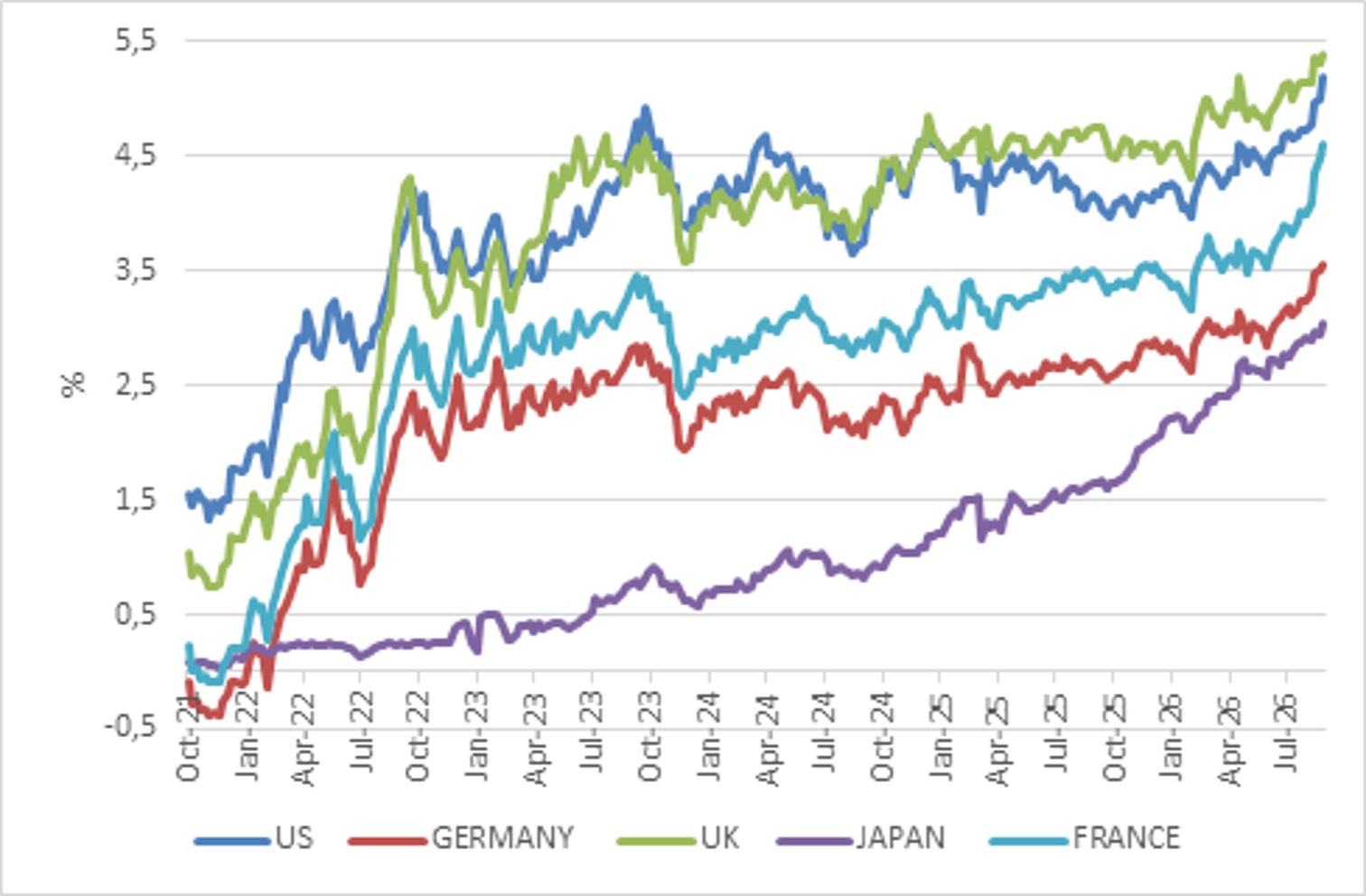
Chart 2: 10-year nominal government bond yields
Source: LSEG Datastream
The US mid-term election is also around the corner but should have limited market impact. Democrats are likely to win the House and possibly the Senate, but President Trump is not on the ballot. It means no big change in policy until at least the 2028 election. However, policy gridlock also means the country’s rising debt level will not be addressed and will continue festering. The US government will borrow almost $2 trillion from the bond market this year, and will now do so at higher yields than in recent years. However, that is just the new borrowing. There are also around $8 trillion in maturing bonds that must be rolled over, in other words, old bonds swapped for new ones. These maturing securities will generally be rolled over at higher yields. For instance, if the Treasury rolled a 5-year security that was issued in October 2021, it will be replacing a bond that yielded 1% with one yielding 5%. In this instance, the level of indebtedness hasn’t increased, but the interest burden has.
Land of the rising yields
And then there is Japan, whose central bank is gradually normalising interest rates after 30 years at near-zero levels. The Bank of Japan cut its policy rate to 0.5% in September 1996 and did not raise it above that level until December last year. Its September 2026 policy meeting took the rate to 1.25%.
There are always two sides to a story. For borrowers, interest rates are at three-decade highs, the 10-year government bond yield now trades at 3% for the first time since August 1996. However, for most Japanese investors, it means they can earn a decent yield on domestic fixed income assets for the first time in their careers. For many years, Japanese money was sent abroad in search of returns, making Japan the world’s largest net creditor. Japan is also the largest foreign holder of US Treasuries, for instance. If more Japanese portfolios tilt towards domestic exposure, there are fewer potential buyers for the trillions of US and European bonds being issued.
One too many
So far, higher yields haven’t hurt stock markets, with the AI theme still captivating investors. However, just as there comes a point in the evening when another cocktail is one too many, and a hangover becomes inevitable, there is also a point at which bond yields are too high for equities. We just don’t know where that point is.
There are three broad ways this happens. Firstly, bonds could compete with equities at the margin for capital from investors. Put differently, if the “safe” asset of a government bond can offer a 5% nominal yield, or a 2.5% inflation-protected yield, riskier equities should arguably also offer a higher yield to keep attracting buyers. Higher yields mean lower prices. Secondly, higher borrowing costs could make life difficult for indebted companies. While corporate borrowing has generally been disciplined in recent years, there are always weak links. Hidden problems usually emerge in rate hiking cycles, such as the failure of Silicon Valley Bank in 2023. Thirdly, to the extent that higher bond yields slow economic activity, it can place pressure on topline growth. For instance, US mortgage rates hit 7% last week as a direct result of the bond market sell-off, and this will further weigh on the housing market. As noted, business activity has been remarkably resilient this year, but even in the fevered build-out of datacentres, there are players who are geared and vulnerable, and there will likely be projects that no longer make sense at higher borrowing costs. This last point also highlights why bond yields usually don’t keep rising forever. Beyond a certain point, higher borrowing costs lead to weaker economic growth and interest rate expectations start falling (leading to a yield curve inversion). A retreat in oil prices will also calm things down.
Removing the punch bowl
It remains a difficult environment for central banks, as inflationary pressures mostly emanate from the supply side. They cannot open the Strait of Hormuz or increase refinery capacity, and their main tool – interest rates – is more effective when inflation is demand-led. In other words, when prices are rising because consumers are spending a lot of money. William McChesny Martin, the longest-serving Fed Chair, famously compared this to a “chaperone who has ordered the punch bowl removed just when the party was really warming up.”
Nonetheless, cost increases from supply disruptions can spill over into other items, pushing up the prices of other goods and services. A weaker currency would make this worse, and the longer people experience high inflation, the more they believe it will be persistent. It is against this backdrop that the South African Reserve Bank’s Monetary Policy Committee met to decide on interest rates last week. The decision to increase the policy rate to 7.25% was unanimous.
While Stats SA reported that August consumer inflation was a touch lower than expected at 4.4% year-on-year, steep fuel price increases in September and early October will push the inflation rate up again. According to the Reserve Bank’s projections, inflation is expected to run slightly above 5% in the last quarter of 2026 and the first quarter of next year, before base effects pull it down to 3.9% in the second quarter of 2027. Since fuel prices increased sharply in the second quarter of this year, it creates a high base for year-on-year comparisons twelve months later. The Reserve Bank expects inflation to be close to the 3% target by the end of next year.
Chart 3: SA inflation and interest rates
Source: LSEG Datastream
While higher fuel prices feed into higher inflation readings, it also represents a real income shock that will weigh on consumer finances and business margins. Where to place the emphasis – downward pressure on economic activity or upward pressure on inflation – is a difficult decision and most central banks have moved cautiously since the war started. The Reserve Bank cut its economic growth forecast for this year from 1.4% to 1.2% but still expects growth to accelerate towards 2% over the medium term.
Its forecast model, the QPM, does not point to any further hikes, and indeed did not favour a rate increase as inflation is expected to return to target eventually. However, with risks tilted to upside given the uncertainty over global fuel and food prices and against the backdrop of rising global rates, the MPC felt compelled to act. While the Reserve Bank doesn’t follow the Fed mechanically, it is always on guard in a Fed hiking cycle.
Chart 4: Reserve Bank economic forecasts at the July and September MPC meetings

Source: SA Reserve Bank
Unlike France, Japan and the US, South Africa’s government is trying to stabilise its debt level. This might seem surprising, given that it is politically difficult and this is a divided country too. But there is sufficient political consensus that a failure to act now will only make things much worse down the line. Even with a looming municipal election, next month’s Medium-Term Budget will most likely stick the script of fiscal prudence.
It is easy to get caught up in the negatives – and there are many risks out there – and miss the opportunities. South African government bond yields are well above any reasonable future inflation scenario, and if the Reserve Bank achieves its 3% target, forward-looking yields on offer from local bonds are still very attractive in real terms. Cash is yielding 3% in real terms based on the Reserve Bank’s inflation forecast for the next 12 months. And while South African investors traditionally did not venture into global bond markets, things are starting to look interesting. A calculation by BlackRock shows that 84% of global fixed income assets, by market weight, now yield more than 4%, compared with only 20% between 2010 and 2021. Long-term fiscal problems mean allocations should be scaled appropriately, and further near-term volatility seems likely. Nonetheless, the best indicator of future returns from bonds has always been the starting yield. Yield-seeking South African investors seem to be spoiled for choice.
ENDS